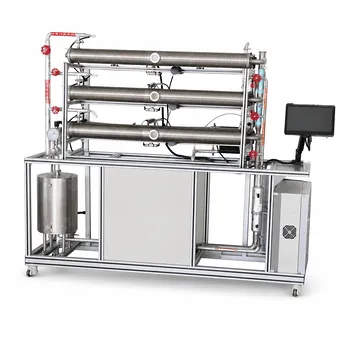
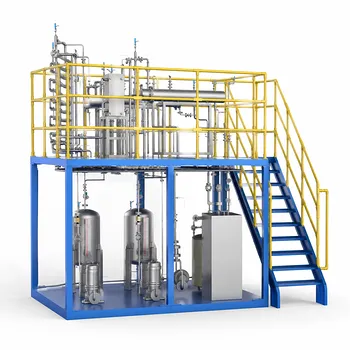
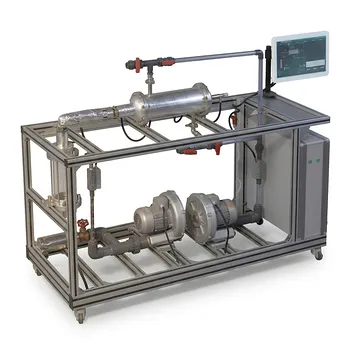
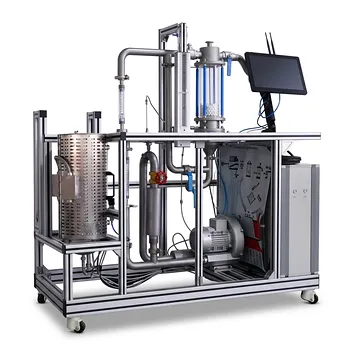
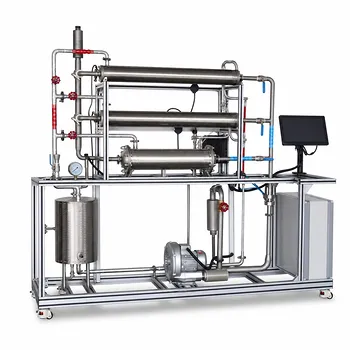
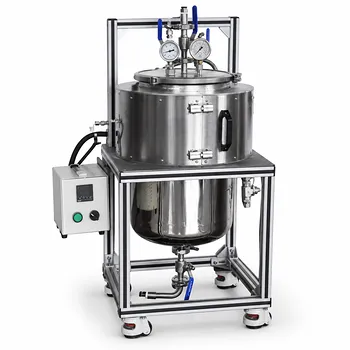
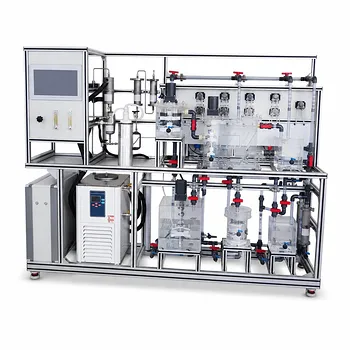
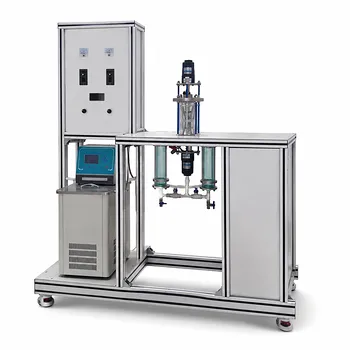
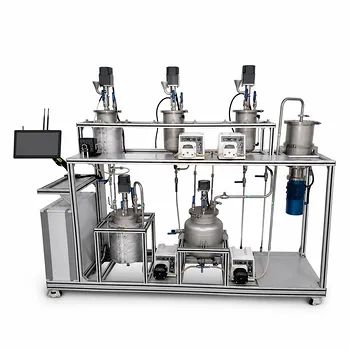
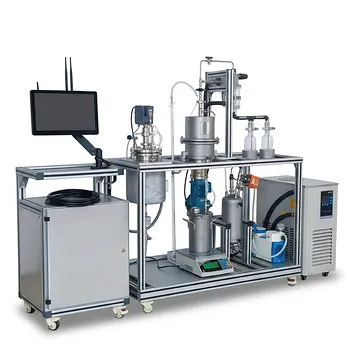
The core distinction between natural and forced convection fundamentally reshapes how you design, operate, and learn from a heat transfer pilot plant.
Your question touches on more than just textbook definitions. Forced convection, using pumps and agitators, allows for the high-performance, controllable systems vital for modern industry. Natural convection, driven by subtle density changes, teaches foundational safety and efficiency limits. An effective educational pilot plant isn't built to favor one, but to quantify the dramatic performance gap between them, allowing students to see how a shift in flow regime alters everything from energy consumption to equipment sizing.
The entire design and operational logic of an educational heat transfer pilot plant hinges on physically separating and measuring these two mechanisms. The goal is to move beyond simply knowing they exist. A well-designed plant allows students to prove that forced convection drastically accelerates heat transfer rates and, critically, to quantify by how much. This contrast cements a deeper engineering intuition for when passive, low-energy cooling is viable and when mechanical power must be spent to overcome process limits.
Designing the Plant to Isolate a Fundamental Difference
The physical layout of a pilot plant must directly reflect the operational difference between a pump-driven process and a purely buoyant one. This isn't just about having different pieces of equipment; it's about creating controlled environments where each mechanism can be studied without interference.
Separating Mechanical Drive from Thermal Drive
To study forced convection, the plant is designed around external mechanical forces. Variable-speed pumps and blowers are non-negotiable components. Their role is to let students directly manipulate fluid velocity, which is the primary independent variable. By increasing the pump speed, they can observe the corresponding, non-linear increase in the heat transfer coefficient. This teaches a core principle: in forced convection, heat transfer rate is a controllable parameter, not just a passive outcome.
The study of natural convection requires a fundamentally different design approach. The system must be stripped of any imposed flow. This involves specialized, often static, modules like heated vertical cylinders or flat plates submerged in a quiescent tank of fluid. The only driving force is the buoyancy created by the heater itself. These modules are instrumented to capture a much slower, gentler process, demonstrating a low-efficiency baseline that is critical for understanding passive safety systems and energy losses.
Accommodating Fluid Properties and Equipment Scaling
The choice between the two modes also dictates the physical hardware. The primary reference correctly notes that this distinction helps students "properly size industrial-grade equipment," and the supplementary references explain why. If a process fluid is viscous or prone to scaling, a natural convection system with low fluid velocity will rapidly foul and fail. A forced convection evaporator, using an external pump to push liquid at high velocities (2-5 m/s), actively mitigates this. An educational plant designed with reconfigurable loops allows students to test this effect, making the link between fluid dynamics and operational longevity tangible.
Operating the Plant to Prove a Core Principle
Once the plant is built, its operation is where the concepts come alive. The key is a comparative experimental protocol where the only variable changed is the fluid's motion.
Running Back-to-Back Comparative Trials
A powerful teaching operation is to measure heat transfer in a single vessel with and without agitation. The heated fluid in a static jacketed vessel transfers energy relatively slowly via natural convection. When the stirrer is turned on, the heat transfer rate instantly jumps. This operational step lets students visually and numerically separate the two mechanisms. They are not just learning a definition; they are seeing the heat transfer coefficient increase dramatically with the onset of forced motion.
Visualizing Low-Efficiency Baselines and System Safety
Operating a natural convection module is about teaching thermal design limits. Students measure the slow rise in temperature on a heated vertical cylinder in still air, calculating a low Nusselt number. This operational data provides a stark contrast to a pumped heat exchanger. It also has a critical practical application: demonstrating the passive cooling rate available if a pump fails. This real-world insight is fundamental for designing inherently safer thermal systems, where engineers must rely on natural convection as a last line of defense.
Understanding the Trade-offs
An objective advisor must highlight the limitations. Neither mode is universally superior, and an educational plant that fails to teach these trade-offs is incomplete.
The Cost of High Performance
The outstanding performance of forced convection comes at a direct cost. Running pumps and agitators consumes significant electrical power, adding to both operational expenses and system complexity. In an educational setting, this allows for a direct energy efficiency analysis. Students can calculate the increased heat transfer rate and weigh it against the measured power draw of the pump, learning to find the economic sweet spot for a given process.
The Pitfall of Misapplied Equipment
A critical pitfall is assuming a pilot plant’s choice of circulation mode scales linearly. Natural circulation evaporators are simple and have no moving parts, but as the primary reference indicates, they are only suitable for low-viscosity, non-scaling fluids. A student who specifies such a system for a crystallizing solution will have designed a blocked, inoperable piece of equipment. The pilot plant must allow them to test this failure mode safely. Similarly, the higher velocities in forced convection can cause erosion or damage shear-sensitive fluids, demonstrating that higher heat transfer is not always the main goal.
Making the Right Choice for Your Educational Goal
Your approach to designing or using a pilot plant should change based on your deepest learning objective. The hardware is just a tool to discover a principle.
- If your primary focus is teaching the fundamentals of dimensionless analysis: Prioritize modules that allow for isolated natural and forced convection experiments on standard geometries (vertical plates, horizontal cylinders). This lets students generate their own Nusselt and Rayleigh number data and validate empirical correlations like $Nu = 0.59Ra^{1/4}$ against their measurements.
- If your primary focus is on industrial process design and optimization: Focus on a reconfigurable flow loop with a variable-speed pump and interchangeable heat exchangers (tube-in-shell, plate, and jacketed vessel). The core operation should be measuring the heat transfer coefficient as a direct function of velocity, and then analyzing the pressure drop and pump power costs to find the true optimum.
- If your primary focus is on safety and passive system design: Dedicate significant lab time to the natural convection modules. The operational protocol should involve a power failure simulation, where students measure the real-time, passive cooling curve and use it to predict the time available before a system reaches a critical, unsafe temperature.
Mastering convection isn't about memorizing definitions; it's about developing the intuition to see fluid motion as the primary lever for controlling heat, and a well-designed pilot plant makes that lever visible and measurable.
Summary Table:
| Feature | Natural Convection | Forced Convection |
|---|---|---|
| Driving Force | Buoyancy (density changes) | External mechanical forces (pumps/blowers) |
| Flow Control | Passive / static environment | Variable speed control (velocity-dependent) |
| Heat Transfer Rate | Low (baseline / safety limits) | High (scalable / industrially relevant) |
| Key Applications | Passive cooling, safety systems | Heat exchangers, evaporators, agitated vessels |
Elevate Your Engineering Lab with LABPARK
Are you looking to bridge the gap between heat transfer theory and industrial reality? LABPARK provides state-of-the-art Educational and Vocational Unit Operations Pilot Plants in chemical engineering, bioprocess & biotech, and environmental & water treatment for universities, research institutes, and enterprises.
Why partner with LABPARK?
- Hands-on Learning: Enable students to master convection mechanisms with highly controllable, instrumented pilot plants.
- Industrial Fidelity: Equip your facilities with scale-down systems designed to mimic real-world operational challenges.
- Tailored Configurations: Access customizable modules designed to match your specific curriculum or research goals.
Ready to transform your laboratory training? Contact LABPARK today to discuss your pilot plant requirements!
Related Products
- Dual Mode Heat Transfer Pilot Plant for Unit Operations Training
- Three-Tube Heat Transfer Educational Pilot Plant for Unit Operations Training
- Comprehensive Multi-Modal Heat Transfer Unit Operations Pilot Plant for Engineering Training
- Shell and Tube Heat Exchanger Heat Transfer Coefficient Determination Educational Pilot Plant
- Solid Spherical Heat Transfer Coefficient Determination Educational Chemical Engineering Pilot Plant
People Also Ask
- When is ε-NTU preferred over LMTD in pilot plants? Predict heat exchanger performance without iteration.
- How do unit conversions affect pilot plant calibration? Avoid errors in heat transfer data analysis
- Why is the prevention of scale formation on heat exchanger surfaces a critical learning objective? Key Lessons
- How is the thermal resistance of a thick-walled hollow cylinder calculated? Key Equations
- Under what conditions can arithmetic mean replace LMTD in pilot plant calculations?