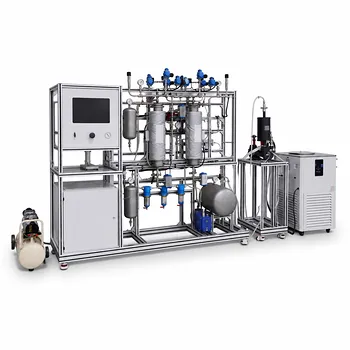
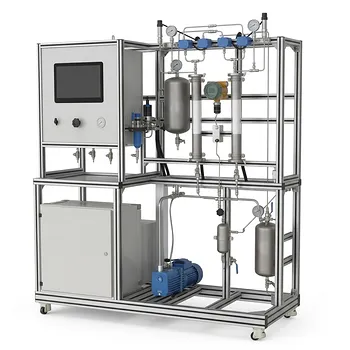
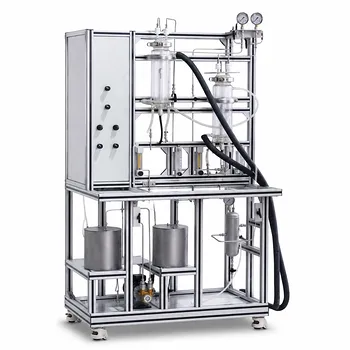
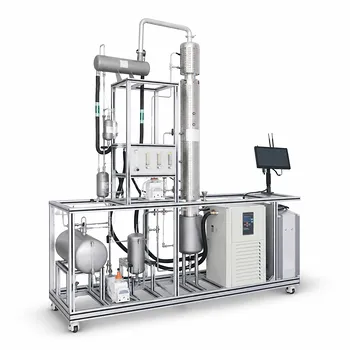
The determination of criticality criteria in multicomponent mixtures directly shapes how you set, monitor, and defend the operating window of a separation column.
When you map the critical locus—the line of temperature, pressure, and composition where the liquid–vapor phase boundary vanishes—you can define the exact subcritical region where two phases coexist stably. In a unit operations pilot plant, this mapping prevents you from accidentally drifting into a supercritical state that would cause flooding, weeping, or complete loss of separation. It also allows you to purposefully operate near but safely below the critical point to exploit enhanced mass transfer without risking hydrodynamic collapse.
Pilot-plant columns live or die by phase stability. Determining criticality criteria—through thermodynamic models and stability limits—gives you a predictive map of the pressure–temperature–composition space. With that map, you can choose feed conditions, reboiler duties, and column pressure that keep the system in a stable two-phase regime, avoiding the abrupt loss of separation that occurs when the column enters its critical or spinodal region.
The Thermodynamic Foundation: Criticality in a Multicomponent World
A multicomponent mixture doesn’t have a single critical point but a critical locus that twists through composition space. For a separation column, this means that the safe operating boundary can shift with every tray composition. Understanding the criteria that define this locus is what turns a black-box pressure limit into a controllable process variable.
The Vanishing Phase Boundary
At the critical point, the properties of the liquid and vapor become identical. Surface tension disappears, density contrast collapses, and the driving force for gravity-driven phase separation vanishes. In a trayed or packed column, this eliminates the distinct liquid and vapor traffic that underpins mass transfer. You get a homogenous supercritical fluid instead of a clean top and bottom product.
Mathematical Criteria: The Spinodal and the Stability Determinant
The theoretical backbone is the intrinsic stability limit of a phase. A homogeneous mixture becomes unstable when the stability determinant (A_{n+1})—derived from the second derivative of the Gibbs or internal energy—drops to zero. That zero crossing defines the spinodal surface, the boundary beyond which the mixture must split into two phases to lower its free energy. The critical point is the unique spot where the spinodal and the coexistence (binodal) curves meet.
In pilot-plant terms, you never want your column to drift onto the spinodal. Doing so means the internal liquid on a tray can spontaneously “foam” into a vapor-like state, creating runaway entrainment or flooding. By applying these criteria, you can calculate the distance to the spinodal for each stage and set your pressure and reboiler duty to maintain a safe margin.
Predicting the Critical Locus: From Theory to Pilot-Plant Guidance
Solving the rigorous multi-dimensional free-energy equations in real time is impractical during a pilot run. Instead, you rely on equations of state (EOS) combined with semiempirical mixing rules to pre-calculate the critical locus before the experiment begins.
Equations of State and Semiempirical Correlations
Tools like the Chueh–Prausnitz correlation or the Redlich–Ngo equation of state with quadratic mixing rules allow you to step through small mole-fraction intervals and map the critical temperature and pressure. For a ternary mixture, this generates a surface that shows exactly how the critical point moves as you move from feed to distillate to bottoms. The primary reference emphasizes that this predictive step is what lets researchers and students navigate critical regions safely rather than discovering them through a pressure spike or a sudden loss of overhead product.
Using the Critical Locus to Define Your Operating Envelope
Once mapped, the locus becomes a constraint line on your column’s pressure–temperature diagram. You select an operating pressure that keeps every tray’s composition well inside the subcritical two-phase region, even with local variations caused by temperature gradients. If the critical pressure drops sharply near the bottom of the column, you may need to increase the reboiler’s steam pressure slightly to stay above the bubble point but still safely below the critical line. This kind of deliberate margin-setting is impossible without the criteria.
Operational Impacts: How Criticality Governs Column Behavior
The translation from thermodynamic criteria to tangible column behavior is where the real value emerges in a pilot plant. A column that ignores criticality is a column that will eventually surprise you.
Preventing Flooding and Weeping Through Stability Maps
Flooding often occurs not just because of excessive vapor velocity, but because the liquid loses its positive definite stability and begins to “break” into vapor-like pockets. When you know the stability determinant is about to cross zero at a given tray temperature, you can preemptively reduce reboiler heat or raise pressure to push the operation back into a safe region. Similarly, weeping on trays can be amplified when the liquid’s density drops abnormally close to the critical density, reducing the head of liquid required to seal the downcomer.
The Danger of Unexpected Supercritical Transitions
A pilot plant that crosses into the supercritical regime without intent instantly becomes a single-phase fluid handler, not a separator. Overhead composition collapses to a feed-like composition, and bottom product vanishes. The primary reference flags this as causing incomplete phase separation and unstable operation. Without pre-determined criteria, you have no warning—pressure and temperature gauges won’t show a dramatic jump; only the product streams will tell you something is wrong.
Optimizing Separation Efficiency at the Edge of the Phase Envelope
If your research goal is to investigate supercritical extraction or to maximize mass transfer in the dense-fluid region, you actually want to push the column close to the critical point. Knowing the exact critical locus lets you operate with confidence at 95–98% of the critical pressure, where diffusivities are high and viscosities are low, without crossing the line. This is how you leverage the criteria to enhance performance rather than merely avoid failure.
Understanding the Trade‑offs and Limitations
No predictive tool is perfect, and blindly trusting a calculated critical locus can still lead to operational hiccups.
- EOS accuracy depends on mixture-specific interaction parameters. If your system contains components for which binary interaction data is scarce, the predicted critical pressure may be off by several percent. A pilot plant should therefore always be commissioned with a ramp-to-critical experiment to calibrate the model.
- The stability determinant approach assumes equilibrium. Real columns experience concentration gradients, staggered flow, and temperature lags. The instantaneous local composition may temporarily touch the spinodal before the steady-state map says it should. This requires a safety margin on top of the calculated envelope.
- The computation itself can be a burden for fast-paced educational settings. While modern software handles it, students must still grasp the underlying theory to interpret why a column suddenly turned into a solvent pump. The educational value is high, but the cognitive load can slow down a training session if not introduced carefully.
Making the Right Choice for Your Pilot Plant Goal
The way you use criticality criteria depends squarely on what you are trying to achieve in the unit operations lab.
After defining your mixture and column configuration, align your strategy with one of these primary objectives:
- If your primary focus is safe, reproducible teaching of distillation principles: Pre-calculate the critical locus and set a conservative operating pressure that is at least 10% below the lowest critical pressure on any tray. Then fix that pressure as a hard limit. Use the criteria to explain why, not to dynamically adjust during the run.
- If your primary focus is research on high‑pressure extraction or supercritical distillation: Map the entire critical locus in detail and run the column at multiple set points clustered just below and just above the critical line. Use the stability determinant to quantify exactly how close you can get before entrainment becomes excessive.
- If your primary focus is process scale‑up and safety demonstration: Conduct a sensitivity analysis on the EOS input parameters to determine a worst‑case critical locus. Set the column’s relief pressure based on that worst case, ensuring that even with model uncertainty the system stays safely subcritical.
When you invest the time to determine and then respect the criticality criteria, the pilot-plant column stops being a temperamental piece of hardware and becomes a predictable, tunable separator that teaches exactly the thermodynamic realities that govern industrial high‑pressure processing.
Summary Table:
| Operating Region | Phase State | Separation Behavior | Operational Action / Precaution |
|---|---|---|---|
| Subcritical | Stable Two-Phase (L-V) | Standard, predictable separation | Maintain normal operating window |
| Near-Critical | High fluctuation, low density contrast | Enhanced mass transfer; risk of weeping/flooding | Calibrate EOS model closely |
| Supercritical / Spinodal | Homogeneous Single-Phase | Complete loss of separation; flooding | Avoid; raise pressure or reduce heat |
Elevate Your Chemical Engineering Lab with LABPARK
Are you looking to safely navigate complex thermodynamic behaviors and optimize separation processes in your curriculum or research?
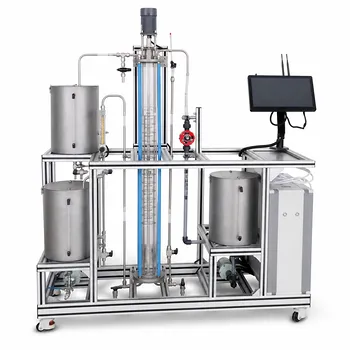
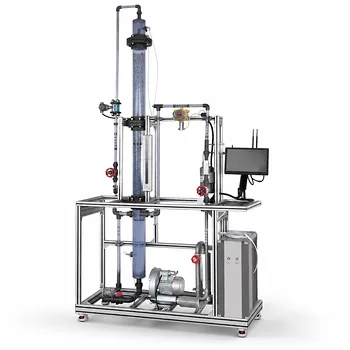
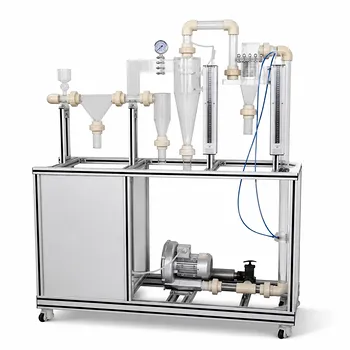
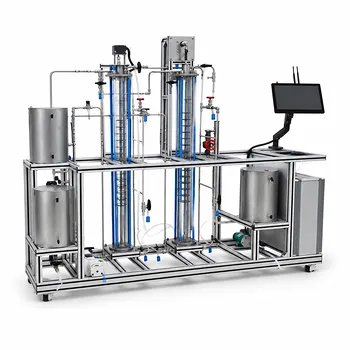
LABPARK provides high-quality Educational and Vocational Unit Operations Pilot Plants in chemical engineering, bioprocess & biotech, and environmental & water treatment. Specifically designed for universities, research institutes, and enterprises, our pilot plants deliver the precise control, safety margins, and reliability needed to study phase behavior and scale up processes with confidence.
Contact LABPARK Today to discover how our pilot plant solutions can enhance your educational and research capabilities!
Related Products
- Bench Scale Dual Column Gas Separation and Capture Educational Pilot Plant
- Pressure Swing Adsorption Educational Unit Operations Pilot Plant
- Multi-Modal Distillation Unit Operations Training Pilot Plant
- Photocatalytic Membrane Separation and Degradation Unit Operations Pilot Plant
- Continuous Sieve-Plate Distillation Pilot Plant for Unit Operations Laboratory Education
People Also Ask
- What are the key thermodynamic considerations for gas mixture modeling? Expert Guide
- How does the separation mechanism of gas permeation differ from liquid membrane processes? Pilot Plant Guide
- Why Are Binary Interaction Parameters Critical for Gas Separation Pilot Plants? Avoid Costly Failures
- Why is Graham's Law critical for gas separation in pilot plants? Master Unit Operations Design
- Which membrane materials are commonly used in gas separation pilot plants, and how is membrane fouling typically managed?