The piping material and wall thickness directly control how fast a pressure wave travels—and thus the peak forces from water hammer.
In fluid mechanics educational pilot plants, the choice of pipe material and wall thickness is not just a construction detail. It is the primary physical lever that changes the pressure wave velocity. According to the classic water hammer theory, materials with a high modulus of elasticity (e.g., steel) and thicker walls (small diameter-to-thickness ratio (D/t)) accelerate the pressure wave, bringing it closer to the speed of sound in open water (about 1440 m/s). Since water hammer overpressure is directly proportional to this wave speed ((p' = \rho c V)), a stiffer, thicker-walled pipe generates a much larger shock. Conversely, flexible materials like plastics or thin-walled pipes slow the wave and dramatically reduce the peak transient pressure, effectively dampening the hazard.
In pilot-scale fluid mechanics setups, pipe stiffness and wall thickness are the tuning knobs for water hammer intensity. Using a more elastic pipe or a thinner wall is the most immediate design choice to cut shock pressures—while this dampens surges, it must always be balanced against the pipe’s ability to hold pressure, resist fatigue, and handle the specific chemicals in the system.
The Physics: How the Pipe Itself Shapes the Pressure Wave
In open water, a pressure disturbance travels at the sonic velocity determined by the fluid’s bulk modulus. But inside a real pipe, the walls stretch and absorb energy. This wall elasticity is what alters the wave speed.
The Modified Bulk Modulus: Accounting for Pipe Stretch
Instead of using the pure bulk modulus of water ((E_v)), engineers use an effective modulus (K) that blends fluid stiffness with pipe flexibility.
[
K = \frac{E_v}{1 + \left(\frac{D}{t}\right)\left(\frac{E_v}{E}\right)}
]
Here (D) is the pipe diameter, (t) is wall thickness, and (E) is the modulus of elasticity of the pipe material.
The denominator grows larger when the pipe is either thin ((D/t) high) or made of a stretchy material ((E) low), making (K) smaller. A smaller (K) directly means a lower pressure wave velocity.
The Wave Speed Equation
The pressure wave velocity (c) is then found using classic fluid mechanics:
[
c = \sqrt{\frac{gK}{w}}
]
where (w) is the specific weight of the liquid. Because (c) scales with (\sqrt{K}), any increase in pipe flexibility—whether from material choice or a thinner wall—will slow the wave. This relationship is what transforms a pilot plant from a simple flow loop into a quantitative teaching tool.
The Joukowsky Equation: Linking Velocity to Risk
Water hammer overpressure is not a vague threat. It is calculated with the Joukowsky equation:
[
p' = \rho c V
]
where (\rho) is the fluid density and (V) is the change in flow velocity. A pipe that doubles the wave speed will double the surge pressure for the same instantaneous valve closure. This linear dependency makes the experimental demonstration of the (D/t) and (E) effects both dramatic and measurable.
Why This Matters in Educational Pilot Plants
Educational units are explicitly designed to visualize and measure transient phenomena. The pipe material and wall thickness become independent variables that students can change to test the theory.
Turning the Formula into a Hands-On Experiment
By installing pipe spool-pieces of different materials (steel, copper, PVC, HDPE) but the same diameter, or the same material with different wall schedules, a pilot plant module allows experiments that:
- Measure the pressure wave velocity directly with fast-transient sensors.
- Validate the modified bulk modulus (K) against known elastic properties.
- Show that plastics (low (E)) consistently yield a wave speed far below that of steel.
- Confirm that moving from a thick Schedule 80 pipe to a thin Schedule 10 pipe measurably lowers (c) and the peak pressure spike.
Demonstrating Water Hammer Risk Quantitatively
Students can close a valve rapidly and record the resulting pressure trace. A steel pipe might show a peak pressure several times higher than a plastic pipe under identical flow conditions. This makes the intangible concept of fluid inertia tangible, reinforcing why industries select ductile lines or surge suppression when using rigid metallic piping.
Understanding the Trade-offs of Low-Wave-Velocity Pipes
Selecting a soft, thin-walled pipe to kill water hammer is not a universal solution. The same flexibility that lowers wave speed brings other constraints that are especially important in educational pilot plants that must run safely for years.
Pressure Containment and Temperature Limits
A thinner wall reduces (D/t) and thus wave speed, but it also lowers the safe working pressure. For pilot plants, the safe pressure rating ((P_s)) is directly linked to the pipe’s schedule number and the material’s allowable stress. A Schedule 40 plastic pipe may dampen water hammer perfectly but may not handle the same static pressure or hot water as Schedule 40 steel. The lab design must verify that the operational pressure—including the residual water hammer—stays below the derated pressure limit of the chosen material.
Fatigue Resistance Under Repeated Surges
Water hammer is a cyclic loading event. In a pilot plant that repeatedly starts, stops, and triggers transients, the pipe material must have an endurance limit (fatigue limit) above the cyclic stress. Flexible plastics can absorb many cycles, but if a thin-walled metal pipe is chosen, the repeated stress from even a reduced water hammer might eventually cause brittle fracture. This teaches students that damping a single peak pressure does not guarantee long-term integrity.
Chemical Compatibility and Real-World Economics
The cheapest low-modulus pipes (like PVC) are not compatible with all fluids. In unit operations labs handling solvents or hot chemicals, material selection often forces a return to steel or specialty alloys. Additionally, the choice of material strongly influences the economic pipe diameter and total installed cost. While a plastic pipe might naturally reduce water hammer, a stainless steel system might still be required—shifting the focus toward active surge protection rather than passive pipe flexibility.
Making the Right Choice for Your Educational Pilot Plant
The pipe material and wall thickness are not afterthoughts—they are deliberate teaching variables and safety features. Here is how to decide based on your primary instructional goal.
- If your primary focus is demonstrating the water hammer formula: Install multiple test sections with distinctly different (D/t) ratios and materials (e.g., rigid steel vs. flexible HDPE). Use fast pressure transducers to let students compute (c) directly and compare with the theoretical model.
- If your primary focus is system safety and minimal shock risk: Choose a flexible plastic pipe with the thickest wall that still meets your pressure rating. Accept that the wave speed will be low, the peak pressures small, and the demonstration subtle—but the plant will run with wide safety margins.
- If your primary focus is replicating industrial practice: Use a carbon steel or stainless steel pipe with standard Schedule 40 walls, but include an accumulator or surge tank. Teach students that when material stiffness cannot be compromised, external surge mitigation becomes essential.
Understanding that the pipe itself is an acoustic element, not just a conduit, transforms water hammer from a mathematical curiosity into a vivid, controllable experiment—and a lesson that sticks.
Summary Table:
| Pipe Parameter | High Modulus / Thick Wall (e.g., Steel) | Low Modulus / Thin Wall (e.g., Plastics/HDPE) |
|---|---|---|
| Wave Velocity ($c$) | High (Closer to ~1440 m/s) | Low (Significantly dampened) |
| Water Hammer Risk | High peak overpressure ($p' = \rho c V$) | Low peak overpressure |
| Best Educational Use | Teaching industrial practices & active surge mitigation | Demonstrating wave speed physics safely & cost-effectively |
Bring Fluid Mechanics to Life Safely with LABPARK
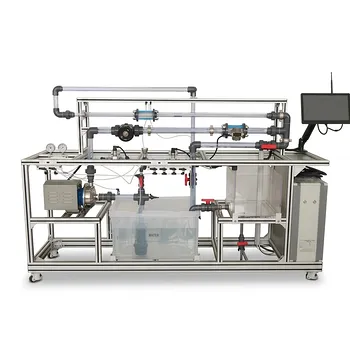
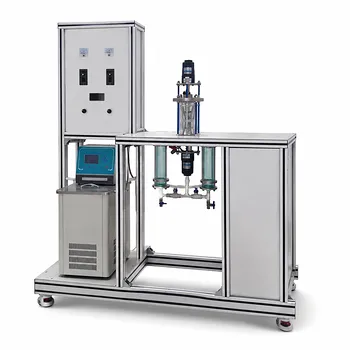
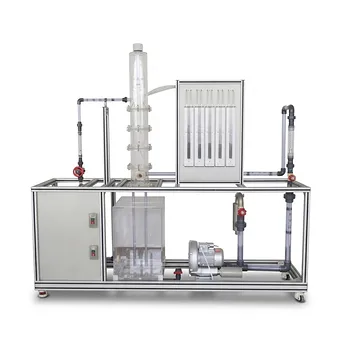
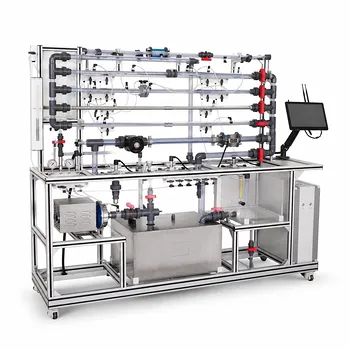
Need to safely demonstrate complex hydraulic transients like water hammer in your laboratory? LABPARK provides premium Educational and Vocational Unit Operations Pilot Plants in chemical engineering, bioprocess & biotech, and environmental & water treatment. Designed specifically for universities, research institutes, and enterprises, our pilot plants ensure precise measurement, high educational value, and long-term operational safety.
Ready to upgrade your engineering curriculum? Contact us today to discuss your laboratory requirements and get a customized solution!
Related Products
- Two Phase Flow Pattern Velocity Resistance Measurement Educational Pilot Plant
- Constant Pressure Filtration Educational Unit Operations Pilot Plant
- Cavitation Phenomenon Demonstration and Analysis Educational Unit Operations Pilot Plant
- Orifice and Venturi Flowmeter Calibration Educational Pilot Plant for Fluid Mechanics Laboratory
- Water Electrolysis Hydrogen Production and Storage Educational Pilot Plant
People Also Ask
- How to update chemometric calibration models in pilot plants? Best practices for process engineers.
- Why Correct Sig Figs & Rounding Matter in Educational Pilot Plants: Ensure Data Accuracy
- How can educational pilot plants be used to teach process safety and risk assessment in chemical engineering curricula?
- How does nuclear yield inefficiency translate to chemical engineering education? Optimize kinetics with pilot plants.
- How to identify two-phase gas-liquid flow patterns? Master fluid dynamics with pilot plants