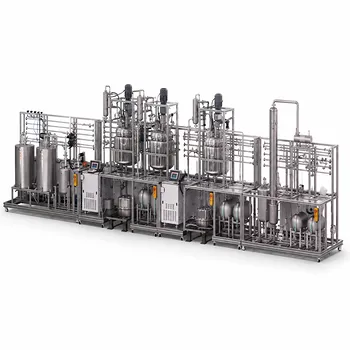
For polymerization pilot plants, you model molecular weight distribution (MWD) using fundamentally different mathematical frameworks depending on whether you’ve chosen a batch or continuous reactor. A continuous reactor configuration demands a steady-state mass balance approach that explicitly accounts for the residence time at every point, giving you a direct, time-averaged picture of the MWD. A batch reactor forces you to model the entire transient life of the reaction, starting from initial monomer and initiator concentrations and tracking the growth of every chain over a discrete batch cycle.
The choice between batch and continuous reactor configurations transforms MWD modeling from a temporal narrative into a spatial, steady-state flow problem. In a batch pilot plant, you simulate a time-dependent symphony of individual chain births and deaths. In a continuous pilot plant, you calculate a probabilistic snapshot governed by how long each molecule lingers in the system. Understanding this shift is critical for predicting mechanical properties, gelation points, and process control on a pilot scale.
The Surface Answer: How Modeling Methods Diverge
Continuous Reactors: Steady-State Mass Balances with Residence Time
In a continuous stirred-tank reactor (CSTR) or tubular reactor, material flows in and out continuously. The MWD model becomes a population balance built around a steady-state assumption. You write a complete mass balance for every polymer chain of length n, including the inflow, outflow, generation, and consumption terms.
This approach explicitly represents the residence time distribution (RTD). Because all chains do not spend the same time inside the reactor, the final MWD is a weighted average of the growth that occurred at many different “ages.” The modeling process directly integrates the RTD into the kinetic equations, making the time evolution of the distribution a built-in output of the steady-state solution.
Batch Reactors: Transient Kinetics as the Starting Point
A batch reactor operates with no inflow or outflow. Its MWD model is purely time-dependent. You start with known initial concentrations of monomer and initiator, then solve a system of ordinary differential equations that describes how the entire distribution evolves from zero conversion up to the final stopping point.
Every chain starts and finishes its life within the same closed environment. There is no “age” distribution to average over—the modeling tracks the population as it collectively matures. This transient kinetic approach gives you a precise, moment-by-moment history of the MWD but provides no spatial or flow-related terms.
The Deep Need: Why Modeling Differences Decide Your Polymer Properties
Residence Time Distribution Shapes the Final MWD
In a continuous reactor, the RTD does more than just mix molecules; it actively sculpts the MWD. A broad RTD—typical of a single CSTR—means some polymer chains exit almost immediately while others remain for long periods. This smears the MWD, often making it broader than what you would produce in an equivalent batch reactor under the same recipe.
In a tubular reactor with plug flow, the RTD is narrow. Here the continuous model behaves more like a batch reactor pushed through space, giving a tighter MWD. The modeling choice forces you to account for these fluid mechanical realities directly.
The Lifetime of a Chain: When Continuous Reactors Broaden or Narrow the MWD
Denbigh’s rule clarifies a non-intuitive outcome: the effect of a CSTR on MWD depends on how long chains live relative to the mean residence time.
In anionic or step-growth polymerizations, chain lifetimes are long. A chain can grow, stop, and possibly react again over many residence times. The continuous outflow acts as an artificial termination event, cutting chains short and mixing old and young populations. This broadens the MWD compared to a batch reactor.
In free-radical polymerization, chain lifetimes are extremely short—a fraction of a second. In a batch reactor, monomer concentration drops over the course of hours, causing “drift” that creates chains of different lengths at different times. Moving to a CSTR holds the monomer concentration constant and replaces the temporal drift with a steady environment, actually narrowing the MWD. Your model must capture these opposite behaviors correctly to predict real pilot-plant output.
From Pilot Plant to Product: Predicting Gelation and Mechanical Properties
MWD directly governs a polymer’s processability, tensile strength, and melt flow. A continuous reactor model that accurately includes the mass balance on every chain length lets you predict gelation points—where cross-linking leads to an insoluble network—more precisely because it accounts for the high-molecular-weight tail that RTD can generate.
Batch reactor models, by contrast, give you a direct timeline of viscosity build-up and gelation risk as a function of batch time. This is essential for pilot-scale safety studies where you must stop the reaction before a dangerous runaway. The modeling approach you adopt directly dictates the alarm thresholds and control strategies you program into the pilot plant’s data acquisition system.
Beyond Kinetics: The Hidden Modeling Variables
Heat Transfer and Mixing Cannot Be Ignored
Batch reactors in a pilot plant often struggle with heat removal because the entire reaction energy is released in a closed vessel over time. Your transient kinetic model must be tightly coupled to an energy balance that predicts temperature excursions and possible thermal runaway—something continuous reactors handle intrinsically through steady-state heat transfer.
Conversely, continuous reactor models may ignore spatial temperature gradients only at great peril. In tubular reactors, you often need a 2D or 3D model combining mass, momentum, and energy balances to capture radial temperature profiles that skew the local kinetics and broaden the MWD. These computational demands are a direct consequence of the reactor choice.
Start-up and Shutdown Dynamics Add Transient Complexity to Continuous Models
Even a “continuous” pilot plant doesn’t live in a perfect steady state. Your model must account for start-up and shutdown transients when the reactor lines up to target composition. For a CSTR, this means solving the time-dependent mass balances until the steady state is reached, effectively blending batch and continuous modeling techniques.
For educational pilot plants, this hybrid modeling requirement is an invaluable lesson: students see first-hand that the ideal steady-state MWD is a fiction until three to five residence times have passed, and the actual product collected during transition will have a different distribution entirely.
Understanding the Trade-offs
Batch Model Simplicity vs. Real-World Variation
A batch model is conceptually simpler: it mirrors the step-by-step progress of a single reaction run. That simplicity makes it easier to teach, validate, and modify. However, it cannot directly predict the batch-to-batch variation that arises from imperfect cleaning, subtle feed variations, or human operator differences—factors that a continuous reactor’s steady-state model actually dampens out.
Continuous Model Complexity vs. Steady-State Precision
A continuous MWD model requires solving algebraic or partial differential equations with RTD convolution. It is mathematically heavier and demands more pilot-plant data (like tracer studies) to calibrate. But once validated, it delivers a high-fidelity prediction of stable, long-run product quality and eliminates the need to model every initial condition permutation.
Modeling for Safety: A Non-Negotiable Distinction
For fast, highly exothermic polymerizations, the batch model must explicitly flag the runaway scenario as a function of time since all reactant is present at once. A continuous reactor model inherently incorporates the safety advantage of low-inventory steady-state operation, but only if you have correctly included the heat removal capacity in the mass balance. Choosing a batch configuration means your model will be the primary risk-assessment tool; in a continuous setup, the process itself provides part of the safety argument.
Making the Right Choice for Your Pilot Plant Study
Your modeling approach should directly mirror the research question and the reactor hardware you plan to use. Choose the configuration that lets you answer the questions that matter most.
- If your primary focus is teaching diverse chemistries and fundamental kinetics: Opt for a batch pilot plant. The transient kinetic model is more intuitive and allows rapid formula screening without complex RTD derivations.
- If your primary focus is scaling up a commercial steady-state process: Select a continuous reactor configuration. The mass balance model will give you the most reliable prediction of consistent MWD, product reproducibility, and long-term process economics.
- If your primary focus is investigating safety and gelation boundaries: Use a batch or semi-batch configuration with a high-fidelity transient model, then compare its predictions against a continuous system’s steady-state solution to understand how reactor design itself mitigates risk.
- If your primary focus is broad vocational training: Invest in a pilot plant that offers both batch and continuous units. This forces students to build both a transient ODE model and a steady-state mass-balance model, revealing how the same chemistry can produce a totally different MWD signature under different flow conditions.
The reactor configuration you select is the first and most powerful modeling decision you make. Once that choice is locked in, your equations are destined to see MWD either as a journey through time or a census shaped by flow—and that perspective will determine everything from your pilot plant’s control philosophy to the polymer properties you ultimately achieve.
Summary Table:
| Feature / Parameter | Batch Reactor Modeling | Continuous Reactor Modeling (CSTR/Tubular) |
|---|---|---|
| Core Framework | Transient kinetics (Time-dependent ODEs) | Steady-state mass & population balances |
| Residence Time (RTD) | Not applicable (uniform reaction time) | Integral to model (governs MWD width) |
| Monomer Drift | Changes over time, affecting chain length | Constant at steady state, reduces drift |
| Thermal & Safety Model | High-risk transient heat-up tracking | Steady-state heat profiles & startup dynamics |
Optimize Your Polymerization Research with LABPARK
Choosing the right reactor configuration is critical for accurate process modeling, scale-up, and safety evaluation. LABPARK provides premium Educational and Vocational Unit Operations Pilot Plants in chemical engineering, bioprocess & biotech, and environmental & water treatment.
Designed specifically for universities, research institutes, and enterprises, our versatile pilot plants enable hands-on validation of both transient batch and steady-state continuous modeling theories.
Ready to elevate your laboratory's research and training capabilities? Contact us today to discuss your custom pilot plant requirements!
Related Products
- Polymerization Granulation and Pellet Processing Educational Unit Operations Pilot Plant
- Ethyl Acetate Synthesis Unit Operations Pilot Plant for Practical Training
- Natural Product Extraction Unit Operations Training Pilot Plant
- Carbon Dioxide Hydrogen Methanol Synthesis Educational Unit Operations Pilot Plant
- Multi-Reactor Educational Pilot Plant for Reaction Engineering Unit Operations
People Also Ask
- How do educational unit operations pilot plants bridge theory and design? Bridge the Engineering Gap
- How do educational unit operations pilot plants address safety and waste management when scaling up?
- Why Compare Predicted and Experimental Excess Enthalpy? Key to Accurate Pilot Plant Scale-up
- When to transition from PID to adaptive control in pilot plants? Key process indicators.
- How do deviations in estimating latent heat impact pilot plant thermal systems? Avoid hardware mis-sizing.