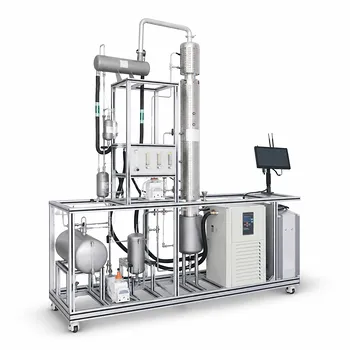
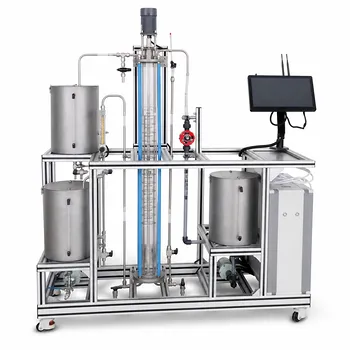
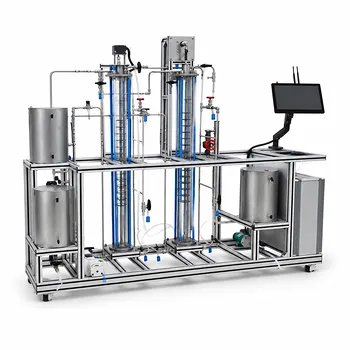
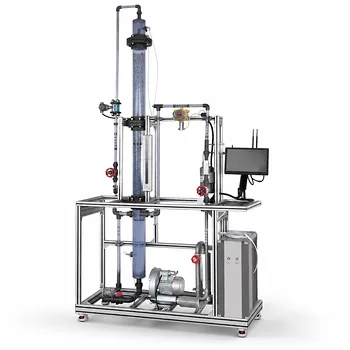
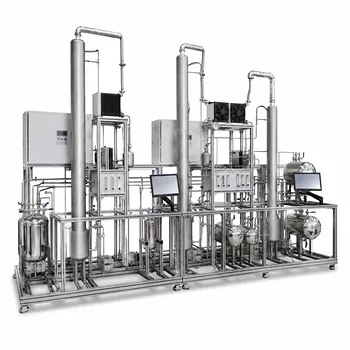
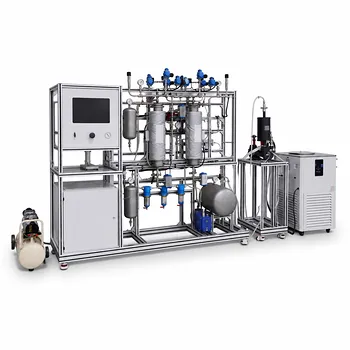
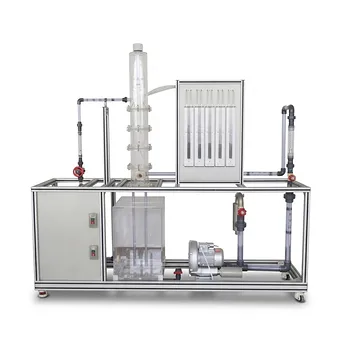
The accuracy of vapor-liquid equilibrium (VLE) calculations is the single most critical thermodynamic input for designing and sizing a distillation column in a pilot plant. Inaccurate VLE data directly corrupts the calculated number of theoretical stages, reflux ratio, feed tray location, and column diameter. Because pilot plants exist to validate scale‑up parameters, a small error in VLE — such as a misjudged relative volatility — can turn a well‑designed experiment into a source of costly mis‑information, completely undermining the plant’s purpose.
The core takeaway: The capital cost and physical dimensions of a separation column change roughly with (ln α)^-1, where α is the relative volatility. Near an azeotrope or at infinite dilution, α approaches 1.0, and the design becomes exponentially sensitive to even minor thermodynamic inaccuracies. A 5% vapor‑pressure error can translate into a >30% deviation in required trays, making precise VLE models not a luxury, but a prerequisite for meaningful pilot‑scale work.
The Thermodynamic Foundation of Column Sizing
Before a pilot plant column can be sized, the separation problem must be translated into a thermodynamic landscape. VLE data provides that landscape.
How VLE Data Defines the Separation Landscape
Distillation design begins with the equilibrium ratio K‑value (K = Y/X). This value, a function of temperature, pressure, and composition, tells you how a component partitions between vapor and liquid.
From K‑values you derive the relative volatility (α) — the ratio of K‑values for the key components. A high α means a component flashes off easily; an α near 1.0 signals a difficult, energy‑intensive separation.
The Alpha Factor and Cost Sensitivity
The primary reference reveals a stark relationship: a column’s capital cost varies approximately as (ln α)^-1.
When α is comfortably high, a 5% error in its value barely moves the needle. But when operating near azeotropes or in dilute regions where α → 1, the natural log term pushes the cost — and therefore the column height, diameter, and heat load — toward extreme sensitivity. This is the deep reason why pilot plants cannot tolerate generic thermodynamic guesses.
The Cascading Impact of VLE Inaccuracies in Pilot Plants
When VLE predictions are off, the error propagates through every dimension of the pilot plant’s physical hardware and operational parameters.
Mis‑Sized Equipment and Tray Requirements
The number of theoretical stages is calculated from the operating line and the equilibrium curve defined by VLE data. If that curve is incorrectly positioned, your stage count is wrong.
For a close‑boiling pair like isopentane and n‑pentane, a seemingly trivial 5% error in vapor pressure (a key input to the K‑value) can introduce a 33% deviation in the number of theoretical trays. A pilot column built to that flawed count will be either hopelessly undersized or wastefully overbuilt.
Wrong Feed Location and Reflux Ratios
The feed tray is determined by the intersection of the q‑line with the equilibrium curve. An inaccurate equilibrium curve shifts that intersection.
If the feed enters too high or too low, separation efficiency collapses — even with the correct number of stages. Similarly, the minimum reflux ratio is pinned directly to the pinch point on the VLE curve. A distorted curve forces operators to run at an incorrect reflux ratio, wasting energy in the reboiler and condenser while failing to achieve the target purity.
Energy Consumption and Operational Costs
The reboiler and condenser sizes are direct functions of the internal vapor and liquid traffic, which hinge on the reflux ratio.
When VLE errors force a higher reflux ratio — or mask an achievable lower one — the pilot plant burns excess utility steam and cooling water. This not only distorts scale‑up energy projections but also masks the true operating cost of the full‑scale process.
Why Pilot Plants Amplify the Need for VLE Precision
A laboratory glass column can tolerate rough estimates because its volume is tiny and its purpose is often demonstration. A pilot plant’s mission is to validate scale‑up, making thermodynamic rigor non‑negotiable.
Non‑Ideal Mixtures and Model Breakdowns
Standard cubic equations of state often fail for mixtures containing polar solvents, glycols, or phenolics.
In these systems, liquid‑phase activity coefficients deviate wildly from ideality. If a pilot plant runs such a mixture using a default Peng‑Robinson model without temperature‑dependent binary interaction parameters, the predicted equilibrium can be off by an order of magnitude. The pilot plant then does not validate the process; it validates a broken model.
The Danger Zone Around Azeotropes and Infinite Dilution
Binary systems like acetonitrile‑isopropanol or n‑butanol‑water exhibit minimum‑boiling azeotropes where the vapor and liquid compositions merge.
A 2°C error in boiling point or a 0.1 mass fraction shift in azeotropic composition can completely change the separation strategy. A pilot column designed to break an azeotrope with the wrong VLE data will either fail entirely or require an entirely different solvent, making the pilot run a waste of time and resources.
Understanding the Trade‑offs
The history of distillation design offers a tempting shortcut: over‑design. Pilot plants are the place to measure the real cost of that shortcut.
Over‑Design as a Historical Crutch
Before robust thermodynamic models, designers used short‑cut correlations (Fenske, Underwood, Gilliland) with large safety margins. This meant extra trays, larger reboilers, and oversized condensers — a brute‑force buffer against imprecise VLE data.
In a pilot plant, that over‑design creates a false sense of security. The column works, but the scale‑up numbers become inflated. A full‑scale plant built on that inflated basis will be unnecessarily capital‑intensive and suffer from poor turndown flexibility.
The Risk of Over‑Reliance on Default Models
Many simulation packages offer built‑in thermodynamic property banks. These are excellent starting points, but they cannot be trusted blindly.
The Chao‑Seader correlation, for example, fails to accurately reproduce pure component vapor pressures under saturation conditions for many hydrocarbons. When a pilot plant operator selects a model without verifying its vapor‑pressure predictions against trusted data, the entire column design — from tray count to downcomer sizing — rests on a flawed foundation.
Making the Right Choice for Your Pilot Plant Goal
The objective is not to achieve “perfect” VLE data, which is impossible, but to align the rigor of your thermodynamic model with the criticality of the separation.
- If your primary focus is validating a scale‑up for a non‑ideal, azeotropic, or close‑boiling mixture: Use a local‑composition activity coefficient model (e.g., Wilson, NRTL) with parameters regressed from high‑quality experimental data. Accept no substituitions.
- If your primary focus is generating quick feasibility data for a well‑known hydrocarbon system: A cubic equation of state (Soave‑Redlich‑Kwong or Peng‑Robinson) with tuned binary interaction parameters is likely sufficient, but always benchmark the pure‑component vapor pressures first.
- If your primary focus is educational demonstration of distillation principles: Intentionally compare runs where the model is deliberately perturbed, so students see how a small VLE shift translates into a large change in tray requirements and product purity.
- If your primary focus is optimizing an existing pilot column: Regress your VLE model against actual pilot plant temperature and composition profile data. This closes the loop between theory and reality and yields the most trustworthy scale‑up parameters.
The bottom line is that a pilot distillation column is only as intelligent as the thermodynamic model driving its design. Trusting generic VLE predictions in regions of high sensitivity does not save time — it merely delays the discovery of a costly design error until after the scale‑up is complete.
Summary Table:
| Distillation Parameter | Impact of VLE Inaccuracy | Consequence for Pilot Plant |
|---|---|---|
| Theoretical Stages | Miscalculated equilibrium curve | Over/undersized column height (up to >30% tray deviation) |
| Feed Tray Location | Shifted operating-equilibrium intersection | Drastic drop in separation efficiency |
| Reflux Ratio | Distorted pinch points & minimum reflux | Wasted energy (reboiler/condenser) & poor purity control |
| Scale-up Reliability | Inaccurate energy & capacity projections | Inflated capital costs for full-scale plant designs |
Optimize Your Chemical Engineering Scale-Up with LABPARK
Accurate thermodynamic validation starts with the right equipment. LABPARK designs and delivers premium Educational and Vocational Unit Operations Pilot Plants for chemical engineering, bioprocess & biotech, and environmental & water treatment.
Whether you are a university teaching the next generation of engineers, a research institute validating scale-up parameters, or an enterprise optimizing process performance, our precise pilot systems ensure reliable results.
Contact LABPARK today to discuss your pilot plant requirements!
Related Products
- Continuous Sieve-Plate Distillation Pilot Plant for Unit Operations Laboratory Education
- Multi-Functional Special Distillation Educational Pilot Plant
- Multi-Modal Distillation Unit Operations Training Pilot Plant
- Continuous Batch Extractive Distillation Educational Pilot Plant
- Dual-Mode Rectification Pilot Plant for Practical Training Unit Operations
People Also Ask
- How to select the right activity coefficient model (Wilson, NRTL, UNIQUAC) for distillation pilot plants?
- Why is vacuum operation capability an essential feature for a distillation unit operations pilot plant? Unlock Efficiency
- How can real-time carbon number prediction improve distillation pilot plants? Optimize control.
- How does catalyst water concentration affect distillation pilot plant design? Key separation train choices.
- What are the primary reflux ratio control strategies? Master Distillation Unit Operations