Temperature is the master control knob for coating viscosity.
The viscosity of coating fluids typically decreases linearly with increasing temperature, often dropping to nearly half its original value when heated from 20°C to 35°C. In unit operations pilot plants, this relationship is critical for training because it teaches students and operators how to actively manage fluid flow and atomization. By manipulating temperature, they learn to handle high-solids, viscous formulations without clogging nozzles, while also monitoring for thermal gelation points that could turn a fluid into an unsprayable semisolid.
Understanding the temperature-viscosity link is not just an academic exercise—it is the operational lever that separates a successful, clog-free coating process from a stalled, messy failure. Pilot plant training that ingrains this principle builds the foundation for all fluid handling and atomization scale-up.
The Science of Temperature-Viscosity in Coating Solutions
The behavior observed in pilot plants is rooted in fundamental transport phenomena. For coating formulations, the relationship between temperature and viscosity is predictable yet powerful, allowing for deliberate process manipulation.
The Linear Decline in Viscosity
The primary effect is straightforward: as temperature rises, viscosity falls in a near-linear fashion. This occurs because increased thermal energy weakens intermolecular forces and hydrogen bonds within the fluid, allowing molecules to flow past each other more easily.
The practical impact is dramatic. A solution that is too thick to pump or spray at room temperature becomes easily manageable with just a modest temperature increase of 15°C. This direct, measurable relationship is the first and most important lesson for any trainee.
The Risks of Thermal Gelation
Not all thermal effects are beneficial. Many coating polymers, such as HPMC solutions, have a critical gelation temperature. When heated beyond this point, they can undergo a phase transition, forming a semisolid gel that cannot be sprayed or pumped.
Pilot plant training gives students the hands-on experience needed to identify these thresholds. They learn to operate within a precise thermal window: hot enough to reduce viscosity, but cool enough to avoid irreversible gelation. This boundary awareness is what prevents catastrophic equipment blockages during real-world processing.
Pilot Plant Training: Turning Theory into Operational Skill
The true value of the temperature-viscosity relationship emerges when training on fluid flow unit operations. It transforms abstract science into a toolkit for solving practical production problems.
Manipulating Viscosity for Reliable Atomization
Highly viscous, high-solids coatings present a direct obstacle to atomization. Without intervention, they will clog nozzles and produce inconsistent spray patterns. The primary reference accurately highlights that heating the formulation just before atomization is the standard industrial solution.
In a pilot plant setting, students witness this cause-and-effect in real time. They learn to adjust feed temperature to hit a target viscosity window, directly correlating a simple thermal adjustment with a stable, fine spray. This teaches them that process control is as much about thermodynamics as it is about mechanical setup.
Monitoring the Complete Thermal Landscape
Beyond simple atomization, pilot plants are ideal for teaching thermal boundary management. Students are trained to continuously monitor fluid temperature, not just at the heater but throughout the recirculation loop and nozzle head.
They observe how heat loss in transfer lines can cause viscosity to climb again, leading to pulsation. They also map the exact gelation curve for a new formulation, using the plant's instrumentation to define a safe operating envelope. This holistic view of temperature as a dynamic, location-specific variable is essential for competent operation and troubleshooting.
Bridging Theory and Real-World Complexity
Supplementary material emphasizes that transport property theories, like the corresponding states method, can fail for complex liquids (especially when $\rho/\rho^c \ge 1$). Pilot plants force students to confront this gap.
They learn that while a linear viscosity decline is a useful rule of thumb, direct experimental measurement is non-negotiable. By comparing their own pilot plant data against predictive models, they develop a critical skepticism that is vital for engineering accurate, safe fluid systems. They learn to trust the instrument, not just the equation.
Understanding the Trade-Offs and Hidden Pitfalls
Temperature control is a potent tool, but it is not a universal fix. Students must also understand the complexities that can undermine a heat-based strategy.
A key complexity is non-Newtonian, shear-thinning behavior. At low shear rates in a pump or pipe, a coating may seem highly viscous even when warm. However, during atomization, shear rates jump well above 200 s⁻¹, at which point the viscosity stabilizes. This means operators must be trained to measure or infer viscosity under process-relevant shear, not just under quiescent conditions.
Furthermore, the exponential relationship between solids content and viscosity can overpower temperature effects. Doubling the solids may require an impractical temperature increase, pushing the fluid dangerously close to its gelation point or degrading heat-sensitive components. This teaches students that formulation and process parameters must be optimized together, not in isolation.
Making the Right Choice for Your Training Goals
The temperature-viscosity lesson in a pilot plant must be tailored to the specific operational skill you want to build. The strategy shifts depending on the primary objective of the exercise.
- If your primary focus is preventing nozzle clogs: Train operators to target the minimum temperature that brings viscosity below a critical pumpability threshold, keeping a 5-10°C safety margin below the known gelation point.
- If your primary focus is achieving stable, high-quality atomization: Educate students on the combined effects of temperature and shear. Have them map the viscosity under peak shear conditions at the nozzle, not just in the feed tank.
- If your primary focus is teaching safe process boundaries: Design an exercise that deliberately approaches—and then carefully tests—the thermal gelation limit. The unforgettable learning moment is seeing a clear solution turn into a solid plug under controlled conditions.
Mastering the temperature-viscosity relationship in a pilot plant does more than teach fluid mechanics; it builds the diagnostic intuition operators need to keep real-world coating lines running smoothly.
Summary Table:
| Parameter | Impact on Coating Viscosity | Pilot Plant Training Focus |
|---|---|---|
| Temperature Rise | Viscosity decreases (e.g., drops by half from 20°C to 35°C) | Hands-on control of fluid flow and atomization to prevent clogs. |
| Thermal Gelation | Exceeding critical limits causes transition to solid gel | Teaching boundary management to avoid catastrophic blockages. |
| Shear Rate | Non-Newtonian shear-thinning at high shear (>200 s⁻¹) | Measuring process-relevant viscosity under active flow conditions. |
| Solids Content | Exponential viscosity increase (can overpower heating) | Balancing formulation variables with thermal control limits. |
Equip Your Lab for Hands-On Fluid Flow & Process Training
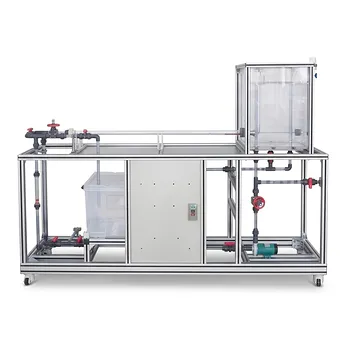
Mastering transport phenomena requires real-world, hands-on experience. LABPARK provides Educational and Vocational Unit Operations Pilot Plants in chemical engineering, bioprocess & biotech, and environmental & water treatment for universities, research institutes, and enterprises. Help your students and operators safely master temperature-viscosity control, atomization, and process troubleshooting.
Contact LABPARK today to find the perfect pilot plant for your training program!
Related Products
- Fluid Friction Resistance Determination Educational Unit Operations Pilot Plant
- Carbon Dioxide PVT Curve Determination Educational Unit Operations Pilot Plant
- Solid Spherical Heat Transfer Coefficient Determination Educational Chemical Engineering Pilot Plant
- Rising and Falling Film Evaporation Educational Unit Operations Pilot Plant
- Liquid-Liquid Mass Transfer Coefficient Determination Educational Pilot Plant
People Also Ask
- How do pilot plants teach U-tube manometers? Master Differential Pressure Calculations
- How is the hydrodynamic entrance length estimated for high-Re channel flows? Design accurate pilot-plant measurements
- How do velocity profiles and flow rates differ in Newtonian and power-law fluids? A Pilot Plant Guide
- How do pilot plants demonstrate siphon pressure variations? Visualizing Bernoulli's Energy Balance
- How does high-frequency pressure oscillation affect velocity distribution and boundary layer behavior? Discover Stokes-layer effects