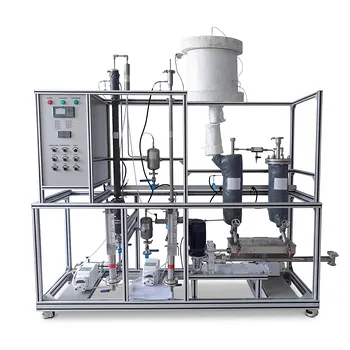
The Primary Weakness of Proportional-Only Control Meets Its Match in Integral Action.
In proportional control systems, a steady-state error must always remain to hold a new controller output. By adding integral control, the output becomes proportional to the accumulated error over time—continuing to adjust even when the error is very small, until the offset is driven to exactly zero. This is how a Proportional‑Integral (PI) controller completely eliminates the steady-state error in chemical engineering pilot plant loops such as flow or liquid level control.
PI control removes offset by integrating past error, so the controller can sustain the necessary output with zero error. However, the integral action must be carefully tuned to avoid overshoot and instability.
Why Proportional Control Can Never Eliminate Offset
The Inseparable Link Between Error and Output
A proportional controller multiplies the current error by a constant gain to generate its output. To produce any sustained, non‑zero output change—for example, to hold a valve at a new position—a persistent error must exist. If the error ever returned to zero, the output would fall back to its baseline, undoing the correction.
A Pilot Plant Example: Liquid Level Under Disturbance
Imagine a level control loop in a unit‑operations pilot plant. In steady state, the inflow matches the outflow. If a disturbance suddenly increases the discharge flow, the tank level starts to fall. The proportional controller opens the inlet valve wider. To keep that valve open and restore the balance, the controller needs an error signal to feed it. The system therefore settles at a new, lower level—offset from the original setpoint. This offset is the unavoidable price of pure proportional control.
How Integral Action Wipes Out Steady‑State Error
The Accumulator Effect: Summing History to Drive Change
Integral control generates an output contribution proportional to the accumulation of error over time (∫error dt). Because it looks backward, even a tiny error that persists for a while builds a meaningful integral term. The controller keeps adjusting the output as long as any error exists, however small.
Zero Error Is the Only Stopping Point
The accumulated integral value continues to change the output until the process variable exactly equals the setpoint. At that moment, the error is zero, and the integral term stops growing—but it retains its last value, delivering exactly the output needed to hold the system at the setpoint. In this way, a PI loop achieves offset‑free control, something proportional action alone can never do.
Understanding the Trade‑offs of Integral Control
The Tuning Dilemma: Integral Time Ti
Integral strength is defined by the integral time Ti—a smaller Ti means stronger integral action. Getting Ti right is the key challenge in a pilot plant:
- Ti too small → the integral action is aggressive, often causing severe overshoot, sustained oscillations, or even instability.
- Ti too large → the integral contribution is too weak, so the system needs an excessively long time to eliminate the offset.
Common Pitfalls: Slow Recovery and Windup
While integral action solves the offset, it can also slow the loop’s response because it must “wait” for the error to accumulate. Poor tuning can lead to integral windup, where the integral term grows far beyond what is needed during a large disturbance, causing a long settling time and large swings. In pilot‑plant operations, this can waste material, damage equipment, or mask true kinetic behavior.
Making the Right Choice for Your Pilot Plant Loop
Every control strategy depends on what matters most for your experiment or process. Use these goal‑based guidelines to decide how to deploy integral action.
- If your primary focus is absolute steady‑state accuracy: Use a PI controller. The integral term will drive the offset to zero, giving you the setpoint fidelity required for precise kinetic studies or quality measurements.
- If your primary focus is minimising overshoot and oscillation: Start with a moderate integral time and prioritize conservative tuning. You may accept a slightly longer time to eliminate offset but will protect sensitive catalysts, fragile sensors, or narrow safety margins.
- If your primary focus is a fast, aggressive response to disturbances: First, tune the proportional gain for speed, then carefully introduce integral action with a sufficiently large Ti to avoid instability. Expect to trade a bit of absolute speed for the guarantee of offset‑free performance.
By understanding exactly how integral action compensates for the proportional offset, you can confidently deliver precise, stable control in even your most sensitive pilot plant campaigns.
Summary Table:
| Control Type | Mechanism | Steady-State Error | Key Limitation / Risk |
|---|---|---|---|
| Proportional (P) | Output proportional to current error | Persistent offset remains | Cannot achieve setpoint under disturbance |
| Proportional-Integral (PI) | Output integrates accumulated error | Eliminated (Zero offset) | Risk of overshoot, oscillations, or windup |
Optimize your process control and hands-on training with precision. LABPARK provides premium Educational and Vocational Unit Operations Pilot Plants in chemical engineering, bioprocess & biotech, and environmental & water treatment. Designed to help universities, research institutes, and enterprises master complex control strategies with reliable, real-world systems. Contact our engineering experts today to find the perfect pilot plant solution for your lab!
Related Products
- Fixed Bed Gas Solid Catalytic Reaction Educational Pilot Plant
- Multi Pump Fluid Transport Process Piping Unit Operations Training Pilot Plant
- Carbon Dioxide Hydrogen Methanol Synthesis Educational Unit Operations Pilot Plant
- Ethyl Acetate Synthesis Unit Operations Pilot Plant for Practical Training
- Natural Product Extraction Unit Operations Training Pilot Plant
People Also Ask
- How do reactor pilot plants safely study gas-solid reactions? Master kinetics with thermal & flow control.
- How does the Mears criterion evaluate transport resistance? Key Guide to Intrinsic Kinetics
- Fluidized vs. Fixed Bed Reactors: Comparing Heat & Complexity in Pilot Plants
- Why is a multibed configuration necessary for exothermic reactions? Optimize your pilot plant trajectory.
- What are the differences between pseudohomogeneous and heterogeneous models in pilot plants?