Hydrostatic head variation does alter local gas velocity and reactant concentration profiles—but for pilot-plant modeling, its impact on the core relationship between axial dispersion and ideal plug-flow conversion is often negligible. In a tall gas-liquid column, decreasing hydrostatic pressure with height causes the gas to expand, increasing its superficial velocity. While this shifts concentration gradients, comparative modeling shows the ratio of reactor lengths predicted by the axial dispersion model versus an ideal plug-flow reactor (PFR) remains virtually unchanged. This means researchers can decouple gas-velocity variations from dispersion effects when interpreting pilot data, provided certain threshold conditions are met.
The primary concern in gas-liquid column pilot plants is not the absolute change in local gas velocity, but whether that variation skews the dispersion-corrected reactor length needed to achieve a target conversion. Modeling demonstrates it does not: the effect of axial dispersion can be treated as independent of hydrostatic-head-driven velocity changes. Under high-pressure operation (>20 atm) or with a dimensionless liquid holdup below 0.1, the entire pressure variation can often be ignored.
The Physical Mechanism: How Hydrostatic Head Changes Gas Velocity
Pressure, Density, and Superficial Velocity Are Linked
In any vertical gas-liquid column, the hydrostatic pressure decreases from bottom to top due to the weight of the two-phase mixture. This pressure drop reduces the gas density, which in turn increases the superficial gas velocity (volumetric flow rate per cross-sectional area). The relationship is governed by the ideal gas law: at a given mass flow, lower density forces higher velocity.
Two Competing Effects: Expansion and Shrinkage
The net velocity change is a battle between gas expansion (from falling hydrostatic pressure) and gas shrinkage (from absorption of the reactant into the liquid phase). Expansion dominates in tall columns with significant liquid holdup. Shrinkage dominates when highly soluble reactants are absorbed at high rates. In many pilot-scale systems, both effects are present but small relative to the column's total height.
Local Velocity Reshapes Concentration Profiles, Not Ultimate Conversion Ratios
Because reactant concentration gradients depend on residence time—which velocity directly controls—the axial concentration profile shifts. However, the primary reference reveals that when you calculate the reactor length required for a given conversion, the ratio $L_{Pe}/L_{\infty}$ (dispersion-corrected length to ideal PFR length) is not significantly affected. The axial dispersion phenomenon remains the dominant non-ideality, and its relative impact is stable even as local velocities change.
Why This Matters for Experimental Modeling
Decoupling Dispersion and Hydrostatic Effects Simplifies Data Analysis
Pilot-plant experiments are often used to train computational models or scale-up designs. If the length ratio is insensitive to hydrostatic head, then you can train your dispersion model on data taken at varying throughputs without a moving target. The supplementary findings confirm that when the dimensionless liquid holdup is less than 0.1, hydrostatic variations are negligible—making high-pressure operations (>20 atm) a safe zone for model simplification.
Practical Thresholds for Neglecting Velocity Variations
The supplementary references provide clear, actionable limits:
- Neglect hydrostatic pressure variation when the dimensionless liquid holdup parameter falls below 0.1. This is common in high-pressure pilot columns.
- Neglect gas absorption effects on velocity when the inlet gaseous reactant mole fraction is less than 0.2. This covers many lean-feed or inert-diluted experiments.
Meeting these criteria allows you to use a constant superficial velocity in your axial dispersion model without introducing significant error. That saves computation time and reduces the number of fitted parameters.
When the Simplification Breaks Down
The "negligible" assumption is not universal. In tall, low-pressure columns (e.g., near-atmospheric) with high liquid holdup, the pressure drop can be several percent of the absolute pressure. This noticeably stretches the gas and alters the velocity profile. Similarly, if your inlet reactant mole fraction exceeds 0.2, shrinkage becomes non-trivial. In those cases, a constant-velocity axial dispersion model will under-predict reactor length for a given conversion, and you must include a velocity correction.
Understanding the Trade-offs
The Risk of Oversimplifying Low-Pressure, High-Absorption Systems
Pilot plants designed to mimic industrial scrubbers at low pressure or with concentrated feed gases are most at risk. Here, the dimensionless liquid holdup can exceed 0.1, and the inlet mole fraction may surpass 0.2. Ignoring hydrostatic head in such a scenario will distort the estimated Peclet number and lead to incorrect scale-up. You would then need a more complex model that integrates the pressure profile into the mass balance.
The Benefit of Focusing on Dispersion Dominance
For the vast majority of pilot columns—especially those operating at elevated pressures for processes like hydrogenation or oxidation—the axial dispersion effect is the main source of deviation from ideality. The primary reference’s key insight is that you can invest your efforts in accurately characterizing dispersion (via tracer studies, for instance) without worrying that changing gas throughput will invalidate the hydrostatic assumptions. This makes pilot-plant campaigns faster and their results more transferable.
Making the Right Choice for Your Experimental Design
Your modeling strategy should hinge on the operating window of your specific pilot column. Use the following goal-based guidance to decide whether to include hydrostatic head variation.
- If your primary focus is building a simple, robust axial dispersion model for a high-pressure pilot plant: Assume negligible hydrostatic effect. Confirm your dimensionless liquid holdup <0.1 and base your entire correlation on constant superficial velocity—the length ratio will not shift appreciably.
- If your primary focus is scaling up from a low-pressure or tall column with high liquid holdup: Do not neglect hydrostatic head. Incorporate a pressure-dependent gas density term in your mass balance, but recognize that the resulting length-ratio correction is often small; only invest in this complexity if your feedstock concentration exceeds a mole fraction of 0.2.
- If your primary focus is training a data-driven surrogate model from pilot data: First, screen your experimental conditions against the thresholds (holdup <0.1, yAᶠ <0.2). If you pass, you can drop velocity variation as an input feature, simplifying the model without loss of accuracy.
Ultimately, the hydrostatic head variation is a real but often self-canceling effect when you look at the ratio that truly governs reactor scale-up—the dispersion-correction factor. For most pilot plants, you can confidently simplify your model and channel your analysis efforts into understanding the axial dispersion itself.
Summary Table:
| Operating Scenario | Modeling Recommendation | Key Thresholds / Conditions |
|---|---|---|
| High-pressure operations | Neglect hydrostatic variation | Dimensionless liquid holdup < 0.1 |
| Lean-feed / diluted experiments | Neglect gas absorption velocity change | Inlet reactant mole fraction < 0.2 |
| Tall, low-pressure columns | Include velocity correction | Holdup ≥ 0.1 or reactant fraction ≥ 0.2 |
Optimize Your Scale-Up and Modeling with LABPARK
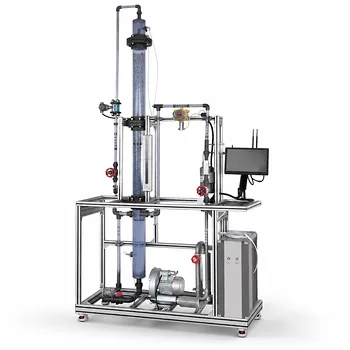
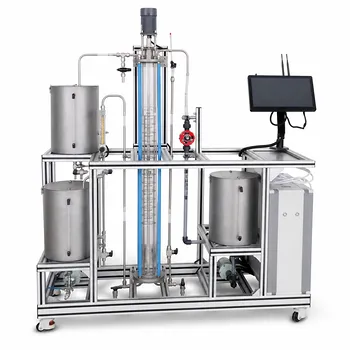
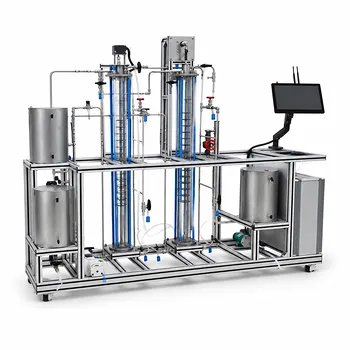
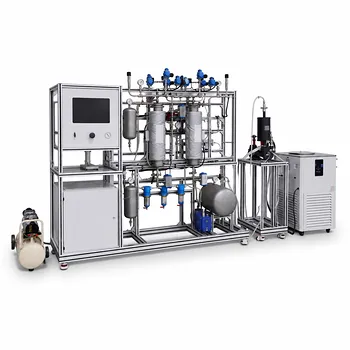
Are you looking to streamline your experimental modeling and scale-up processes? LABPARK provides premium Educational and Vocational Unit Operations Pilot Plants in chemical engineering, bioprocess & biotech, and environmental & water treatment. Built for universities, research institutes, and enterprises, our equipment delivers the precision and reliability you need to master complex fluid dynamics and reaction kinetics.
Contact us today to discuss your pilot plant requirements!
Related Products
- Packed Bed Absorption Educational Unit Operations Pilot Plant
- Educational Rotary Disc Liquid-Liquid Extraction Pilot Plant
- Comprehensive Liquid-Liquid Extraction Pilot Plant for Engineering Education
- Bench Scale Dual Column Gas Separation and Capture Educational Pilot Plant
- Absorption and Desorption Educational Unit Operations Pilot Plant
People Also Ask
- How Do Flow Regimes Transition in Packed Bed Pilot Plants? Key Scale-up Insights
- How does reactant concentration determine absorption column control? Gas-film vs. dual-film.
- How is the packing height of an absorption column calculated? Master HTU & NTU Concepts
- How does static vs. operating holdup affect pilot plant calibration? Avoid Critical Scale-Up Errors
- Why is counter-current flow selected for gas absorption? Maximize Pilot Plant Efficiency