The diameter of a microfluidic channel is the single most critical geometric parameter governing mixing performance. Reducing the channel diameter of a mixing tee—for example, from 254 µm to 100 µm—dramatically improves mixing at a given Reynolds number. This is because smaller channels shrink the distance molecules must travel and amplify the surface-to-volume ratio, both of which accelerate mass transfer.
Understanding how channel diameter influences mixing is central to teaching process intensification in chemical engineering pilot plants. However, the compelling gains in mass transfer are balanced by real-world limitations in pressure containment, sealing, and fabrication. The true educational value lies in demonstrating both the scientific principle and the engineering trade-offs it demands.
The Fundamental Science: How Diameter Drives Mixing
Smaller channels transform mixing by altering two transport mechanisms simultaneously.
Shortening the Diffusion Path
At the microscale, mixing is dominated by laminar flow. Without turbulence, molecules must mix through diffusion alone. The diffusion time scales with the square of the distance—so halving the channel width can reduce mixing time by a factor of four. When student pilot plants reduce a mixing tee from 254 µm to 100 µm, the diffusion path length shrinks by more than half, leading to visibly faster homogenization.
Enhancing Surface-to-Volume Ratio
A smaller diameter also boosts the surface area available for interaction relative to the fluid volume. This amplification enables more efficient mass transfer between fluid layers. It’s a powerful demonstration of a first-principles transport phenomenon that underpins micro-reactor design.
Relating to Reynolds Number and Flow Regime
Crucially, the improvement occurs at a constant Reynolds number. This means the mixing upgrade is not due to a change in flow regime (turbulent vs. laminar) but purely a geometric effect. For students, decoupling these variables reinforces the core concept that scale-down alone can achieve process intensification, without always requiring higher velocities.
Teaching the Principle in a Pilot Plant Setting
Translating this science into an educational pilot plant yields rich learning opportunities.
Demonstrating Process Intensification Visually
Running side-by-side experiments with 254 µm and 100 µm tees under identical flow conditions makes the diffusion principle tangible. Observing the vastly different mixing lengths directly links textbook transport theory to a physical, scaled-down system.
Using Student Experiments with Mixing Tees
Simple mixing tee setups allow students to control one variable—channel diameter—while measuring outlet concentration uniformity. This builds a hands-on appreciation for how micron-level changes can transform reactor performance, a lesson that’s far more memorable than a simulation alone.
Challenges and Trade-offs of Ultra-Small Channels
The same reduction that boosts mixing introduces severe engineering constraints. Ignoring these in a pilot plant would be a disservice to a thorough education.
Pressure Drop and Pumping Requirements
Halving the diameter quadruples the pressure drop for the same flow rate due to the Hagen–Poiseuille relationship. Pumps that easily drive flow through a 254 µm channel may stall or become dangerously over-pressurized when connected to a 100 µm line, demanding careful pump selection and energy-balance calculations.
Sealing Integrity and High-Pressure Failure
Extremely small channels, such as 100 µm, become prone to sealing failures under high-pressure pump operations. The tiny sealing surfaces are unforgiving of any misalignment or debris, leading to leaks that can ruin an experiment and risk safety. This is a non-negotiable teaching point about the mechanical limitations of micro-scale systems.
Flow Maldistribution and Blockage Sensitivity
Microchannels manufactured through etching or milling have finite dimensional tolerances. When channels shrink, blockages or small manufacturing variances cause disproportionate flow maldistribution across parallel plates. Resistance network models, often used in pilot plant analysis, show that a single blocked 100 µm channel can reroute flow catastrophically, compromising mixing uniformity and heat transfer.
Fabrication Tolerances and Costs
Achieving precise, repeatable dimensions below 150 µm requires costly fabrication methods and stringent quality control. For an educational pilot plant that must endure repeated assembly and cleaning, fragile, ultra-narrow channels may not survive a full semester of student use.
Smart Compromises for Reliable Pilot Plant Operation
Real-world pilot plants rarely adopt the absolute best mixing geometry. Instead, they balance performance with durability.
The 177 µm “Sweet Spot”
A channel diameter of around 177 µm often represents a pragmatic compromise. It still delivers a substantial reduction in diffusion path length compared to 254 µm, but offers dramatically better pressure containment and sealing reliability than 100 µm. For a teaching lab, this size can withstand typical pump pressures while still clearly demonstrating the mixing-size relationship.
Augmenting with Ultrasound Energy
Integrating ultrasound energy transforms the mixing physics. For a 254 µm channel, ultrasound can slash mixing time from 1400 µs to 240 µs; for 177 µm, it can plunge to 70 µs. This active mixing aid lets you achieve 100‑µm‑equivalent mixing performance without crossing the dangerous pressure-containment threshold. It also brings process intensification into a realm students can hear and measure.
Leveraging Geometric Enhancements (Zigzag, Wave-line)
Rather than pushing diameter to the extreme, you can introduce transverse velocity components through zigzag or wave-line channel shapes. These geometries reduce the effective mixing length by disrupting the laminar boundary layer, achieving mixing enhancement without the full pressure-drop penalty of a smaller straight channel. They also open the door to discussions on secondary flows and Dean vortices.
Practical Integration into Educational Curricula
The mixing–diameter relationship extends beyond a single tee. It serves as a gateway to broader chemical engineering competencies.
Modeling Flow Distribution with Resistance Networks
Pilot plants can incorporate resistance network models to simulate how blockages or diameter variations alter flow across multiple channels. Students learn to treat microchannels like branches in an electrical circuit, gaining a systems-level view of maldistribution and its impact on mixing performance.
Connecting Micro-scale to Macro-scale Transport Line Sizing
The diameter selection logic for microfluidic mixing tees mirrors the macro-scale pipe sizing exercises students perform for pilot plant transport lines. Both require balancing capital cost, pressure drop, and process efficiency. Demonstrating this continuity from micro-channels to 3-inch Schedule 40 pipe reinforces the universality of transport principles.
Making the Right Choice for Your Educational Pilot Plant
Your channel diameter decision depends on what you most want to teach.
- If your primary focus is demonstrating the core principle of diffusion path length reduction: Use a 100 µm tee in a short, low-pressure demonstration run, and carefully explain the pressure-drop and sealing risks.
- If your primary focus is running robust, repeatable student experiments over many cycles: Adopt the 177 µm “sweet spot” mixed with ultrasound, showcasing mixing times competitive with smaller channels while maintaining system integrity.
- If your primary focus is teaching advanced reactor design under real-world constraints: Include both 254 µm and 177 µm modules, and add zigzag vs. straight channel comparisons, requiring students to calculate the pressure-energy trade-offs for each.
- If your primary focus is integrating hands-on flow maldistribution or blockage analysis: Build a multi-channel plate and use resistance network models to quantify how a partial blockage in one narrow channel disrupts overall mixing uniformity.
A well-designed educational pilot plant doesn’t just chase the smallest diameter; it uses the diameter choice to illuminate the full engineering picture—where faster mixing must always be tempered by the realities of pressure, sealing, and reliability.
Summary Table:
| Channel Diameter | Mixing Performance | Pressure Drop & Sealing Risk | Ideal Educational Use Case |
|---|---|---|---|
| 100 µm | Excellent (Fast diffusion) | Very High (Prone to leaks/blockages) | Short, low-pressure theory demonstrations |
| 177 µm | High (Optimal balance) | Moderate (Reliable operation) | Standard multi-cycle hands-on lab courses |
| 254 µm | Moderate (Slower diffusion) | Low (Highly robust) | Baseline testing and active mixing experiments |
Elevate Your Teaching Lab with LABPARK
Bring advanced transport phenomena to life. LABPARK provides high-quality Educational and Vocational Unit Operations Pilot Plants in chemical engineering, bioprocess & biotech, and environmental & water treatment designed specifically for universities, research institutes, and enterprises.
By partnering with us, you benefit from:
- Robust Engineering: Systems built to withstand student operation while demonstrating critical trade-offs like pressure drop and sealing limits.
- Advanced Teaching Modules: Seamlessly integrate microfluidic unit operations, active acoustic mixing, and flow distribution modeling.
- Customized Solutions: Tailored equipment configurations that align directly with your curriculum and research goals.
Contact our engineering experts today to discover how LABPARK can transform your laboratory training!
Related Products
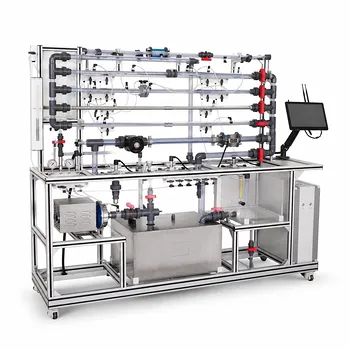
- Multi Pump Fluid Transport Process Piping Unit Operations Training Pilot Plant
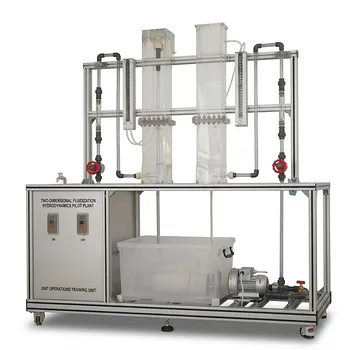
- Two-Dimensional Fluidization Hydrodynamics Educational Pilot Plant for Unit Operations Training
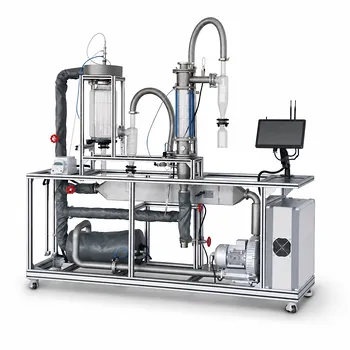
- Multi-Reactor Educational Pilot Plant for Reaction Engineering Unit Operations
- Multi-Functional Drying Educational Unit Operations Pilot Plant
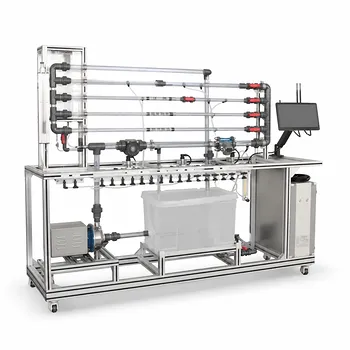
- Comprehensive Fluid Mechanics Educational Unit Operations Pilot Plant
People Also Ask
- Why distinguish Newtonian & non-Newtonian fluids in pilot plants? Prevent design errors.
- Why is the chemical plant startup schedule crucial? De-risk scale-up with pilot plants.
- When to transition from PID to adaptive control in pilot plants? Key process indicators.
- Why Use PTFE & Hastelloy in Chemical Pilot Plants? Prevent Corrosion & Ensure Safety
- How to study gasification in pilot plants? Compare exit gas composition & efficiency