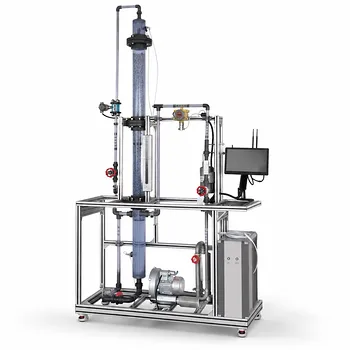
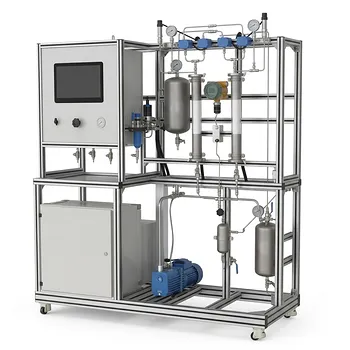
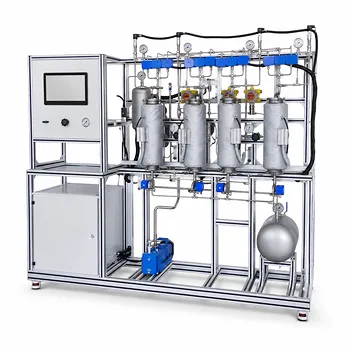
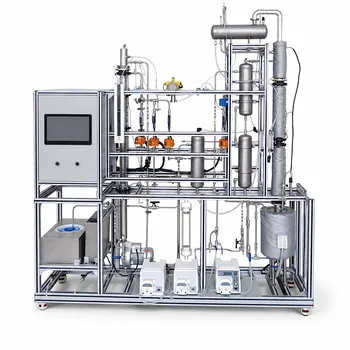
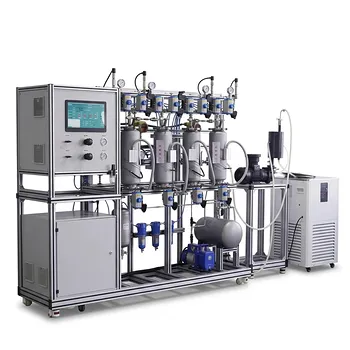
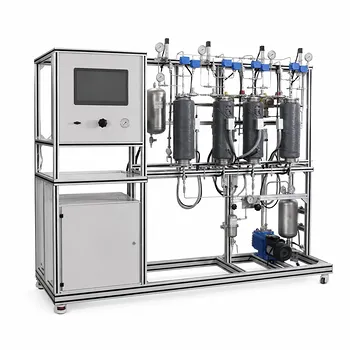
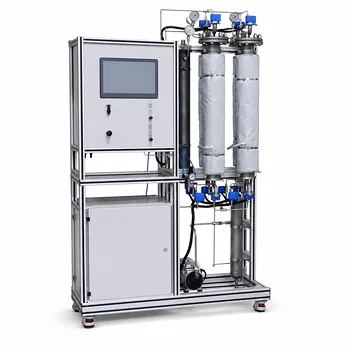
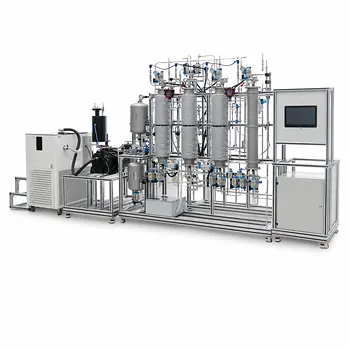
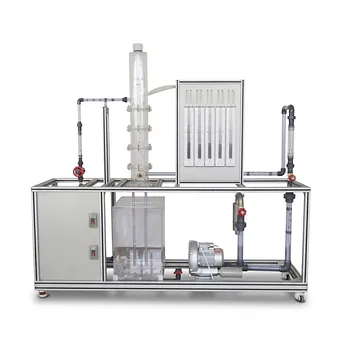
A packed column gas absorption pilot plant turns abstract chemical engineering theory into a hands-on investigation of industrial pollution control. In a university laboratory, this apparatus allows students to directly manipulate gas and liquid flow rates, solvent concentrations, and packing types while measuring absorption efficiency. It visibly demonstrates the core phenomena of chemical absorption and environmental scrubbing—including mass transfer, reaction kinetics, column flooding, and pressure drop—making the principles that drive full-scale wet scrubbers and carbon capture plants both tangible and quantifiable.
The pilot plant bridges the gap between textbook equations and real equipment operation. By physically observing loading points, calculating mass transfer coefficients, and comparing physical versus chemical absorption, students gain a visceral understanding of how industrial gas cleaning systems are designed, optimized, and trouble-shot.
How the Packed Column Enables Mass Transfer
Maximizing Contact Area with Structured Packing
The column is filled with packing material—random or structured elements like Raschig rings or structured mesh. These create a vast gas-liquid interface surface area without requiring a large vessel volume. The liquid absorbent trickles downward as a thin film over the packing, while the gas rises counter-currently. This arrangement maximizes the rate at which a solute can move from the gas phase into the liquid, governed by the driving force (concentration difference) and the available transfer area.
Counter-Current Flow and Concentration Gradients
The pilot plant operates with the gas flowing upward and the liquid flowing downward. This counter-current design ensures that the gas with the highest solute concentration contacts the liquid that is least saturated with the solute at the bottom, and the cleaned gas exits the top against the fresh, solute-free absorbent. Students can measure inlet and outlet concentrations to verify that a steeper overall concentration gradient dramatically improves removal efficiency—a concept that also explains why single-stage separations are often insufficient.
Chemical Absorption vs. Physical Scrubbing
Reaction Kinetics Shut Down Back-Pressure
Physical absorption depends solely on solubility: a solute like CO₂ dissolves into water until equilibrium is reached, governed by Henry’s Law. Chemical absorption introduces a rapid, irreversible reaction that instantly consumes the dissolved solute in the liquid phase. The pilot plant demonstrates this by using a dilute sodium hydroxide (NaOH) solution to scrub an acid gas. Because the acid reacts immediately to form a salt, the concentration of the free solute in the liquid film drops nearly to zero. This eliminates the back-pressure that would otherwise push the solute back into the gas, enabling near-complete removal even at much lower liquid flow rates.
Comparing the Two Modes Experimentally
A well-designed pilot plant allows students to switch between a pure water system (physical absorption) and a reactive solvent (chemical absorption). By plotting the amount of gas absorbed versus the gas flow rate or solvent flow rate, the data reveals a striking difference: chemical systems maintain high efficiency over a wider range of conditions, whereas physical systems plateau quickly once solubility limits are approached. This side-by-side comparison reinforces why industrial flue gas desulfurization units or amine-based CO₂ scrubbers rely on chemical reactions rather than simple dissolution.
Operational Boundaries: Flooding, Loading, and Pressure Drop
Visualizing the Loading Point and Column Flooding
A critical lesson the pilot plant teaches is hydraulic limits. As gas velocity is increased, a pressure drop across the packing bed naturally rises—but suddenly begins to spike. This marks the loading point, where gas starts to hold back the downward liquid flow. If the gas rate is pushed further, the column floods: liquid pools at the top and gas bubbles violently through a froth. The pilot plant’s transparent column or differential pressure manometer makes this transition unmistakable. Students learn to identify the operating window below the loading point where the column operates stably and mass transfer is most efficient.
Measuring Pressure Drop and Blower Power
A U-tube or digital manometer connected across the packing shows the real-time pressure drop. Data collected at varying gas rates produce a pressure drop curve that mirrors classical design correlations. From these measurements, students can compute the required blower pumping power, directly connecting fluid dynamics to energy cost—a genuine industrial design trade-off.
Bridging the Lab to the Industrial Scrubber
Scaling Principles: HTU, NTU, and Packing Height
The pilot plant brings the design equation Z = H_G × N_G to life. By measuring inlet and outlet concentrations, students compute the Number of Transfer Units (N_TU), a measure of separation difficulty. The Height of a Transfer Unit (H_TU) is determined experimentally from the packed height and NTU. Manipulating liquid-to-gas ratios and observing the corresponding change in H_TU reveals how packing geometry and flow conditions affect mass transfer efficiency—the exact data an engineer would use to size a full-scale column.
Modularity and Multi-Stage Scrubbing
Some pilot plants feature two columns in series or adjustable bed heights. This modularity shows that increasing the contact volume or number of theoretical stages directly boosts capture—simulating how industrial NOx recovery or acid gas removal uses multiple packed sections to meet emissions limits. The measurable reduction of outlet concentration after a second column provides a clear, quantitative lesson in the benefit of staging.
Understanding the Trade-offs and Common Pitfalls
-
Scaling Down Masks Some Real-World Complexities. Lab systems often use harmless solutes (CO₂/N₂ with water or dilute NaOH) to avoid toxic gases. While safe, this sacrifices the nuanced influence of high-temperature corrosion, fouling, or complex solution chemistry (e.g., amine degradation) that dictate industrial maintenance and solvent selection.
-
Packing Selection Is a Lab-Specific Art. Small columns are prone to channeling and uneven liquid distribution if packing isn’t installed carefully. The ideal packing for a 4-inch diameter pilot column may behave very differently from a 3-foot diameter industrial unit, so students must recognize that scalе-up factors (like liquid distributors) are often more critical than the packing choice itself.
-
The Obviousness of Flooding Hides Subtle Inefficiency. Students learn to avoid total flooding, but the real danger in a plant is prolonged operation near the loading point, where a small control upset can trigger flooding. The pilot plant’s clarity may give a false sense of safety; operators must appreciate that the system must run with a safety margin below the loading point, not just below the flood point.
-
Chemical Absorption Creates its Own Waste. Demonstrating chemical scrubbing with NaOH is elegant, but it produces a salt-laden liquid effluent. This directly connects to the reality that every scrubber is also a wastewater generator—a lesson reinforced by supplementary pilot plants that treat the contaminated blowdown via gravity separation or stripping, as seen in full-scale gas liquor treatment.
Making the Right Choice for Your Lab Learning Objectives
The pilot plant is a versatile teaching tool; how you run it should match what you want to convey.
-
If your primary focus is mass transfer fundamentals: Operate with a simple CO₂-water system and measure the change in concentration with varying gas rates to experimentally determine the overall mass transfer coefficient and NTU. Focus on comparing correlations, not on achieving the highest removal.
-
If your primary focus is industrial scrubber design: Use a reactive solvent (dilute NaOH) and map the flooding curve. Run at a constant liquid load and incrementally increase gas flow to identify loading and flooding, then calculate the required blower power. This teaches safe operational limits and energy optimization.
-
If your primary focus is environmental impact: Connect two columns in series and demonstrate the nonlinear improvement in removal efficiency. Complement the absorption run with a simple stripping or wastewater treatment step to show that the cleaned gas is only one part of a circular process—the spent solvent also demands management.
-
If your primary focus is visualizing reaction kinetics: Compare physical versus chemical absorption side-by-side, holding all other variables constant. The dramatic difference in outlet concentrations makes the concept of mass transfer enhancement by chemical reaction impossible to dismiss.
A packed column gas absorption pilot plant does more than demonstrate a unit operation—it compresses the entire problem space of industrial air pollution control into a single bench-scale ecosystem, equipping the next generation of engineers to think in terms of fundamentals, limits, and system-level consequences.
Summary Table:
| Operational Parameter | Physical Absorption | Chemical Absorption |
|---|---|---|
| Driving Force | Solubility limits (Henry's Law) | Rapid chemical reaction |
| Solute Removal | Plateaus quickly as saturation nears | High efficiency (near-complete removal) |
| Typical Solvent | Pure water | Dilute NaOH or amine solutions |
| Liquid Flow Rate | Requires higher rates for same target | Effective at lower flow rates |
Elevate Your Engineering Lab with LABPARK
Are you looking to bridge the gap between textbook theory and hands-on industrial practice? LABPARK provides state-of-the-art Educational and Vocational Unit Operations Pilot Plants in chemical engineering, bioprocess & biotech, and environmental & water treatment for universities, research institutes, and enterprises.
Bring complex mass transfer and environmental scrubbing principles to life with our high-quality, modular pilot plants. Contact our team today to discuss your lab requirements and receive a customized proposal!
Related Products
- Packed Bed Absorption Educational Unit Operations Pilot Plant
- Absorption and Desorption Educational Unit Operations Pilot Plant
- Multimodal Absorption and Desorption Pilot Plant for Unit Operations Training
- Bench Scale Dual Column Gas Separation and Capture Educational Pilot Plant
- Pressure Swing Adsorption Educational Unit Operations Pilot Plant
People Also Ask
- How Do Flow Regimes Transition in Packed Bed Pilot Plants? Key Scale-up Insights
- How does reactant concentration determine absorption column control? Gas-film vs. dual-film.
- How is the packing height of an absorption column calculated? Master HTU & NTU Concepts
- How does the wall effect impact packed-bed conversion? Essential pilot plant scale-up tips.
- How does static vs. operating holdup affect pilot plant calibration? Avoid Critical Scale-Up Errors