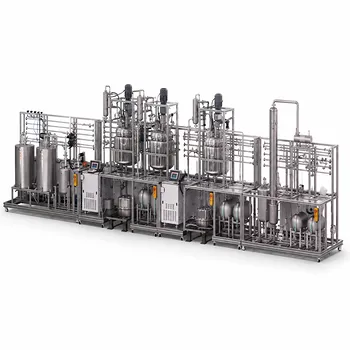
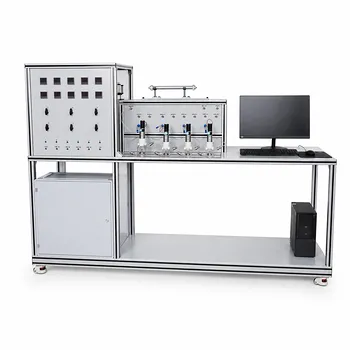
A modular pilot plant is not a single machine; it’s an experimental toolkit.
A modular structure splits the reactor unit into distinct, swappable blocks—gas feed, liquid feed, manifold, reactor, heater, effluent, and analytical modules. This design allows researchers to independently control process parameters across subsections, reconfigure flow paths for different reaction types, and integrate diverse sampling strategies without rebuilding the plant. The result is a single pilot platform that can shift rapidly from catalyst screening to process optimization, and from batch compounding to continuous micro‑reaction, maximizing the value of every square foot of lab space.
A modular architecture decouples the fixed plant from the fluid experiment. By treating each unit operation as a plug‑and‑play component, teams can reconfigure hardware, adjust control strategies, and swap analytical tools in hours rather than months—turning the pilot plant into a true experimental variable, not a constant.
The Anatomy of a Modular Reactor System
Modular flexibility starts with a clean separation of functions. Instead of a monolithic reactor skid, the system is built from purpose‑designed modules that connect via standard interfaces.
The Core Building Blocks
A typical modular setup includes a Gas Feed Module and Liquid Feed Module for precise reactant delivery, a Manifold Module to distribute streams, and a Reactor Module that houses the catalyst or reaction zone.
A dedicated Heater Module handles temperature control, while the Effluent Module manages downstream flow. Analytical Modules (such as a mass spectrometer or gas chromatograph) plug directly into the product stream, and an Automation/Informatics Module synchronizes control and data logging.
Why Physical Separation Matters
When each function lives in its own module, a change in one part of the process doesn’t ripple through the entire plant.
You can upgrade a heater module to reach higher temperatures without redesigning the feed system. You can swap a packed‑bed reactor for a micro‑reactor without disturbing the analytical chain.
This isolation of change is what transforms a static installation into a flexible research platform.
How Modularity Enables Experimental Versatility
The surface benefit is reconfiguration. The deep benefit is that modularity lets you treat the plant itself as an experimental variable—something you can adjust to probe different scientific questions or educational scenarios.
Independent Control of Process Subsections
A single manifold can feed a large reactor matrix while dividing it into independently controlled subsections.
In a 48‑reactor screening array, for example, you might split the system into six blocks of eight reactors. Each block can run at a different pressure or feed composition, all from the same master fluid delivery system.
This means a single experimental campaign can explore a full factorial design without duplicating the entire plant.
Reconfigurable Flow Paths for Different Reaction Types
When studying multi‑bed adiabatic systems, the pilot plant can be rearranged to link separate reactor stages through external inter‑bed heat exchangers or waste‑heat boilers.
To demonstrate internal‑cooling loops, the same set of modules can be plumbed to inject quench gas directly between catalyst beds inside a single reactor column.
Students and researchers can compare heat recovery configurations, temperature profiles, and conversion efficiencies in real time, all with the same base hardware.
Adaptable Sampling and Analytical Strategies
Modular analytical modules let you choose the best detection method for each experiment.
You can route an effluent stream to a gas chromatograph for detailed component breakdown in one run, then switch to a mass spectrometer for high‑speed transient measurement in the next.
This plug‑and‑play approach eliminates the need for permanent multi‑instrument installations and ensures that the analytical detail matches the experimental question.
Rapid Screening and Process Optimization
When the goal is to find a lead catalyst or a winning set of conditions, speed matters.
A modular system that combines micro‑reactor modules, continuous flow paths, and integrated analytics enables the same hardware to perform high‑throughput screening one week and detailed kinetic modeling the next.
Because micro‑reactors possess exceptionally high heat and mass transfer rates, reactions that would require cryogenic batch cooling (down to –60°C) can be run safely at ambient temperature, slashing energy costs and safety risks while gathering data faster.
Bridging the Gap Between Lab and Plant: Educational and Research Benefits
Modularity doesn’t just serve the experiment—it serves the people running it. Pre‑designed, validated modules simplify deployment, training, and the demonstration of real‑world process trade‑offs.
Minimizing Engineering Downtime
Building a custom pilot plant typically demands heavy internal engineering support, even when using external EPC contractors.
Pre‑assembled modular units from a manufacturer arrive validated and ready to connect, so teams spend their time running experiments rather than commissioning equipment. Research groups and teaching labs with limited engineering staff can go from unboxing to meaningful data in days.
Teaching Multi‑Purpose Fine Chemical Operations
Fine chemical manufacturing relies on batch compounding, frequent grade changes, and stringent cleaning procedures.
With a modular pilot plant, trainees can practice batch recipe management, switching product formulations, and optimizing clean‑in‑place sequences exactly as they would in a commercial multi‑purpose plant. Each module swap reinforces the concept of flexible production layout.
Demonstrating Process Intensification
Integrating micro‑reactor modules into an otherwise conventional pilot plant makes the case for process intensification tangible.
Students see firsthand that reactions which normally require extreme cooling can be performed safely at ambient conditions, and they measure the resulting improvements in yield and purity. The lesson: smarter equipment can eliminate entire utility systems.
Understanding the Trade‑offs
No design decision is cost‑free. Modularity brings powerful flexibility, but it also demands a pragmatic assessment of limits.
- Higher upfront capital: Individual modules with robust, leak‑free connectors can cost more than a single integrated skid, especially when multiple reactor types are purchased at the outset.
- Interface complexity: Every connection between modules is a potential source of leakage, dead volume, or thermal inconsistency. Standardized, well‑engineered interfaces are essential; a poor connection can become the weak link in an otherwise precise experiment.
- Over‑modularization risk: For a highly repetitive, single‑purpose process, the ability to swap modules may go unused, making the extra flexibility an unnecessary expense.
- Control integration effort: Linking modules from different vendors—or adding home‑built components—can complicate automation and data synchronization. The Informatics Module must speak a common language across all blocks.
Acknowledging these trade‑offs ensures that modularity is applied where it delivers the most experimental value, rather than as a universal prescription.
Making the Right Choice for Your Experimental Goal
Select the modular configuration that matches the demands of your primary application. Below are pragmatic guideposts based on real‑world research and teaching scenarios.
- If your primary focus is high‑throughput catalyst screening: Choose a system with a manifold that divides a large reactor matrix into independently controlled subsections, and pair it with integrated gas chromatography or mass spectrometry for rapid sequential sampling.
- If your primary focus is comparing different reactor configurations (e.g., adiabatic multi‑bed vs. cold‑shot quench): Select modules that allow you to link reactor stages with external heat exchangers or integrate internal quench injection lines, so you can swap topologies without rebuilding the plant.
- If your primary focus is teaching unit operations and multi‑purpose batch processing: Prioritize pre‑validated, plug‑and‑play modules that minimize setup time and let students practice formulation changes, cleaning protocols, and flexible production layouts.
- If your primary focus is process intensification and safety: Integrate continuous micro‑reactor modules to run exothermic or hazardous reactions under ambient conditions, cutting energy costs, chemical inventory, and risk.
Modularity turns your pilot plant from a fixed tool into an adjustable lens—so you never have to change the whole system just to change the experiment.
Summary Table:
| Module Type | Core Function | Key Experimental Benefit |
|---|---|---|
| Feed & Manifold | Delivers and distributes reactants | Independent control of flow, pressure, and composition |
| Reactor & Heater | Thermal control & reaction zone | Rapid swapping of reactor types (e.g., batch to continuous) |
| Effluent & Analytical | Downstream processing & testing | Plug-and-play integration of GC, MS, and other sensors |
| Automation/Informatics | System-wide control & data logging | Seamless run synchronization and simplified recipe management |
Scale Your Research and Training with LABPARK
Maximize your laboratory's capabilities with LABPARK. We provide state-of-the-art Educational and Vocational Unit Operations Pilot Plants across chemical engineering, bioprocess & biotech, and environmental & water treatment sectors.
Designed specifically for universities, research institutes, and enterprises, our modular systems empower your teams to minimize setup times, easily reconfigure experimental setups, and demonstrate real-world chemical processes safely.
Ready to transform your lab? Contact LABPARK today to find the perfect modular pilot plant configuration for your goals!
Related Products
- Multi-Reactor Educational Pilot Plant for Reaction Engineering Unit Operations
- Tubular Reactor Flow Characteristics Determination Educational Unit Operations Pilot Plant
- Natural Product Extraction Unit Operations Training Pilot Plant
- Ethyl Acetate Synthesis Unit Operations Pilot Plant for Practical Training
- Fixed Bed Gas Solid Catalytic Reaction Educational Pilot Plant
People Also Ask
- How do educational unit operations pilot plants address safety and waste management when scaling up?
- How do educational unit operations pilot plants bridge theory and design? Bridge the Engineering Gap
- Why Compare Predicted and Experimental Excess Enthalpy? Key to Accurate Pilot Plant Scale-up
- Why Use PTFE & Hastelloy in Chemical Pilot Plants? Prevent Corrosion & Ensure Safety
- How to study gasification in pilot plants? Compare exit gas composition & efficiency