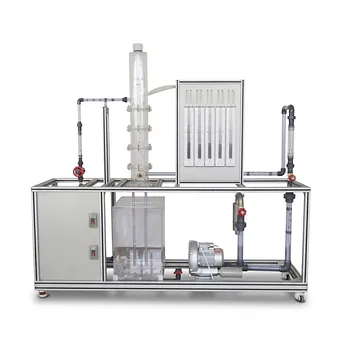
Surface chemistry is the key. A flotation cell achieves separation by exploiting the natural or induced differences in the water-repelling (hydrophobic) character of solid particles. Air is injected into a continuously stirred slurry, and hydrophobic particles selectively cling to the ascending air bubbles. They rise as a particle-laden froth that overflows for recovery, while hydrophilic particles remain behind in the pulp and are removed as tailings.
Flotation isn't about density or magnetism—it's about making one type of particle act like a water-hating bubble rider while everything else stays submerged. Pilot plants demonstrate this by letting you intentionally manipulate surface chemistry, then watch the separation happen in real time.
The Core Principle: Controlled Incompatibility
Making Particles Hydrophobic
The starting point is a slurry of finely ground solids (typically 50–400 μm). In their natural state, most minerals and contaminants are hydrophilic—they attract water and will not float. To drive separation, you add a chemical surfactant called a collector. The collector’s molecules have one end that selectively adsorbs onto the target particle’s surface, leaving the other, water-repellent end exposed. This transforms the target’s surface from water-loving to water-hating.
Bubble Attachment and the Three-Phase Contact
Once air is introduced through spargers or an impeller, millions of tiny bubbles form. A hydrophobic particle can only attach to a bubble if it can displace the thin water film between them, creating a stable three-phase contact (solid–liquid–gas). Hydrophilic particles cannot achieve this; the water film remains intact, and they stay suspended. This is the fundamental separation mechanism.
Froth Zone: The Second Stage of Selectivity
The bubble–particle aggregate floats upward into the froth layer. Here, weakly attached or entrapped gangue particles can drain back into the pulp with the draining water, a process called froth drainage. The quality of this second cleaning stage depends heavily on the frother chemical—a surfactant that stabilizes the bubbles, controls froth height, and manages drainage time.
How Pilot Plants Bring the Process to Life
From Textbook to Turbulence
In a pilot plant, a flotation cell is not a black box. You can vary aeration rates, impeller speed, and the precise dosage of collectors and frothers. Each change shows a direct cause-and-effect relationship: increase the collector too much, and you may float everything (loss of selectivity); use too little frother, and the bubbles coalesce prematurely, dropping their valuable load. The pilot cell makes the invisible surface interactions visible through froth behavior and recovery rates.
Mineral Processing Demonstrations
A classic educational setup uses a simple ore—like a synthetic mixture of quartz and galena—to demonstrate mineral concentration. By adding a xanthate collector that specifically targets galena, students see a metallic grey froth loaded with lead sulfide, while the clean quartz sand remains in the cell. Adjusting the aeration rate and froth depth directly impacts the grade–recovery curve, teaching the fundamental optimization tension between purity and total metal captured.
Environmental Remediation Applications
For industrial wastewater treatment, the same cell is used with a different collector system. Flocculants or precipitated air are employed to remove emulsified oils, heavy metal precipitates, or microplastics. The pilot demonstration might treat a sample of oily wastewater; the resulting froth is a concentrated, floating sludge that can be skimmed off, leaving clarified water. Here, the key variable is often the bubble size—finer bubbles provide a larger total surface area for capturing dilute contaminants.
Understanding the Trade-offs
The Inevitable Entrainment Problem
No froth is 100% pure. Fine hydrophilic particles can be mechanically carried upward by the water between bubbles, a phenomenon called entrainment. In pilot trials, you’ll see recovery increase with aeration, but so does entrainment, leading to a dirtier concentrate. The lesson: faster floating often means a less selective separation.
Chemistry Overdoes It
Adding more collector is not a free path to higher recovery. Beyond a certain concentration, the collector can form a second layer on the particle surface, making it hydrophilic again, or it can coat all particles non-selectively. Pilot plant experiments often include an exercise in finding the “critical micelle concentration” effect, where recovery plateaus and then falls.
The Bubble Size Dilemma
Smaller bubbles are great for capturing ultrafine particles but rise slowly, reducing the cell’s throughput capacity. Larger bubbles increase capacity but can miss the smallest particles. The pilot plant teaches that there is no single correct setting—only the right balance for your specific feed particle size distribution.
Making the Most of Your Pilot Plant Trial
The flotation cell is a perfect sandbox for testing how theory meets messy reality. To get actionable insights, align your experiments with your primary goal.
- If your primary focus is maximizing recovery of a valuable mineral: Push the collector dosage and aeration rate, but constantly monitor froth drainage and entrainment. The true upper limit is where the incremental gain in recovery is wiped out by the loss of concentrate grade.
- If your primary focus is producing an ultra-clean effluent for environmental discharge: Prioritize fine bubble generation and long froth residence time. Use a weak frother to keep the froth layer shallow and wet, maximizing the drainage of any mechanically entrained contaminants before the froth is removed.
- If your primary focus is understanding the fundamental chemistry: Start with a simple, two-mineral system, and vary only one chemical (collector pH, for example) at a time. Measure contact angle or bubble attachment probability directly if possible, and use the froth appearance (bubble size, color, stability) as a qualitative indicator of the surface state.
Trust the froth—it is the oldest and most honest sensor in the plant.
Summary Table:
| Key Component | Separation Mechanism & Role | Pilot Plant Demonstration & Optimization |
|---|---|---|
| Collector | Renders target particles hydrophobic | Manipulating chemical dosage to balance recovery and grade |
| Air Bubbles | Attach to hydrophobic particles to lift them | Varying bubble size to match feed particle size distribution |
| Froth Zone | Enables drainage of entrained contaminants | Adjusting frother levels and froth depth to control purity |
Bring Hands-On Separation Chemistry to Your Lab
To master complex separation processes like flotation, you need hands-on experience. LABPARK provides premium Educational and Vocational Unit Operations Pilot Plants in chemical engineering, bioprocess & biotech, and environmental & water treatment. Specifically tailored for universities, research institutes, and enterprises, our systems turn abstract surface chemistry into observable, real-world data.
Take your research and training to the next level—contact LABPARK today to find the ideal pilot plant solution for your facility!
Related Products
- Constant Pressure Filtration Educational Unit Operations Pilot Plant
- Centrifugal Pump Performance and Orifice Flowmeter Calibration Educational Pilot Plant
- Rising and Falling Film Evaporation Educational Unit Operations Pilot Plant
- Two-Dimensional Fluidization Hydrodynamics Educational Pilot Plant for Unit Operations Training
- Educational Rotary Disc Liquid-Liquid Extraction Pilot Plant
People Also Ask
- How do educational unit operations pilot plants bridge theory and design? Bridge the Engineering Gap
- How do educational unit operations pilot plants bridge theory and industrial process development? Hands-On Learning
- How do educational unit operations pilot plants address safety and waste management when scaling up?
- How do unit operation requirements differ between traditional chemical processes and bioprocesses? Build Better Pilot Plant Curricula
- Why splitting a filtration batch doesn't always reduce cycle time? Pilot Plant Insights