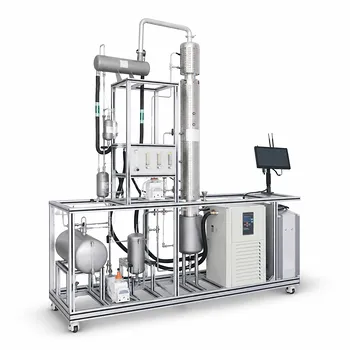
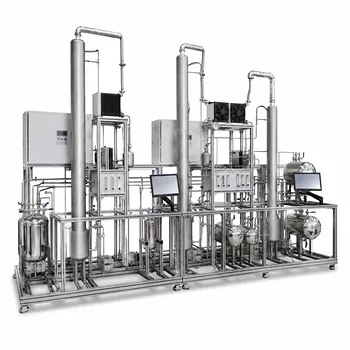
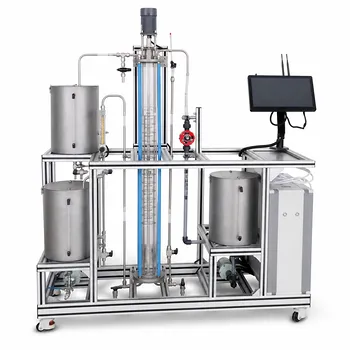
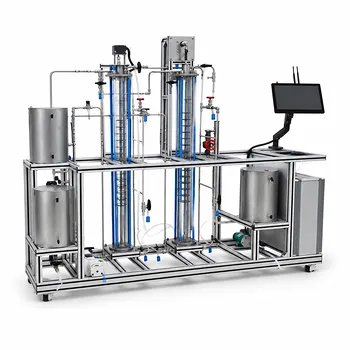
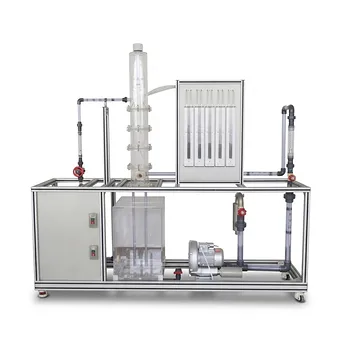
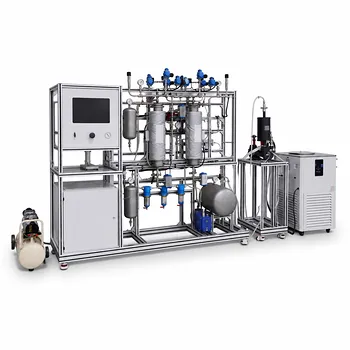
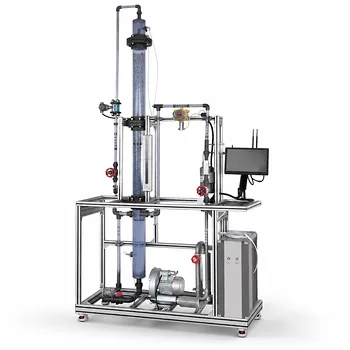
At its core, distillation is a game of escaped tendencies. A distillation column pilot plant separates liquid mixtures by exploiting the inherent differences in component volatility. When heat is applied, the more volatile (lighter) components preferentially vaporize and rise to the top of the column, where they are condensed as the overhead product. Simultaneously, less volatile (heavier) components remain largely in the liquid phase and are drawn off at the bottom. This controlled manipulation of vapor-liquid equilibrium allows the pilot plant to physically demonstrate the fundamental principles that govern industrial-scale separation.
The entire separation hinges on relative volatility, the ratio of vapor pressures between components. A pilot column makes this abstract thermodynamic concept tangible by showing how repeated vaporization–condensation steps multiply the effect of even small volatility differences, turning a theoretical possibility into a high-purity reality.
The Fundamental Principle: Relative Volatility and Vapor-Liquid Equilibrium
A pilot plant’s ability to separate depends entirely on how a mixture’s components distribute themselves between liquid and vapor phases. This distribution is quantified by relative volatility, which determines both the feasibility and the difficulty of the separation.
What is Relative Volatility?
Relative volatility ($\alpha$) compares the tendency of one component to vaporize versus another. For two components A and B in an ideal solution, it simplifies to the ratio of their pure-component vapor pressures: $\alpha = p_A^0 / p_B^0$.
When $\alpha$ is significantly greater than 1, the more volatile component A concentrates powerfully in the vapor. If $\alpha = 1$, the vapor and liquid have identical compositions, and ordinary distillation cannot separate them. This is the hallmark of an azeotrope.
How VLE Drives Separation in a Single Stage
Inside the column, each point of contact between rising vapor and descending liquid is a theoretical equilibrium stage. On a single tray or across a packing element, volatile components migrate from the liquid into the vapor, while less volatile ones condense from the vapor into the liquid.
This exchange repeats at every stage. The pilot plant’s temperature and pressure conditions directly influence the equilibrium compositions, giving students a live demonstration of vapor-liquid equilibrium (VLE) and mass transfer in action.
The Fractional Distillation Process: Multiplying Separation Efficiency
Simple boiling enriches a vapor only once. Fractional distillation stacks multiple equilibrium stages to achieve high purities—exactly what a pilot column is designed to demonstrate.
The Step-by-Step Enrichment in a Pilot Column
Consider a classic benzene–toluene mixture. Heat it in the reboiler: the first vapor might contain only 54% benzene. But as that vapor rises to the first tray, it partially condenses, releasing a liquid richer in toluene while the remaining vapor grows richer in benzene.
At the second tray, the vapor composition can leap to 76% benzene. After just a third equilibrium contact, it may exceed 97%. The fractionating column continuously returns the heavier residue downward while delivering almost pure volatile vapor to the overhead condenser.
What the Pilot Plant Teaches About Tray and Packing Efficiency
A pilot column’s height, tray count, or packing bed depth directly translates to the number of theoretical stages. By measuring actual compositions, students can calculate stage efficiency and see how reflux ratio—the portion of condensate returned to the column—controls product purity. Higher reflux typically yields better separation but demands more energy.
Beyond Simple Binary Splits: Batch Operation and Special Techniques
Many real-world mixtures defy straightforward continuous fractional distillation. Pilot plants expand education into these complex scenarios by configuring operations in batch mode or by adding auxiliary agents.
Batch Distillation: Separating Complex Mixtures Over Time
A single batch column can handle multi-component mixtures (ternary, quaternary) by exploiting the transient nature of the batch. After stabilizing under total reflux, product fractions are collected sequentially in order of increasing boiling points.
Transition cuts (intermediate fractions containing mixtures of two adjacent components) are drawn between high-purity product cuts and later recycled into subsequent batches. This teaches students how to determine cut-times based on column top-temperature changes and how fraction collection logistics and recycle loops operate in chemical plants.
Steam Distillation: When Heat Sensitivity Demands Lower Temperatures
For heat-sensitive organic compounds, a pilot plant can introduce an immiscible vapor—typically steam—into the mixture. The steam reduces the partial pressure of the organic components, enabling the mixture to boil at a temperature well below the compound’s normal boiling point.
For example, a bromobenzene–water mixture boils at 95°C, whereas pure bromobenzene boils at 156°C. The pilot setup connects a steam generator to the heated vessel, routes the vapor to a condenser, and collects the phase-separated distillate. No thermal decomposition occurs, perfectly demonstrating the principle.
Extractive and Azeotropic Distillation: Breaking the Volatility Deadlock
When relative volatility is near 1—like acrylonitrile (77.3°C) and acetonitrile (81.6°C)—or when an azeotrope forms (ethanol–water), the pilot plant must employ special techniques.
Extractive distillation introduces a high-boiling solvent (often water) near the top of the column. The solvent selectively associates with the more soluble component (acetonitrile) and carries it to the bottom, while the purified other component (acrylonitrile) exits overhead or from a side stream. The solvent-to-feed ratio (e.g., 8:1 water-to-acrylonitrile) is a critical control parameter students learn to optimize.
Azeotropic distillation adds an entrainer (like benzene for ethanol–water) that forms a new, low-boiling azeotrope. The entrainer–water azeotrope distills off first, leaving dry ethanol behind. A pilot plant studying this requires precise temperature monitoring at multiple stages, multiple feed ports, and rigorous reflux control to calculate minimum reflux ratios and map temperature profiles.
Understanding the Trade-offs and Limitations
No single pilot configuration solves every problem. Each distillation mode comes with its own constraints.
Energy consumption rises steeply as volatility differences shrink or as reflux ratio increases—a pilot column makes this cost tangible through utility measurements.
Azeotropic limits fundamentally cap ordinary distillation. If $\alpha = 1$, the only options are a different technique or an auxiliary agent, which adds cost, complexity, and solvent recovery steps.
Batch operations offer flexibility but introduce transient dynamics, lower throughput, and the need for strict cut-point control. Poor timing can ruin an entire product fraction.
Scale-up fidelity is never perfect. Fluid dynamics, tray efficiencies, and heat loss patterns change from pilot to industrial scale. The pilot teaches the principles, but engineers must still apply safety factors and design corrections when moving to production.
Making the Right Choice for Your Experiment or Scale-up Goal
Your specific objective dictates how you should employ a distillation pilot plant. Use these goal-driven guidelines to focus your experimental work.
- If your primary focus is understanding fundamental VLE and mass transfer: Operate a continuous binary fractional column under varied reflux ratios, measure compositions, and calculate stage efficiencies.
- If your primary focus is scaling up a new binary mixture: First determine $\alpha$ and the required theoretical stages from pilot data, then design the industrial column with appropriate tray efficiencies and column diameter.
- If your primary focus is handling azeotropes or close-boiling mixtures: Configure the pilot for extractive or azeotropic distillation, and dedicate test runs to finding the optimum solvent ratio or entrainer feed location.
- If your primary focus is separating heat-sensitive or high-boiling products: Set up a steam distillation pilot run, and confirm that the distillation temperature stays safely below the thermal degradation limit while still achieving adequate purity.
Pilot plants transform abstract thermodynamic equations into hands-on wisdom, but knowing which configuration to use—and recognizing the inherent limits of volatility-based separation—ensures that the lesson translates into a successful real-world process.
Summary Table:
| Distillation Technique | Operating Principle | Ideal Use Case |
|---|---|---|
| Fractional | Multiplies separation via repeated vaporization-condensation stages | Binary mixtures with moderate volatility differences |
| Batch | Sequential fraction collection over time based on boiling points | Multi-component mixtures and flexible operations |
| Steam | Introduces steam to lower partial pressure and boiling point | Heat-sensitive or high-boiling compounds |
| Extractive/Azeotropic | Adds a solvent or entrainer to alter relative volatility | Close-boiling mixtures or breaking azeotropes |
Bring Chemical Engineering Principles to Life with LABPARK
Are you looking to bridge the gap between thermodynamic theory and hands-on practice? LABPARK provides state-of-the-art Educational and Vocational Unit Operations Pilot Plants in chemical engineering, bioprocess & biotech, and environmental & water treatment for universities, research institutes, and enterprises.
Our advanced pilot systems empower students and researchers to master vapor-liquid equilibrium, mass transfer, and complex separation techniques.
Contact LABPARK today to discover how we can enhance your lab's capabilities!
Related Products
- Continuous Sieve-Plate Distillation Pilot Plant for Unit Operations Laboratory Education
- Multi-Functional Special Distillation Educational Pilot Plant
- Multi-Modal Distillation Unit Operations Training Pilot Plant
- Continuous Batch Extractive Distillation Educational Pilot Plant
- Dual-Mode Rectification Pilot Plant for Practical Training Unit Operations
People Also Ask
- What are the primary reflux ratio control strategies? Master Distillation Unit Operations
- How can real-time carbon number prediction improve distillation pilot plants? Optimize control.
- How to select the right activity coefficient model (Wilson, NRTL, UNIQUAC) for distillation pilot plants?
- How does catalyst water concentration affect distillation pilot plant design? Key separation train choices.
- Why is vacuum operation capability an essential feature for a distillation unit operations pilot plant? Unlock Efficiency