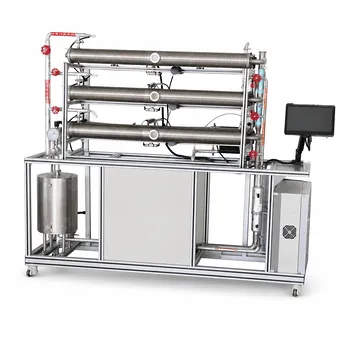
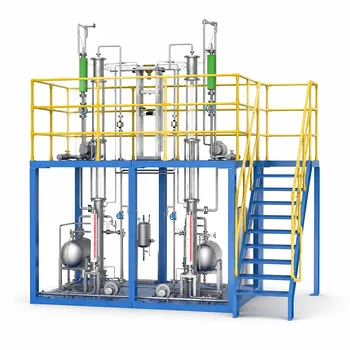
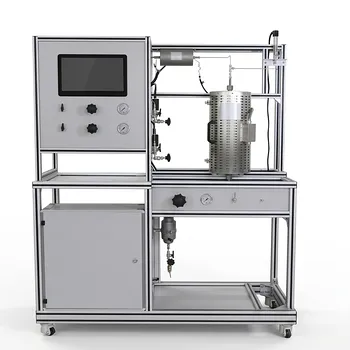
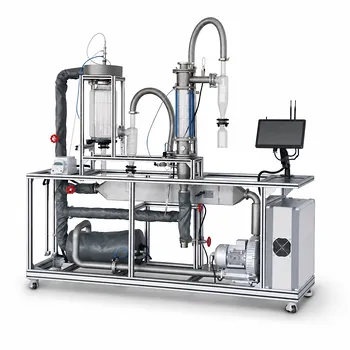
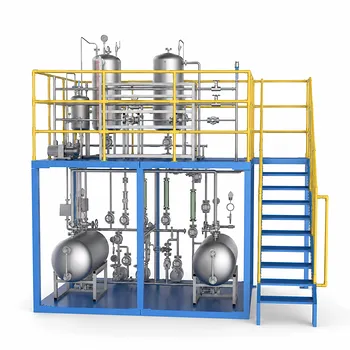
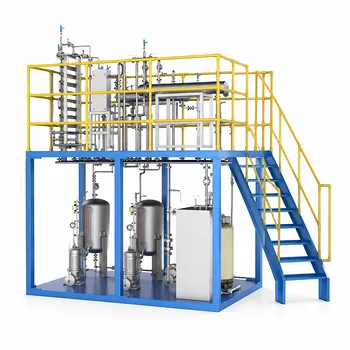
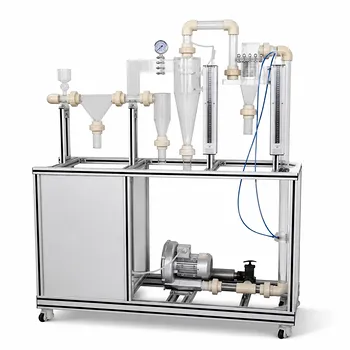
Vocational pilot plants address piping integrity and pressure management primarily through hands-on, industrial-grade system design that transforms abstract engineering principles into tangible failure-prevention skills.
These scaled-down facilities use the same pipes, fittings, and support structures found in full-size plants. Every component is deliberately chosen to demonstrate the direct relationship between mechanical design, fluid pressure, and long-term reliability. Instead of simply talking about theory, students walk the lines, inspect joints, and trace pressure drops—building an intuitive understanding of why systems fail and how to stop that from happening.
Core Takeaway: Vocational pilot plants prevent mechanical failures by teaching the why behind the design. They bridge the gap between textbook formulas and real-world consequences, showing students that piping integrity is not a one-time calculation but a continuous discipline of proper support, pressure calculation, thermal management, and rigorous safety review.
The Critical Link Between Physical Design and Safety Mastery
The primary reference highlights that these pilot plants are built with industrial-grade components precisely so that the physical layout becomes the textbook. This isn’t about scale; it’s about fidelity.
How the Layout Teaches Stress Concentration
Every bend, flange, and valve in a pilot plant creates a stress riser—a point where mechanical failure is most likely to begin. By physically tracing these pathways, students learn to identify where pressure-induced forces concentrate.
Pressure creates both hoop and longitudinal stress in pipes. The physical manifestation of water hammer or expansion can be felt and heard, making the need for adequate support intuitive rather than just academic.
The Danger of Improper Modifications
A core teaching moment comes when instructors demonstrate temporary bypasses or improvisations. A poorly clamped hose or a missing support becomes a vivid lesson in how process modifications undermine integrity.
These demonstrations are controlled but impactful. They cement the lesson that any change, no matter how small, requires a formal review. The pilot plant becomes a sandbox for learning why HAZOP (Hazard and Operability Study) protocols exist—not just what they are.
The Engineering Basics Made Tangible: Pressure and Thermal Stress
The supplementary references provide the quantitative and mechanical backbone. Vocational plants turn these equations and concepts into physical challenges students must solve.
Calculating Safe Working Pressure as a Hands-On Activity
The formula $P_s = (\text{Schedule Number} \times \sigma_s) / 1000$ is not just a slide in a presentation. In a pilot plant, students measure pipes, identify Schedule 40 or 80, and then calculate the safe working pressure for the actual material at operating temperature.
This instantly connects pipe schedule to safety margin. They see that a thinner pipe might suffice for water at room temperature but could fail catastrophically at 200°C—or if the wrong material is selected. The math becomes a survival tool, not an abstraction.
Managing Thermal Expansion You Can See
Pilot plants that involve steam or hot-oil systems visibly expand when heated. This isn't theoretical; you can observe a straight run of pipe bowing if it’s not properly anchored.
Designers deliberately build in expansion loops, bends, or flexible bellows. Students learn to calculate the expected expansion and then verify that these devices are absorbing the movement. They see how a rigidly fixed pipe would exert massive forces on pump nozzles or glass vessel connections, cracking them.
The Art of Pipe Support and Vibration Control
Appropriate pipe supports are not an afterthought; they are a design discipline. In the pilot plant, students adjust variable spring hangers or feel the vibration near a pump discharge.
They learn that supports must carry weight while also guiding thermal movement. A support that is too rigid causes thermal stress; one that is too loose allows vibration-induced fatigue. This hands-on tuning develops a diagnostic instinct for spotting dangerous rattle or sag.
Understanding the Trade-offs
Even in a teaching environment, the pilot plant reveals that perfect integrity is a compromise between safety, cost, and maintainability.
Balance Between Flexibility and Stability
Adding more expansion loops increases safety against thermal stress but also increases the total piping length, fluid hold-up, and potential leak points. Students learn to optimize, not maximize. A flexible bellows is compact but more prone to fatigue than a simple pipe loop. Each choice involves a trade-off.
The Cost of Over-Engineering vs. the Risk of Failure
A Schedule 80 pipe can handle far more pressure, but it’s heavier, more expensive, and harder to modify. Pilot plant exercises often ask students to justify why a Schedule 40 line is adequate for a given service—based on $\sigma_s$ and operating conditions—teaching economical design without compromising the safety envelope.
The Inspection Trap
A pilot plant that looks sound can still hide internal corrosion or gasket deformation. Students learn that visual inspection is insufficient; they must integrate pressure-testing procedures and torque verification of flange bolts into their routine. The plant teaches that integrity is a state you actively maintain, not a feature you buy once.
Making the Right Choice for Your Learning Goal
The principles learned on these vocational units translate directly into industrial competence. How you approach them depends on your primary focus.
- If your primary focus is mastering root cause analysis: Spend extra time on the "modification" demonstrations. Learn to identify how a single missing support or a rigid bypass can cascade into a full system failure.
- If your primary focus is design engineering: Deep-dive into the pipe schedule calculations and the thermal expansion layout. Use the pilot plant to test your designs under real heat and pressure before scaling up.
- If your primary focus is operational safety leadership: Own the HAZOP process on the unit. Practice walking down a P&ID line by line, predicting what forces are at play, and asking "what if?" for every support and valve.
Vocational pilot plants succeed not because they simulate every possible failure mode, but because they make the fundamental physics of piping integrity so clear that graduates can apply that logic to any system they encounter.
Summary Table:
| Integrity Focus Area | Key Physical Challenge | Educational Outcome |
|---|---|---|
| Stress Concentration | Identifying stress risers (bends, flanges, bypasses) | Hands-on risk assessment and HAZOP mastery |
| Pressure Management | Calculating safe working pressure (pipe schedules) | Verification of safety margins under temperature loads |
| Thermal & Vibration | Managing visible thermal expansion and pump vibration | Proper design of expansion loops, bellows, and supports |
Elevate Your Practical Engineering Training with LABPARK
Equip your students and researchers with the vital skills to prevent mechanical failures and manage pressure safety in real-world scenarios. LABPARK provides premium Educational and Vocational Unit Operations Pilot Plants in chemical engineering, bioprocess & biotech, and environmental & water treatment tailored for universities, research institutes, and enterprises.
Bring industrial-grade fidelity to your curriculum today. Contact us now to discover how we can customize a pilot plant solution to fit your educational goals!
Related Products
- Three-Tube Heat Transfer Educational Pilot Plant for Unit Operations Training
- Multimodal Absorption and Desorption Pilot Plant for Unit Operations Training
- Carbon Dioxide Hydrogen Methanol Synthesis Educational Unit Operations Pilot Plant
- Multi-Reactor Educational Pilot Plant for Reaction Engineering Unit Operations
- Multi-Functional Drying Educational Unit Operations Pilot Plant
People Also Ask
- When is ε-NTU preferred over LMTD in pilot plants? Predict heat exchanger performance without iteration.
- How to Verify Air-Side Heat Transfer Coefficient with a Pilot Plant? Practical Lab Guide
- Why is emissivity critical in heat transfer pilot plants? Bridge the Gap Between Theory & Industrial Design
- How can a heat transfer pilot plant demonstrate waste heat recovery? Learn to optimize industrial thermal systems.
- How does transitioning to a multi-shell heat exchanger affect required area? Optimize pilot plant design.