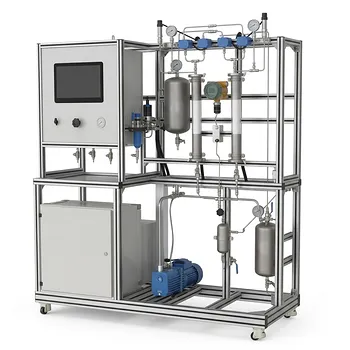
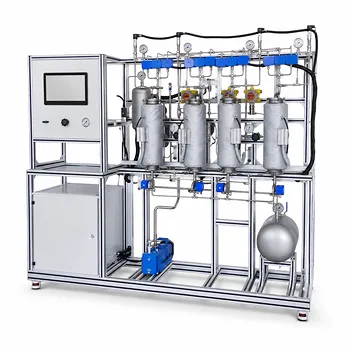
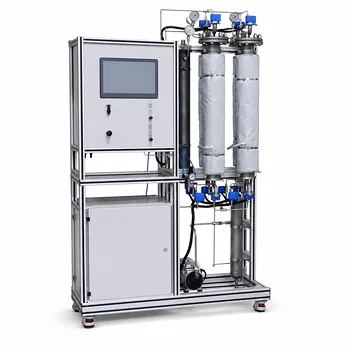
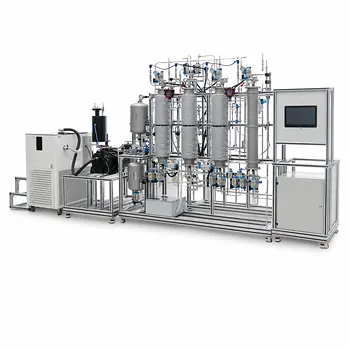
Polymer adsorption in pilot-scale columns is never instantaneous. The process is governed by a slow, competitive displacement mechanism that can lead to incomplete removal of target high-molecular-weight polymers if column designs rely on simple equilibrium assumptions. Lower molecular weight chains diffuse faster and occupy active surface sites first, only to be gradually pushed aside by heavier chains with stronger binding. In a pilot plant, this means residence time, adsorbent pore structure, and fluid dynamics become the levers that determine operational success.
Polymer adsorption in fixed-bed columns is a kinetic race, not a thermodynamic snap. Light chains reach the surface first but lose the long game to heavy chains. Pilot plant designers must accommodate this slow displacement by elongating contact times and choosing adsorbents whose pores can physically admit the targeted polymer fraction—otherwise the column will bleed high‑value material and fail to deliver reproducible data.
The Stepwise Reality of Polymer Surface Attachment
The Early Bird: Low Molecular Weight Species Arrive First
Smaller polymer chains diffuse through the boundary layer much faster than their high molecular weight counterparts. Because diffusion coefficients scale inversely with molecular size, these light molecules are the first to strike the adsorbent surface. In the early moments of column operation, the adsorbent bed gets loaded primarily with these fast-moving but weakly bound species.
This creates an illusion of completed adsorption well before the system has truly equilibrated. If an operator halts the run too soon or analyses the effluent after only a shallow contact time, the column may appear to be performing perfectly while the real heavy-molecule target is still slipping through.
The Long Game: Gradual Displacement by Heavy Chains
Thermodynamics favours high molecular weight molecules. Their larger contact area and greater number of interaction points per chain generate a much stronger binding affinity. Over time, these heavier polymers muscle their way onto the surface, displacing the already‑adsorbed light chains.
This displacement is painfully slow. The heavy chains must diffuse through the stagnant film, navigate any pore network, and then find a spot where the collective interaction energy exceeds that of the incumbent. Insufficient residence time halts this exchange mid-stream, leaving the surface saturated with the wrong species and the target polymer uncaptured.
The Viscosity Bottleneck
Polymer solutions, especially at industrially relevant concentrations, exhibit high viscosities. This dramatically slows both bulk diffusion and film‑side mass transfer. In a pilot plant adsorption column, the viscous drag resists the molecular movement needed to renew the surface and ferry chains into the adsorbent. Simple residence time calculations based on low‑viscosity fluids will grossly underestimate the required contact time, leading to columns that look properly scaled on a spreadsheet but fail in practice.
Reshaping Column Design Around Kinetic Realities
Residence Time: The Non‑Negotiable Safety Margin
The slow displacement kinetics force a fundamental design rule: residence time must be long enough for heavy chains to complete their conquest. Pilot plant columns need a generous safety margin beyond the theoretical equilibrium contact time. This often means taller beds, lower flow rates, or both. In an educational pilot plant, running at deliberately longer contact times demonstrates how effluent concentration profiles drift over time as displacement progresses—turning a design constraint into a powerful teaching signal.
Pore Structure: The Molecular Gatekeeper
If the adsorbent is porous, high molecular weight polymers can be completely excluded from the interior simply because of their size. No amount of residence time will overcome geometric exclusion. The column design must therefore select an adsorbent with pores large enough to accept the target fraction while still providing sufficient surface area. This is a classic trade‑off: larger pores reduce exclusion but lower the specific surface area, demanding a larger column to maintain capacity.
Liquid Distribution and Surface Renewal
While external film resistance is not always the rate‑limiting step, promoting frequent surface renewal can partially offset the sluggish diffusion. In a packed adsorption column, maintaining uniform liquid distribution and encouraging thin, continuously reforming films over the packing accelerates the transfer of fresh polymer solution to the surface. The penetration theory shows that shorter exposure times at the interface steepen the concentration gradient and raise the mass transfer coefficient. For polymer adsorption, good liquid distribution can shave critical minutes off the required residence time without sacrificing bed capacity.
Regeneration Cycles and Pilot Plant Logistics
Many pilot plants operate a closed‑loop solvent system where the adsorption column must be periodically regenerated. The same slow kinetics that govern adsorption also govern desorption. High molecular weight polymers, once settled into deep binding wells, are reluctant to leave. Regeneration steps may need longer stripping times, elevated temperatures, or chemical displacement. Pilot plant designers should match the regeneration strategy to the binding type—physical adsorption allows milder regeneration (lower temperature, pressure swing), while any chemical adsorption demands equipment rated for high thermal loads and precise temperature control.
Understanding the Trade‑offs
Pursuing perfect adsorption of high molecular weight polymers invites several engineering compromises.
- Longer residence time → bigger column: A taller or wider column increases capital cost and footprint, and with viscous polymer solutions can ramp up pressure drop, risking channeling and uneven flow.
- Larger pores → lower surface area: An adsorbent that welcomes heavy chains loses specific area for every‑chain binding. Total capacity per unit volume drops, forcing a larger bed to capture the same mass of polymer.
- Low flow rates → poor surface renewal: Slashing flow to extend contact time may backfire if it thickens the stagnant film and starves the surface of fresh polymer solution, actually slowing the displacement process.
- Regeneration intensity → energy and time: Aggressive regeneration to recover the heavy fraction can shorten adsorbent life or demand high‑grade materials of construction, undermining the pilot plant’s cost‑effectiveness.
In a training or research pilot plant, these compromises become learning opportunities. Students can deliberately manipulate flow rate, bed length, and adsorbent pore size to observe the kinetic bottleneck, learning why “equilibrium‐only” designs fail with polymeric fluids.
Making the Right Choice for Your Pilot Plant
The optimal adsorption column setup is never generic—it aligns with the specific goal of the pilot campaign.
- If your primary focus is removing or recovering a specific high molecular weight polymer: Choose an adsorbent with pores large enough to accommodate the target without exclusion, then size the column to deliver a residence time that allows complete displacement. Expect a taller bed and lower throughput.
- If your primary focus is demonstrating kinetic effects for educational purposes: Operate the column intentionally at shorter residence times and track the effluent composition over time. Use the gradual breakthrough of light chains and the delayed appearance of heavy chains to illustrate competitive adsorption to students.
- If your primary focus is mimicking an industrial process where throughput is critical: Use a high‑flow, short‑residence‑time column but pair it with an online monitor (e.g., RI or UV detector) to watch for heavy‑chain slippage. Combine this with a guard bed or a downstream polishing stage to capture any escaping target polymer.
- If your primary focus is solvent reuse and closed‑loop operation: Match the bed size and regeneration protocol to the slow desorption kinetics, and design the heat integration system (preheating rich solvent with hot lean solvent) to handle the extended regeneration cycles demanded by heavy polymer stripping.
Respecting the slow, competitive nature of polymer adsorption transforms a pilot plant column from a black‑box into a tool that reveals the true mass‑transfer story—and ensures the data you collect actually represent the process you aim to model.
Summary Table:
| Operational Aspect | Kinetic/Competitive Challenge | Design & Operational Solution |
|---|---|---|
| Molecular Weight Competition | Light chains adsorb first but are slowly displaced by heavier chains. | Extend column residence time (taller beds or lower flow rates). |
| Viscosity Bottleneck | High viscosity slows bulk diffusion and boundary layer mass transfer. | Enhance liquid distribution and promote continuous surface renewal. |
| Pore Accessibility | Large polymers are geometrically excluded from small adsorbent pores. | Choose adsorbents with optimized, larger pore structures. |
| Column Regeneration | Heavily bound polymers require high energy/time to desorb. | Implement extended stripping cycles and precise temperature control. |
Optimize Your Unit Operations with LABPARK Pilot Plants
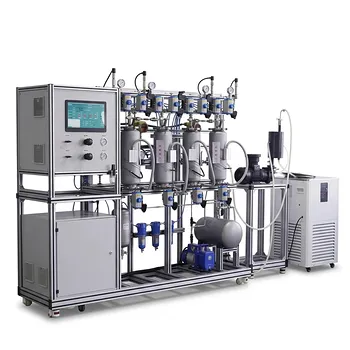
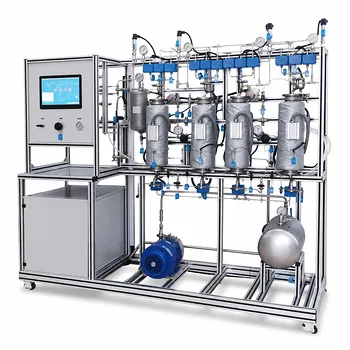
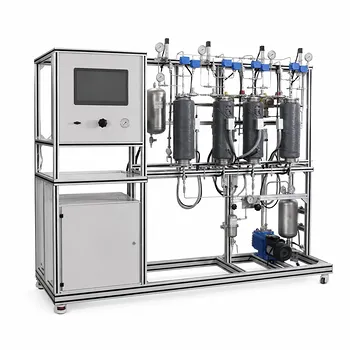
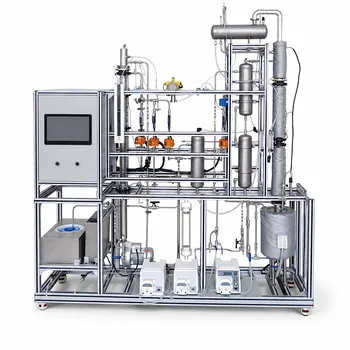
Bridging the gap between theoretical chemical kinetics and practical column design requires hands-on, high-performance equipment. LABPARK provides premium Educational and Vocational Unit Operations Pilot Plants in chemical engineering, bioprocess & biotech, and environmental & water treatment for universities, research institutes, and enterprises.
Our custom-engineered pilot systems enable students and researchers to manipulate flow rates, bed heights, and thermal profiles to observe complex mass-transfer phenomena in real-time, ensuring future engineers are fully prepared for industrial-scale challenges.
Ready to elevate your laboratory training and research capabilities? Contact us today to find the perfect pilot plant solution for your institution!
Related Products
- Packed Bed Absorption Educational Unit Operations Pilot Plant
- Absorption and Desorption Educational Unit Operations Pilot Plant
- Pressure Swing Adsorption Educational Unit Operations Pilot Plant
- Bench Scale Dual Column Gas Separation and Capture Educational Pilot Plant
- Multimodal Absorption and Desorption Pilot Plant for Unit Operations Training
People Also Ask
- How Do Flow Regimes Transition in Packed Bed Pilot Plants? Key Scale-up Insights
- How does reactant concentration determine absorption column control? Gas-film vs. dual-film.
- How is the packing height of an absorption column calculated? Master HTU & NTU Concepts
- How does the wall effect impact packed-bed conversion? Essential pilot plant scale-up tips.
- How does static vs. operating holdup affect pilot plant calibration? Avoid Critical Scale-Up Errors