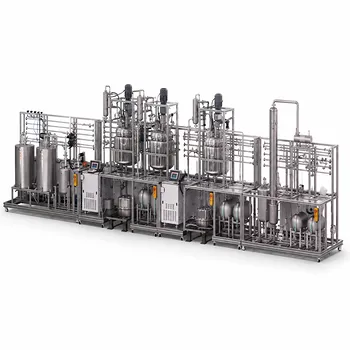
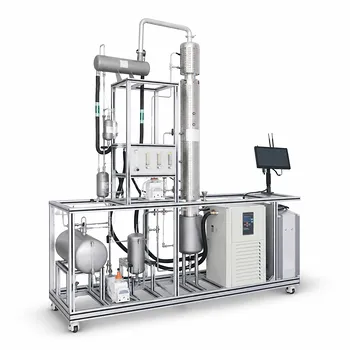
Intelligent control systems transform pilot plants from static equipment into self-optimizing, educational powerhouses. By continuously learning from operational data and autonomously adapting their parameters, these systems maintain stable process performance despite varying feed conditions, equipment degradation, or component failures. This eliminates the need for manual recalibration and gives students a front-row seat to advanced automation—allowing them to study how real-world processes respond to complex, time-varying challenges in a safe, industrial-scale environment.
The learning and adaptive capabilities of intelligent control do more than automate—they turn a unit operations pilot plant into a self-correcting experimental platform. Students gain experiential insight into non-linear dynamics, process resilience, and the inner workings of the control algorithms that drive modern chemical manufacturing, bridging the gap between textbook theory and 21st-century industrial practice.
The Intelligent Core: Learning and Adaptability
Intelligent control systems differ from fixed-parameter controllers by possessing two defining capabilities. Together, they enable the plant to handle uncertainty without constant human intervention.
How Learning Functions Continuously Optimize Control
The learning function turns every experimental run into a source of improvement.
These systems gather data during normal and disturbed process operations, classify patterns, and estimate system performance. Based on this continuous stream of information, they update the control strategy to deliver better setpoint tracking, disturbance rejection, or yield optimization over time.
In a distillation column pilot plant, for example, the controller might learn the relationship between feed temperature fluctuations and tray temperatures, progressively refining its actions to minimize off-spec product even before a student notices the disturbance.
The Power of Adaptive Self-Tuning in Dynamic Environments
The adaptability function gives the plant a form of operational resilience that conventional PID loops lack.
When faced with unknown inputs, sensor drift, or component failures, an adaptive controller automatically adjusts its own parameters in real-time. This self-repairing behavior is critical because pilot plants frequently experience time-varying characteristics—catalyst deactivation in a reactor, fouling in a heat exchanger, or raw material composition changes.
An adaptive system detects these shifts and retunes itself to keep the process at its optimal state, something fixed-gain controllers cannot do. This directly addresses the instability in product yields or quality that would otherwise require a human operator to re-tune the loop.
Seamless Operation Without Manual Recalibration
The practical outcome of learning and adaptation is hands-off stability under variability.
Processes such as extraction or absorption must handle fluctuating feed concentrations, flow rates, and pressure surges. When an intelligent controller is in place, it maintains stable operation across these variations without a teaching assistant or student needing to stop the experiment and recalibrate.
This reliability is not only an operational advantage; it also frees students to focus on higher-level analysis—like comparing simulated and real-world data—rather than wrestling to keep the pilot plant running.
Elevating the Educational Experience
The operational enhancements directly fuel a richer, more meaningful learning environment. Students move from running scripted procedures to investigating dynamic, real-world process behavior.
Bridging Theory with Real-World Process Dynamics
Textbook models often assume steady-state conditions or ideal linear responses. An intelligent control system exposes students to what actually happens when those assumptions break.
By watching the plant adapt to a feed disturbance or compensate for exchanger fouling, students see process dynamics in action. They can use trend screens—sampling data from every second up to hourly intervals—to analyze transient behaviors during startup, deliberate disturbances, and adaptive recovery. Combining this with simulation software lets them compare theoretical predictions against the plant’s learned response, reinforcing the gap between ideal models and physical reality.
Safe Experimentation at an Industrial Scale
Pilot plants already provide an enclosed, instrumented environment for studying hazardous reactions. Intelligent control adds an extra layer of predictive safety.
Because these systems continuously monitor and adapt to process conditions, they can preemptively adjust operating parameters or trigger soft interlocks when exothermic reactions or volatile byproducts drift toward unsafe regions. For a student running an absorption experiment that involves a toxic gas, this means the plant can compensate for unexpected pressure drops or temperature spikes automatically, even as the student intentionally probes the system’s limits.
Hands-On Experience with Industry 4.0 Technologies
The learning and adaptive algorithms live inside a broader digital ecosystem. Smart differential pressure transmitters with HART protocol, PLCs, and dedicated control group screens all feed data into—and receive commands from—the intelligent controller.
Students interact with the same layered automation they will meet in industry: viewing flowcharts that dynamically display active fluid paths, grouping PID loops to compare process variables and manipulated variables side-by-side, and diagnosing why the adaptive controller changed a tuning parameter. This direct exposure demystifies autonomous operation and builds the troubleshooting intuition essential for modern chemical engineers.
Understanding the Trade-Offs
An honest assessment requires acknowledging that intelligent control also introduces new challenges that educators and researchers must manage.
Complexity and the Black Box Challenge
When a controller learns and adapts its own parameters, the reason for a particular action can become opaque. Students may see the plant self-correct without grasping the underlying logic.
To prevent this from becoming a “magic box” demonstration, curricula must incorporate exercises that visualize the adaptation process—for example, logging when and why parameters changed, or comparing adaptive behavior against a baseline fixed-parameter controller. Without this, students risk missing fundamental control theory.
Overreliance May Undermine Fundamental Skills
If the pilot plant always adapts automatically, students may never truly master manual loop tuning or troubleshooting a poorly behaved PID controller.
The solution is to stage the learning journey. An intelligent platform can still be switched to manual or conventional mode, allowing students to first tune loops by hand, experience instability, and then activate adaptive control to appreciate what it compensates for. This comparative approach cements both fundamental and advanced skills.
Implementation and Validation Costs
Retrofitting a fleet of pilot plants with the necessary smart sensors, data acquisition infrastructure, and validated adaptive algorithms requires investment. While many educational plants already have HART-enabled transmitters and advanced PLCs, the validation effort to ensure the learning system behaves predictably under all student-induced scenarios is non-trivial.
However, for institutions focused on graduating Industry 4.0-ready engineers, that cost is often a strategic investment rather than an expenditure.
Making the Right Choice for Your Educational or Research Goals
The degree to which you leverage learning and adaptive capabilities should match your primary objective. A single pilot plant can serve multiple purposes if the control architecture is flexible.
- If your primary focus is teaching fundamental process control: Use the intelligent system in a transparent, comparative mode. Start students with manual PID tuning, then enable the adaptive layer so they can contrast fixed and adaptive behavior—reinforcing why process changes matter.
- If your primary focus is advanced industrial readiness: Maximize the autonomous operation capabilities. Let students design disturbance scenarios, interpret trend and control group screens, and diagnose how the plant learns and self-corrects, building the analytical skills demanded by modern automated facilities.
- If your primary focus is research into process dynamics or adaptive algorithms: Treat the pilot plant as a programmable testbed. Use the learning function to gather high-fidelity data sets and validate new adaptive strategies under repeatable yet realistic physical conditions.
These intelligent capabilities are not just automation add-ons—they are the bridge that turns a unit operations pilot plant into a living laboratory, equipping the next generation of chemical engineers with the insight to design, control, and optimize the resilient processes that will define the future of the industry.
Summary Table:
| Feature | Traditional Control | Intelligent Adaptive Control |
|---|---|---|
| Parameter Tuning | Manual recalibration required | Autonomous self-tuning in real-time |
| Disturbance Response | Requires operator intervention | Self-corrects to maintain stability |
| Process Safety | Reactive safety interlocks | Predictive safety & auto-adjustments |
| Learning Value | Fixed textbook scenarios | Interactive, real-world Industry 4.0 dynamics |
Bring Industry 4.0 to Your Lab with LABPARK
Equip your students and researchers with the future of chemical manufacturing. LABPARK provides state-of-the-art Educational and Vocational Unit Operations Pilot Plants in chemical engineering, bioprocess & biotech, and environmental & water treatment.
Designed for universities, research institutes, and enterprises, our pilot plants integrate advanced intelligent control systems to bridge the gap between textbook theory and real-world industrial practice safely and efficiently.
Ready to upgrade your engineering curriculum or research capabilities? Contact LABPARK today to discuss your custom pilot plant needs!
Related Products
- Carbon Dioxide Hydrogen Methanol Synthesis Educational Unit Operations Pilot Plant
- Multi-Reactor Educational Pilot Plant for Reaction Engineering Unit Operations
- Ethyl Acetate Synthesis Unit Operations Pilot Plant for Practical Training
- Multi Pump Fluid Transport Process Piping Unit Operations Training Pilot Plant
- Multi-Modal Distillation Unit Operations Training Pilot Plant
People Also Ask
- How do temp & pressure affect methanol synthesis pilot plants? Optimize equilibrium and catalyst performance.
- Why is a purge system necessary when operating a gas recirculation loop in a methanol synthesis pilot plant? (Guide)
- Why do modern methanol pilot plants operate at lower pressures? Catalyst & Feed Requirements Explained
- What are the operational requirements for catalyst activation? Safe Methanol Pilot Plant Operation
- Why is the chemical plant startup schedule crucial? De-risk scale-up with pilot plants.