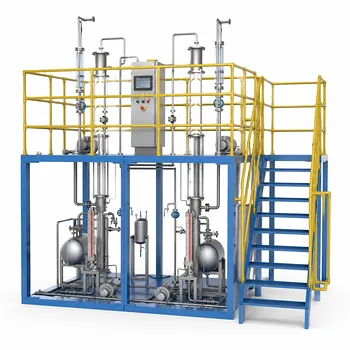
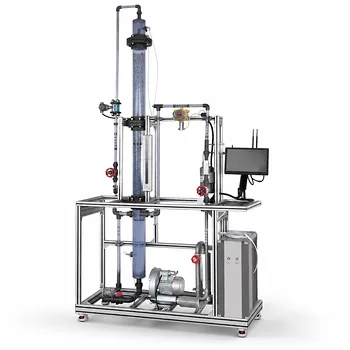
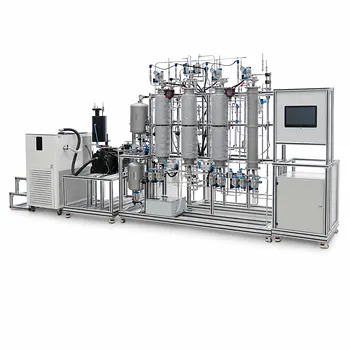
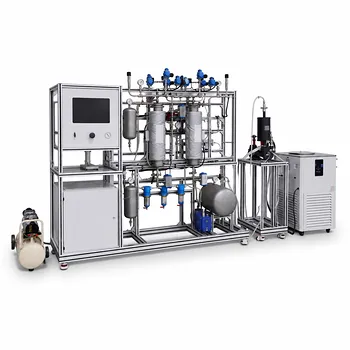
The same physical adsorption that keeps your laboratory desiccator bone-dry is the exact mechanism scaled into pilot-plant purification columns.
Silica gel and molecular sieves remove moisture by physically trapping water molecules on their internal surfaces. In a pilot plant, this batch process transforms into a continuous operation where the desiccant is packed into a column, and gas or liquid flows through it. The goal shifts from simply “keeping a sample dry” to quantifying and optimizing mass transfer zones, breakthrough curves, pressure drop, and thermal regeneration cycles. For gas streams that contain reactive impurities like HCl or SO₂, a complementary chemical scrubbing step is often added, which relies on rapid, selective reactions rather than physical adsorption.
The core challenge is no longer just choosing a desiccant with enough capacity—it’s designing a scalable, predictable unit operation. Pilot plants let you map the dynamic behavior of the same physical adsorption you trust in the lab, while also integrating chemical scrubbing for non-aqueous contaminants, bridging the gap between a silica gel packet and a 10‑meter industrial dryer.
From Benchtop Desiccation to Continuous Drying
The Physical Adsorption Mechanism Is Largely Unchanged
Silica gel and molecular sieves dry by physisorption—water molecules adhere to the vast internal surface area of the solid.
The lab-quoted capacities, roughly 0.3 g water per gram of silica gel and 0.25 g/g for molecular sieves, are equilibrium values.
In a pilot plant, the same material is used, but its dynamic capacity becomes the critical design parameter.
Scaling Up: Fixed‑Bed Columns and Breakthrough Dynamics
Instead of a static jar, the desiccant is held in a packed column or adsorption bed.
As moist fluid passes through, a mass transfer zone (MTZ) forms where adsorption is actively occurring.
By monitoring the outlet moisture over time, engineers generate a breakthrough curve—the fingerprint of bed efficiency and the basis for sizing industrial units.
Capacity, Regeneration, and Energy Trade-offs
Pilot plants directly measure how long a bed can operate before breakthrough, and how much energy is required for thermal regeneration.
Molecular sieves, for example, require higher regeneration temperatures than silica gel, which directly impacts operating costs.
The pilot data also reveal the pressure drop across the bed as a function of flow rate and particle size, influencing pump/compressor selection.
Liquid Purification with Molecular Sieves: Pore Size Selectivity
How 3A vs. 4A Sieves Exclude Solvent Molecules
Physical adsorption is identical whether drying a liquid or a gas, but liquid systems demand pore‑size selectivity.
3A molecular sieves (pore ~0.3 nm) admit water (kinetic diameter ~0.27 nm) but exclude larger solvent molecules like ethanol or unsaturated hydrocarbons.
4A sieves (pore ~0.4 nm) can dry methanol or ethers where slightly larger pores are acceptable without co‑adsorbing the solvent.
Pilot Plant Implementation: Immersion or Column Packing
In the lab, you might simply add sieves to a flask and filter later.
A pilot plant scales this into a packed column with controlled residence time, or a stirred tank with continuous recirculation and filtration.
The choice between immersion and column flow directly affects adsorption kinetics, pressure drop, and regenerability.
Gas Purification: Beyond Moisture Removal
Physical Scrubbing for Soluble Impurities
Some gas‑phase impurities can be removed by simple dissolution—passing the gas through a liquid wash bottle (absorber) where only the contaminant dissolves.
This is essentially a physical separation driven by solubility differences, analogous to how water vapor physically adsorbs onto silica gel.
Chemical Scrubbing for Reactive Contaminants
When impurities are acidic (HCl, SO₂) or otherwise reactive, chemical scrubbing is used.
The gas flows through a solution of NaOH (or another reagent) that reacts rapidly and selectively with the contaminant, converting it to a non‑volatile salt.
Crucially, the scrubber design must prevent any reaction with the target product gas and avoid introducing new impurities.
Ensuring Adequate Contact Time and Scrubber Design
A simple but effective pilot‑scale configuration is the “long inlet, short outlet” tube arrangement in wash bottles.
This forces the gas to travel a longer path through the scrubbing solution, maximizing contact time and reaction efficiency.
Matching the scrubber’s liquid volume and concentration to the gas flow rate prevents channeling and ensures complete impurity removal.
Understanding the Trade‑offs
Physical Adsorption Capacity vs. Regeneration Costs
Silica gel offers a higher weight‑based equilibrium capacity than molecular sieves under humid conditions, but molecular sieves maintain a high capacity even at low relative humidity.
However, molecular sieves demand more energy for regeneration, which can dominate operating expenses in large‑scale drying.
Chemical Scrubber Selectivity Risks and Waste Handling
A chemical scrubbing agent must be chosen to react only with the target impurity.
An overly aggressive reagent might attack the product gas or generate a toxic by‑product, turning a purification step into a safety hazard.
Additionally, spent scrubbing solutions become a waste stream that must be neutralized and disposed of, adding complexity and cost.
Making the Right Choice for Your Pilot Plant
The pilot plant is your proving ground—use the same desiccant chemistry you would in production, but adjust the unit operation design based on your purification goal.
- If your primary focus is deep moisture removal from a gas or liquid: Start with physical adsorption columns. Use the pilot to map breakthrough curves, measure pressure drop, and verify the temperature and purge gas needed for regeneration.
- If your primary focus is removing acidic or reactive impurities from a gas stream: Incorporate a chemical scrubber upstream of the physical dryer. Optimize the scrubbing solution concentration and contact time to completely neutralize the impurity without creating new contaminants.
- If your goal is to purify a solvent without co‑adsorbing the product: Select a pore‑size‑matched molecular sieve (3A or 4A) and run column flow experiments to confirm minimal product loss before scaling.
- If you are bridging from lab jar tests to a commercial design: Do not rely on static equilibrium capacities. Use pilot data to validate the dynamic capacity, mass transfer zone length, and regeneration cycle time—these numbers, not the lab‑jar capacities, will determine the full‑scale economics.
By treating your pilot plant as a quantified, instrumented extension of the laboratory desiccator, you turn a simple “drying” task into a fully predictable and scalable purification unit operation.
Summary Table:
| Purification Method | Mechanism | Primary Application | Key Scale-Up Design Parameters |
|---|---|---|---|
| Silica Gel | Physical Adsorption (Physisorption) | Bulk gas/liquid moisture removal | Mass transfer zone (MTZ), breakthrough curve, pressure drop |
| Molecular Sieves | Pore-Selective Adsorption | Deep drying, selective solvent purification (3A/4A) | Pore-size exclusion, dynamic capacity, high-temperature thermal regeneration |
| Chemical Scrubbers | Chemical Reaction | Acidic or reactive gas impurities (HCl, SO₂) | Liquid-gas contact time, reagent selectivity, waste neutralization |
Scale Up Your Purification Processes with LABPARK
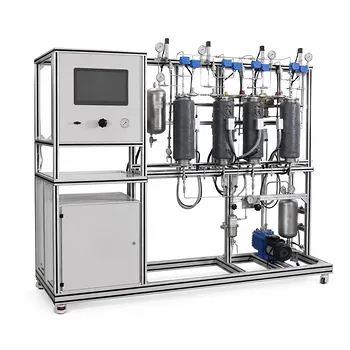
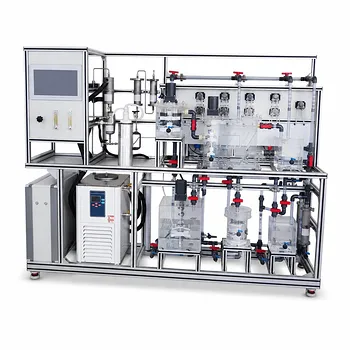
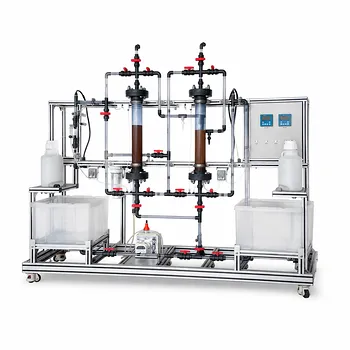
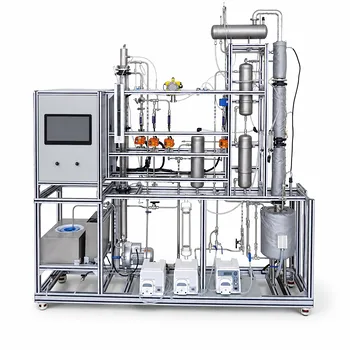
Transitioning from benchtop desiccation to continuous column operations requires precise, scalable equipment. LABPARK provides advanced Educational and Vocational Unit Operations Pilot Plants in chemical engineering, bioprocess & biotech, and environmental & water treatment.
Designed specifically for universities, research institutes, and enterprises, our pilot plants enable you to accurately map breakthrough curves, evaluate pressure drops, and optimize thermal regeneration cycles.
Ready to elevate your engineering lab? Contact us today to explore our customizable pilot plant solutions!
Related Products
- Electrolyte Distillation Purification and Formulation Educational Pilot Plant
- Green Anhydrous Ethanol Purification Extractive Distillation Unit Operations Training Pilot Plant
- Fixed-Bed Chemical Reaction and Gas Dust Tar Removal Unit Operations Pilot Plant
- Bench Scale Carbon Dioxide Capture Educational Unit Operations Pilot Plant
- Thermal Desorption Exhaust Gas and Tail Water Treatment Educational Pilot Plant
People Also Ask
- Why does simple distillation yield higher efficiency than flash distillation? Key thermodynamic differences.
- How to Integrate Spectroscopy in Distillation Pilot Plants for Advanced Process Control
- How does the feed thermal state influence distillation pilot plant design and utility consumption?
- How to Configure a Distillation Pilot Plant? Key Steps for Multi-Mode Setup
- How to Verify Distillation Boundary Lines & Composition Regions with Pilot Plants