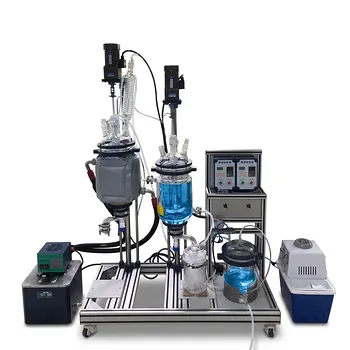
Polymorph screening in a crystallization pilot plant hinges on one decisive question: do you need to isolate the thermodynamically stable form, or do you need to map out the full landscape of possible crystal structures? The selection between slurry crystallization and cooling crystallization is not a matter of preference—it is a direct choice between thermodynamic control and kinetic control of the solid-state outcome.
Slurry crystallization is the most reliable method to drive a system toward its most stable polymorph through solvent-mediated transformation. Cooling crystallization, by contrast, operates under kinetic control and often follows Ostwald’s rule of stages, allowing the transient appearance of less stable forms. Your choice in the pilot plant therefore depends entirely on whether the goal is to anchor onto the final, stable structure or to deliberately explore metastable diversity.
The Thermodynamic Road: Slurry Crystallization for Stable Forms
In polymorph screening, slurry crystallization is the method of choice when you need to identify and isolate the thermodynamic minimum of the system. The process works by creating an environment where molecules have enough mobility—and enough time—to constantly dissolve and re-deposit until the lowest-energy crystal lattice emerges.
How Solvent‑Mediated Transformation Works
When a solid is suspended in a saturated solution and held at constant temperature, any metastable polymorph will dissolve more readily than the stable one. The stable form then nucleates and grows from the solution, slowly consuming the less stable material in a process called solvent‑mediated transformation. Over time, the entire crystal population converges to the single, most stable polymorph.
The 8 mM Solubility Rule for Fast Screening
To make this transformation practical in a pilot plant, you need sufficient solute mobility. Selecting a solvent that provides high solubility—typically exceeding an 8 mM threshold—accelerates the exchange. Below this level, the kinetics of dissolution and recrystallization become impractically slow, while above it, the transformation can be completed within realistic experimental windows. This rule is the key design parameter when setting up slurry screening runs in a unit operations pilot plant.
The Kinetic Path: Cooling Crystallization for Metastable Discovery
When the research objective is to uncover the entire polymorphic landscape—including the elusive, highly energetic forms that may never appear at equilibrium—cooling crystallization becomes the essential tool. It deliberately pushes the system into high supersaturation, where kinetic selection dominates.
Ostwald’s Rule of Stages in Action
Cooling a clear, concentrated solution rapidly creates a sudden, deep supersaturation. Under these conditions, the crystal form with the lowest activation barrier to nucleation appears first—often the least stable polymorph. This is Ostwald’s rule of stages: the system moves stepwise toward stability, first forming the most accessible structure, which may later convert to a more stable one. In a pilot plant, recording the sequence of forms that appear during a controlled cooling ramp reveals the full metastable cascade.
When Cooling Works Best: Steep Solubility Curves
Cooling crystallization is most effective when the solute’s solubility drops dramatically with temperature (for example, from >100 mg/g at elevated temperature to <20 mg/g at low temperature). Under these conditions, modest temperature changes generate the large supersaturation needed for kinetic trapping. The supplementary references confirm that this steep solubility–temperature relationship is the standard engineering criterion for choosing cooling over evaporation, and it applies equally to polymorph screening when you want to capture non‑equilibrium forms.
Bridging the Gap: Pilot Plant Considerations
Translating these concepts into a unit operations pilot plant demands more than a choice on paper—it requires a configuration that can faithfully execute thermodynamic or kinetic regimes while producing meaningful, scalable data.
Modular Setups Enable Side‑by‑Side Comparisons
Educational and research pilot plants often combine multiple crystallizer types—tank crystallizers for batch slurry aging, jacketed vessels with precise temperature control for cooling ramps, and even OSLO‑type fluidized beds. A modular design allows students to run slurry and cooling experiments on the same chemical system, directly comparing the polymorphic forms produced by each mode.
Automating Control Loops for Reproducibility
What transforms a simple glass‑beaker experiment into a robust pilot‑scale screening is the automated control loop. Rather than manually adjusting a cooling rate, the pilot plant profiles temperature, monitors in‑situ concentration via process analytical technology (PAT), and logs agitation speed. For slurry runs, maintaining a constant temperature while tracking particle size or Raman signatures confirms when thermodynamic equilibrium has been reached. For cooling runs, automated feedback prevents uncontrolled secondary nucleation that could obscure the polymorphic outcome.
Understanding the Trade-offs
No single method is universally superior. Researchers and students must weigh the limitations of each approach to design a screening campaign that yields the right type of information.
The Time Cost of Thermodynamic Certainty
Slurry crystallization guarantees you will find the stable form, but it can be slow. Even at solubilities above 8 mM, full conversion of a metastable slurry may take hours or days. If the screening timeline is tight, or if the stable polymorph happens to nucleate only sluggishly, you risk missing a rapidly forming metastable candidate that could have practical value.
The Instability of Metastable Forms
Cooling crystallization can generate a zoo of metastable polymorphs, but these forms are inherently unstable. They may transform on the filter paper, during drying, or under the beam of an analytical instrument. Pilot‑plant operation must incorporate immediate sampling, rapid solid‑liquid separation, and often sub‑ambient storage (quenching) to preserve what has been kinetically trapped.
Making the Right Choice for Your Screening Goal
Your selection between slurry and cooling crystallization in a pilot plant should be directly driven by the specific question the polymorph screen is meant to answer.
- If your primary focus is identifying the most stable, patentable, or formulation‑ready polymorph: Select slurry crystallization with a high‑solubility solvent (>8 mM) and allow sufficient residence time for the solvent‑mediated transformation to complete.
- If your primary focus is discovering the widest possible range of polymorphs, including highly energetic and fast‑dissolving forms: Use cooling crystallization with a steep solubility‑temperature profile, implement automated supercooling control, and plan for immediate quenching of the product.
- If your primary focus is education and understanding the thermodynamic vs. kinetic control paradigm: Run both methods on the same solute using a modular pilot plant, and let students trace the polymorphic evolution from the initially formed kinetic product to the final equilibrium form.
Ultimately, the crystallization unit operations pilot plant is the instrument that lets you turn a deliberate choice—thermodynamic anchoring or kinetic exploration—into a crystalline answer.
Summary Table:
| Feature | Slurry Crystallization | Cooling Crystallization |
|---|---|---|
| Control Mode | Thermodynamic control | Kinetic control (Ostwald's rule) |
| Target Outcome | Most stable, equilibrium polymorph | Metastable diversity and transient forms |
| Solubility Requirement | High solubility (> 8 mM) for transformation | Steep temperature-solubility curve |
| Process Speed | Slow (requires hours to days for aging) | Rapid (requires immediate quenching) |
Bring Advanced Crystallization to Your Lab
Equip your students and researchers with the tools to master complex chemical processes. LABPARK provides state-of-the-art Educational and Vocational Unit Operations Pilot Plants in chemical engineering, bioprocess & biotech, and environmental & water treatment for universities, research institutes, and enterprises.
Whether you are optimizing industrial polymorph screening or teaching thermodynamic vs. kinetic control, our modular pilot plants deliver reliable, scalable data. Contact LABPARK today to request a quote and elevate your research and training capabilities!
Related Products
- Multi Functional Membrane Crystallization Educational Unit Operations Pilot Plant
- Potassium Salt Thermal Dissolution and Crystallization Separation Educational Unit Operations Pilot Plant
- Multi-Modal Distillation Unit Operations Training Pilot Plant
- Multi-Reactor Educational Pilot Plant for Reaction Engineering Unit Operations
- Dual-Mode Rectification Pilot Plant for Practical Training Unit Operations
People Also Ask
- Control Crystallization Pilot Plant Secondary Nucleation: 4 Key Adjustments
- Why is precise temperature control critical in crystallization pilot plants? Key to Scale-Up Success
- How Crystal vs Amorphous Solids Guide Crystallization Pilot Plant Objectives
- What key factors should be considered when configuring a crystallization unit operations pilot plant?
- What are the benefits of integrating online PAT tools like ATR-FTIR into crystallization unit operations pilot plants?