The pore-to-molecule size ratio is the single most overlooked variable in pilot plant diffusion calculations. When you operate adsorption or liquid-phase catalytic unit operations, and the diffusing molecule’s diameter becomes comparable to the catalyst or adsorbent pore diameter, the effective diffusivity plummets. This happens because the pore wall not only physically excludes the molecule from a fraction of the pore volume—quantified by an equilibrium partition factor (K_p)—but also imposes hydrodynamic drag on the molecule as it moves, quantified by a drag coefficient (K_r). Ignoring these factors during pilot plant data analysis will lead you to systematically overestimate mass transfer rates, producing breakthrough and conversion predictions that are overly optimistic and fail at scale.
The core of the problem: pilot plant models that treat diffusivity as a constant bulk property break down as pore size shrinks toward the molecular scale. Correcting for restricted diffusion using the pore-to-molecule size ratio—via (K_p) and (K_r)—is not a refinement; it is a necessity to avoid mistaking mass transfer limitations for slow kinetics and to reliably scale up adsorption or catalytic reactors.
Why the Ratio Matters: The Physics of Restricted Diffusion
Steric Exclusion: The Partition Factor (K_p)
When a molecule approaches a pore entrance, its finite size prevents it from sampling the entire geometric pore volume. (K_p) represents the fraction of the pore cross-section that is actually accessible to the molecule’s center. For cylindrical pores and spherical molecules, (K_p) drops sharply as the ratio (\lambda = d_m/d_p) (molecular diameter to pore diameter) increases beyond about 0.1. Above (\lambda \approx 0.5), the available cross-section becomes so small that transport essentially ceases. This thermodynamic exclusion directly reduces the concentration gradient available for diffusion.
Wall Drag: The Enhanced Hydrodynamic Resistance (K_r)
Even the molecules that enter the pore experience an increased drag force from the close pore walls. The drag coefficient (K_r) captures this additional friction; it always has a value ≤1 and decreases as (\lambda) grows. In liquid-filled pores, this effect is particularly significant because the no-slip condition at the wall creates a steep velocity gradient. The combined result is that the effective diffusion coefficient (D_{\text{eff}}) is not merely (D_{\text{bulk}} \times \text{porosity}), but must be corrected further:
(D_{\text{eff}} \propto D_{\text{bulk}} \cdot K_p(\lambda) \cdot K_r(\lambda)).
The Ratio in Different Transport Regimes
The restriction factors apply on top of the underlying diffusion mechanism. In liquid-phase catalysis, the mean free path is of the same order as molecular size, so molecular diffusion dominates; you start with a bulk liquid diffusivity and then apply (K_p) and (K_r) as (\lambda) increases. In gas-phase adsorption, you must first determine if you are in the molecular or Knudsen regime—based on the pore radius relative to the gas mean free path—and only then factor in the restrictive effects when the pore diameter and molecule size are comparable. In both cases, the pore-to-molecule size ratio is the final gatekeeper that determines the actual mass transfer coefficient.
The Consequences of Ignoring Size Ratios in Your Pilot Plant
Overestimated Diffusion Rates Drive Faulty Scale-Up
Pilot plants exist to generate data that predict commercial-scale performance. If you assume unrestricted bulk diffusivity, your model will calculate unrealistically fast intraparticle mass transport. This makes the catalyst or adsorbent appear more active than it truly is. When you scale up to a larger bed, the real-world residence time requirement will be far longer than predicted, causing product quality shortfalls or premature breakthrough. The primary reference is explicit: ignoring this restriction in zeolites or porous catalysts leads directly to overestimated diffusion rates.
Misdiagnosed Kinetic Parameters
Kinetics are usually extracted from pilot plant data by decoupling mass transfer effects. If you overrate diffusion, you will underestmate the intrinsic activation energy or overrate the rate constant. This muddies the entire reaction engineering model. Consistently applying the restricted diffusion correction ensures that the intrinsic kinetics you obtain from your pilot plant are transferable—not artifacts of an oversimplified transport model.
Fouling and Degradation Look Like Something Else
Especially in liquid-phase unit operations, colloids, macromolecules, or reaction by-products can narrow pores over time. This shifts the effective (\lambda) upward, progressively throttling diffusion. Without a model that ties diffusivity to the instantaneous pore size ratio, you may misinterpret declining performance as catalyst deactivation, when in fact it is increased mass transfer resistance from pore narrowing. Supplementary references on membrane fouling mirror this: particles near the pore size cause internal blockages that are notoriously difficult to clean.
How to Integrate the Ratio into Pilot Plant Diffusivity Calculations
Characterize Pore and Molecule Sizes Experimentally
You cannot apply a correction without knowing both the pore size distribution of your adsorbent or catalyst and the effective solute diameter. Use gas adsorption (BET/BJH), mercury porosimetry, or advanced microscopy (TEM/SEM) to get the pore architecture. As the supplementary references emphasize, catalyst preparation methods influence crystallite sizes and pore structure, so measure your actual material, not vendor specifications. Determine the solute’s molecular diameter from liquid-phase diffusivity correlations (Wilke-Chang) or from molecular modeling.
Select the Correct Restrictive Diffusion Model
Classical models like the Renkin equation give (K_p) and (K_r) as functions of (\lambda) for cylindrical pores. For slit-shaped pores in many catalysts, different geometric relationships apply. Integrate these into the particle-scale mass balance. When modeling a fixed-bed pilot reactor, the effective diffusivity used in the pellet mass balance must be (D_{\text{eff}} = D_{\text{bulk}} \cdot \phi_p \cdot K_p(\lambda) \cdot K_r(\lambda) / \tau), where (\tau) is tortuosity. Any deviation from this will corrupt your effectiveness factor.
Validate with Tracer and Breakthrough Experiments
Run a non-reactive tracer injection in your pilot adsorption column or a pulse of a non-adsorbing solute of known size through the catalytic reactor. Fit the tailing of the response curve to back-calculate the effective pore diffusivity. If the fitted diffusivity is much smaller than the unrestricted estimate, restricted diffusion is active. Use this to calibrate the (\lambda)-dependent model before extracting reaction kinetics.
Common Pitfalls and Trade-offs to Avoid
- Assuming a single pore size: Real materials have a distribution. Use a volume-averaged or parallel-pore model. A single nominal pore diameter can mask that a subset of smaller pores severely restrict transport and control the overall rate.
- Neglecting tortuosity changes with pore blockage: As small pores plug, the diffusion path lengthens. The combined effect of a rising drag coefficient and increased tortuosity can cause a steeper-than-expected decline in performance.
- Over-narrowing pores for higher surface area: There is a fundamental trade-off. Reducing pore size increases the specific surface area (good for activity), but once (\lambda) exceeds ~0.1, you pay a heavy diffusivity penalty. At some point, the catalyst or adsorbent becomes diffusion-starved, and the extra surface area is wasted. Pilot plant data must be used to find the optimum pore size that balances kinetics and mass transfer.
Making the Right Choice for Your Pilot Plant Goal
Your path forward depends on what you are trying to accomplish with your pilot unit:
- If your primary focus is extracting intrinsic kinetics: Correct the effective diffusivity for restricted diffusion using (K_p) and (K_r) based on your characterized pore-to-molecule size ratio. Only then can you trust the fitted rate constants.
- If your primary focus is scaling up a fixed-bed adsorber or reactor: Build a validated model that includes the (\lambda)-dependent diffusivity. If you skip this step, your full-scale column will break through or reach conversion far earlier than your pilot plant predictions suggest.
- If your primary focus is catalyst or adsorbent development: Use the pore-to-molecule ratio as a design lever. Characterize the diffusion penalty as you decrease pore size, and deliberately walk the trade-off between surface area and mass transfer resistance to find the optimum structural parameters.
Mastering the pore-to-molecule size ratio transforms your pilot plant from a simple data generator into a precise tool for predicting real-world performance.
Summary Table:
| Key Factor | Symbol / Formula | Description | Impact if Ignored |
|---|---|---|---|
| Steric Exclusion | $K_p$ | Pore walls physically exclude molecules from part of the pore volume. | Overestimates concentration gradient. |
| Wall Drag | $K_r$ | Increased hydrodynamic resistance/friction near pore walls. | Overestimates effective diffusivity ($D_{\text{eff}}$). |
| Effective Diffusivity | $D_{\text{eff}} \propto D_{\text{bulk}} \cdot K_p \cdot K_r$ | Combined restricted diffusion model for small pores. | Leads to premature breakthrough & scale-up failure. |
Scale Up with Confidence using LABPARK Pilot Plants
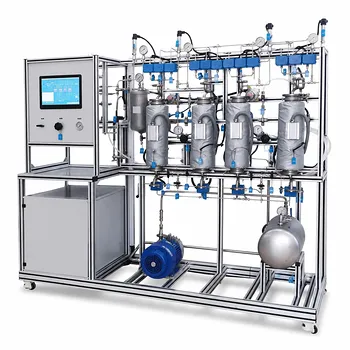
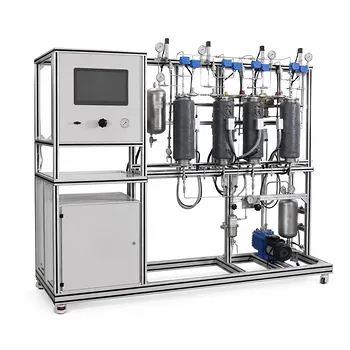
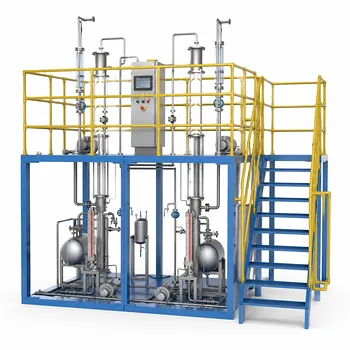
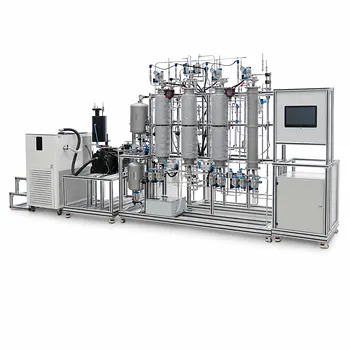
Accurate mass transfer and kinetic modeling require reliable experimental data. LABPARK provides state-of-the-art Educational and Vocational Unit Operations Pilot Plants in chemical engineering, bioprocess & biotech, and environmental & water treatment.
Designed specifically for universities, research institutes, and enterprises, our systems help you master complex transport phenomena and avoid costly scale-up errors.
Contact LABPARK today to discuss your pilot plant requirements and request a quote!
Related Products
- Packed Bed Absorption Educational Unit Operations Pilot Plant
- Absorption and Desorption Educational Unit Operations Pilot Plant
- Carbon Dioxide Adsorption and Capture Educational Unit Operations Pilot Plant
- Multi-Component Gas Pressure Swing Adsorption Pilot Plant for Unit Operations Education
- Pressure Swing Adsorption Educational Unit Operations Pilot Plant
People Also Ask
- How Do Flow Regimes Transition in Packed Bed Pilot Plants? Key Scale-up Insights
- How does reactant concentration determine absorption column control? Gas-film vs. dual-film.
- How is the packing height of an absorption column calculated? Master HTU & NTU Concepts
- How does static vs. operating holdup affect pilot plant calibration? Avoid Critical Scale-Up Errors
- Why is counter-current flow selected for gas absorption? Maximize Pilot Plant Efficiency