The modeling of heat transfer in pilot-scale stirred tank reactors hinges on selecting the correct empirical correlation for the heating or cooling configuration. In unit operations laboratories, the process-side film coefficient for an aerated, mechanically agitated vessel is commonly modeled using the Rao and Murti correlation. For a wall-aerated (jacketed) vessel, the correlation takes the form with constants b = 1.35 and m = 0.59. For a coil-aerated (internal coil) vessel, the constants shift to b = 0.87 and m = 0.64. This differentiation directly reflects how the geometry of the heat-exchange surface alters fluid dynamics and thermal boundary layer behavior.
The surface need is to know which parameters to plug into the model. The deep need is to understand why those parameters differ and how to integrate that single film coefficient into a complete thermal model that characterizes pilot-plant performance. Pilot labs achieve this by combining geometry-specific Nusselt correlations with overall heat transfer coefficient (U) calculations, resistance-in-series analysis, and experimental methods like the Wilson plot to teach the fundamentals of stirred tank thermal design.
The Governing Correlation for Aerated Stirred Reactors
Heat transfer from the process fluid to a jacket or coil is dominated by the turbulence created by the impeller. The Rao and Murti correlation captures this by linking the Nusselt number (the dimensionless heat transfer coefficient) to the Reynolds, Prandtl, and Froude numbers, plus a viscosity correction term.
The Rao and Murti Equation
The correlation is written as:
[ \frac{h_w, d_R}{k_{T,l}} = b , Re^m , Pr^{0.33} , Fr^{-0.1} \left(\frac{\mu_w}{\mu_l}\right)^{-0.14} ]
Here, (h_w) is the heat transfer coefficient at the wall (jacket) or coil surface, (d_R) the reactor diameter, (k_{T,l}) the liquid thermal conductivity, (Re) the impeller Reynolds number, (Pr) the Prandtl number, and (Fr) the Froude number. The exponent on the Froude number is fixed at -0.1, indicating that surface aeration effects play a subtle but consistent role for both configurations.
Why the Constants Change with Configuration
The coefficients (b) and (m) are empirical and encode the influence of flow pattern and turbulence distribution. A jacket surrounds the entire vessel wall, creating a large, relatively uniform shear field. The exponent (m = 0.59) and constant (b = 1.35) reflect this wall-dominated turbulence.
An internal coil, however, acts as a baffle-like obstruction that generates localized high-shear zones around the coil tubes. This alters the power-law relationship between Reynolds number and heat transfer, resulting in a higher exponent (m = 0.64) but a smaller leading constant (b = 0.87). The net effect is that at a given agitation speed, the two configurations yield different film coefficients, and using the wrong set of constants will skew the modeled thermal profile.
From Single Film Coefficient to Overall Thermal Model
The Rao and Murti correlation provides only the process-side film coefficient ((h_i) or (h_w)). In a pilot plant, students must embed this into the overall heat transfer coefficient (U) to model real heat exchange.
The Resistance-in-Series Concept
For a jacketed reactor, (U) is built from three primary resistances:
[ \frac{1}{U} = \frac{1}{h_i} + \frac{x}{k} + \frac{1}{h_j} ]
The inner coefficient (h_i) comes from the Rao and Murti correlation. The wall resistance ((x/k)) is fixed by the vessel material. The jacket-side coefficient (h_j) is determined by the utility fluid flow. For an internal coil, a similar sum applies, but the area ratio between the inner and outer coil surfaces must be factored in, making the full equation more intricate (as shown in the supplementary reference for (U_o)). This layered approach teaches that the configuration-specific correlation is just one piece of the thermal puzzle.
Calculating the Heat Duty
The overall driving force uses the log mean temperature difference (LMTD):
[ Q = U A \Delta T_m ]
In a pilot lab, (Q) is often measured directly from a heat balance on the process fluid. By knowing (A) and (\Delta T_m), students can back-calculate an experimental (U) and compare it to the value predicted by the correlation. Discrepancies then lead to discussions on fouling factors, boundary layer approximations, and the limits of empirical models.
Experimental Characterization: The Wilson Plot Method
Pilot-scale reactors are not just theoretical exercises; they are physical systems that need characterization. The Wilson plot is the gold standard for teaching how to decouple wall and fluid resistances.
How the Wilson Plot Works
By operating the reactor at various stirring speeds (n) and measuring the overall (U) under steady heat transfer (often using a cooling curve), a plot of (1/U) versus (n^{-2/3}) yields a straight line. The y-intercept of this line is (1/U_{max}), the inverse of the maximum possible overall heat transfer coefficient under infinite turbulence (where the process-side resistance theoretically vanishes). This (U_{max}) is independent of the process fluid and is a fundamental fingerprint of the reactor’s jacket or coil design.
Bridging Correlation and Experiment
The Wilson plot directly validates the correlation’s expected behavior. Since the Rao and Murti equation shows (h_i \propto Re^{0.59}) (jacket) or (\propto Re^{0.64}) (coil), and (Re) is proportional to (n), the dependence of (h_i) on (n) is known. A Wilson plot experiment therefore allows students to verify the exponent (m) for their specific geometry, reinforcing the lesson that empirical constants are not universal but must be matched to the configuration.
Understanding the Trade-offs in Lab Practice
Pilot plants are educational platforms as much as process tools, so modeling accuracy must be weighed against practical considerations.
Jacketed Vessels: Simplicity and Cleanability
Jackets provide a clean, unobstructed reactor interior. This makes them ideal for teaching basic heat transfer concepts because the model is straightforward, with a well-defined heat transfer area (the vessel wall) and no internal obstructions to complicate mixing. However, the heat transfer area is limited by the external surface, making jackets suitable for low-to-moderate heat loads. In a lab, this is often sufficient for demonstrating principles without the complexity of internal structures.
Internal Coils: Higher Heat Load, More Complex Modeling
Coils dramatically increase the heat transfer area, handling higher exothermic or endothermic reactions. But they also introduce dead zones and hinder uniform mixing, which the model must acknowledge. The Rao and Murti correlation with its altered constants partially accounts for this, but the physical presence of the coil makes cleaning difficult and can complicate sterilization—a key drawback in multi-purpose educational labs. Students learn that higher thermal performance comes at the cost of reduced hydraulic simplicity and greater uncertainty in predicting local heat transfer along the coil length.
External Loops: An Alternative for Special Cases
Some pilot plants employ external pump circulation through a heat exchanger. This configuration removes the heat transfer area constraint entirely and simplifies the stirred tank itself. However, it adds an external pump and heat exchanger, shifting the educational focus from stirred-tank hydrodynamics to overall system integration. It is rarely modeled with the Rao and Murti correlation, which is specific to immersed surfaces.
Making the Right Choice for Your Lab Objective
The selection of a heating/cooling configuration—and the corresponding modeling approach—should align with the educational or process goal.
- If your primary focus is teaching the fundamentals of stirred-tank heat transfer: Use a jacketed vessel with the Rao and Murti constants (b=1.35, m=0.59). The clean geometry reduces confounding variables, and the well-established Wilson plot procedure can be easily demonstrated.
- If your primary focus is exploring scale-up implications or handling demanding thermal loads: Introduce an internal coil and use (b=0.87, m=0.64). Force students to wrestle with the trade-off between increased area and impaired mixing, and have them experimentally determine a configuration-specific exponent via a Wilson plot.
- If your primary focus is characterizing an unknown or student-built reactor: Employ the Wilson plot method to derive (U_{max}) and validate the process-side exponent. This teaches that real-world design often requires deconstructing the overall coefficient to isolate individual resistances.
- If your primary focus is cleanability and rapid turnaround between experiments: Stick with a jacketed reactor. The smooth internal walls minimize cross-contamination risk and simplify the mass balance, letting students focus purely on thermal performance without the complexity of cleaning coiled tubes.
By matching the correlation parameters to the physical configuration, you equip students with a precise, defensible model of the thermal boundary layer—turning a simple stirred tank into a profound lesson in transport phenomena and empirical design.
Summary Table:
| Configuration | Constant ($b$) | Exponent ($m$) | Key Benefit | Key Drawback |
|---|---|---|---|---|
| Jacketed (Wall-Aerated) | 1.35 | 0.59 | Uniform shear, easy to clean | Limited heat transfer area |
| Coil-Aerated (Internal Coil) | 0.87 | 0.64 | Large heat transfer area | Hinders mixing, hard to clean |
Upgrade Your Lab with Advanced Unit Operations Pilot Plants
To help your students and researchers successfully bridge the gap between empirical correlations and real-world chemical processes, you need robust, industry-grade hardware.
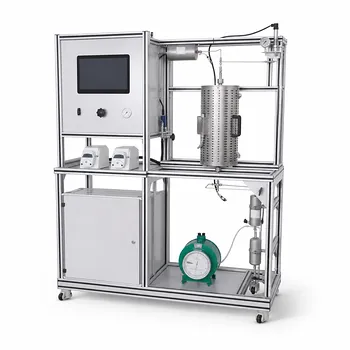
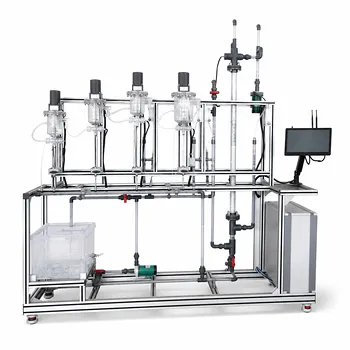
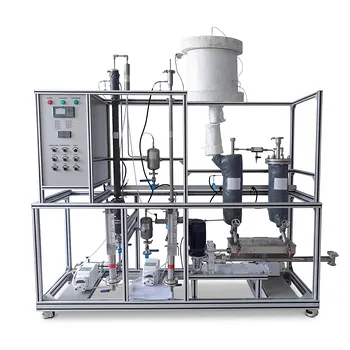
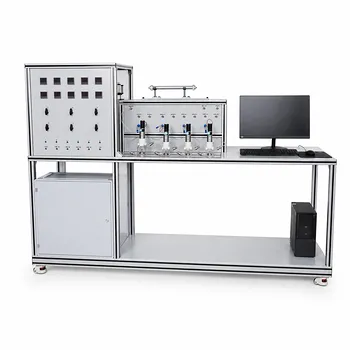
LABPARK provides state-of-the-art Educational and Vocational Unit Operations Pilot Plants in chemical engineering, bioprocess & biotech, and environmental & water treatment. Specifically designed for universities, research institutes, and enterprises, our pilot plants enable hands-on experimentation with heat transfer modeling, reactor scale-up, and automated process control.
Ready to elevate your department's educational capabilities? Contact LABPARK today to consult with our engineering team on the ideal pilot plant configuration for your lab.
Related Products
- Multi-Stage Stirred Tanks in Series Residence Time Distribution and Mixing Performance Determination Educational Pilot Plant
- Multi-Reactor Educational Pilot Plant for Reaction Engineering Unit Operations
- Multi Functional Catalytic Reaction and Reactor Evaluation Educational Unit Operations Pilot Plant
- Ethylbenzene Dehydrogenation Educational Unit Operations Pilot Plant
- Micro-Scale Gas-Solid Catalytic Reaction Educational Pilot Plant
People Also Ask
- How does MRF model impeller rotation in CFD? Key Boundary Conditions Explained
- How can a CSTR pilot plant demonstrate reactor staging? Visualize volume savings.
- How does steady-state multiplicity affect the operation and safety of exothermic reactions within a CSTR pilot plant? - Guide
- What parameters to monitor transitioning from Batch to CSTR? Master Pilot Plant Setup
- Why is temperature regulation via a cooling jacket a critical feature in CSTR pilot plants used for laboratory training?