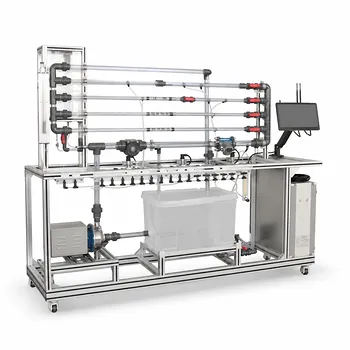
Pilot-scale reaction engineering units make non-elementary mechanisms testable by connecting mechanism-based models to measured reactor behavior. They provide controlled temperature, flow, residence time, mixing, and concentration conditions for collecting kinetic data across multiple operating points. Students and researchers can then test rate expressions for free-radical chain reactions or enzymatic fermentations, estimate kinetic parameters, and compare idealized predictions with real reactor performance.
Pilot units turn complex reaction mechanisms from theoretical sequences into experimentally testable models. Their value lies in combining controlled reaction conditions, species measurements, and hydrodynamic characterization so that both chemical kinetics and reactor nonidealities are evaluated.
Why Non-Elementary Mechanisms Need Pilot-Scale Testing
Overall Stoichiometry Does Not Define the Rate Law
For an elementary reaction, the rate expression can often be written directly from the molecular reaction step. A non-elementary reaction instead proceeds through several steps, so its overall stoichiometric equation does not reveal the reaction orders or intermediate-species dependence.
The observed rate may depend on initiation, propagation, termination, adsorption, inhibition, enzyme saturation, or transport limitations. Pilot-scale experiments provide the data needed to distinguish these effects.
Intermediate Species Control the Observed Behavior
Free-radical mechanisms contain short-lived active intermediates. Enzymatic fermentations involve enzyme-substrate complexes, cellular intermediates, and sometimes inhibitory or competing pathways.
Because these species are difficult to measure directly, models commonly use assumptions such as the Pseudo-Steady-State Hypothesis (PSSH) for short-lived intermediates. Pilot data help determine whether the resulting rate law is consistent with measured reactant consumption and product formation.
How Pilot Units Support Mechanism-Based Modeling
Controlled Operating Conditions
Pilot units allow temperature, feed concentration, residence time, pressure, agitation, and flow rate to be varied systematically. This makes it possible to observe how the reaction responds when one influential variable changes while others remain controlled.
For radical systems, temperature and initiator concentration may strongly affect initiation and termination. For fermentations, substrate concentration, temperature, pH, dissolved oxygen, and agitation can influence enzyme or cell activity.
Measurement of Reaction Progress
Samples or online sensors can provide concentration data along the reaction path or over time. These measurements support calculations of conversion, selectivity, reaction rate, and product formation.
Repeating the experiment at different concentrations allows users to estimate reaction orders and test whether the rate follows a proposed expression rather than assuming orders from the overall equation.
Testing Dynamic Rate Constants
A mechanism-based model may contain several rate constants rather than one overall constant. Pilot experiments provide observations that can be used to estimate these parameters and assess whether they remain constant over the operating range.
A mismatch between predicted and measured behavior may indicate an incorrect mechanism, changing activity, mass-transfer limitation, or an unmodeled side reaction.
Modeling Free-Radical Chain Reactions
Separating Initiation, Propagation, and Termination
A chain reaction is commonly represented by three functional stages:
- Initiation: active radicals are formed.
- Propagation or chain transfer: radicals react with stable molecules and generate new radicals.
- Termination: radicals are removed through recombination or other deactivation steps.
The overall reaction rate may therefore depend on radical generation and loss rates, not simply on the concentration of the primary reactants.
Applying the Pseudo-Steady-State Hypothesis
For a short-lived radical intermediate, the PSSH approximates its net rate of accumulation as zero. This reduces a detailed set of elementary balances to a usable rate expression for the measurable reaction.
Pilot units let students compare the resulting expression with data collected at different initiator levels, temperatures, concentrations, and residence times. The comparison shows when the approximation is useful and when radical accumulation or changing operating conditions makes it unreliable.
Relating Kinetics to Safety and Selectivity
Radical reactions can be highly sensitive to temperature and mixing. A pilot unit provides a controlled environment for studying heat release, concentration gradients, conversion, and by-product formation before considering larger equipment.
The measurements also help reveal whether a nominally kinetic effect is actually caused by poor heat removal, inadequate mixing, or residence-time variation.
Modeling Enzymatic Fermentations
Testing Michaelis-Menten Behavior
A basic enzyme-catalyzed rate expression can be written in Michaelis-Menten form:
[ r = \frac{V_{\max}S}{K_M + S} ]
where (S) is substrate concentration, (V_{\max}) represents the maximum rate under the modeled conditions, and (K_M) characterizes the concentration range over which the rate changes from substrate-sensitive to near-saturated.
Pilot experiments across a range of substrate concentrations allow users to test whether the data exhibit saturation rather than a simple first- or second-order relationship.
Identifying Practical Limitations
Real fermentations may depart from basic Michaelis-Menten behavior because of substrate inhibition, product inhibition, enzyme deactivation, cell growth, nutrient limitations, or changing pH. Pilot units make these departures visible under controlled but realistic operating conditions.
Agitation and aeration also affect oxygen transfer and mixing. If the measured rate changes with agitation or gas flow, the apparent kinetics may include a mass-transfer limitation rather than representing intrinsic enzyme or cell kinetics alone.
Connecting Batch and Continuous Operation
Batch operation provides concentration-versus-time data and is useful for estimating kinetic parameters. Continuous stirred-tank or plug-flow operation adds residence-time information and exposes the model to steady-state conditions.
Comparing both modes helps determine whether a proposed kinetic expression remains valid when concentrations, dilution rate, and biological activity change.
Separating Reaction Kinetics from Reactor Behavior
Residence-Time Distribution Reveals Nonideal Flow
Real reactors do not always behave as ideal batch, plug-flow, or perfectly mixed systems. Channeling, bypasses, stagnant zones, and dead volume can cause some material to react for much less or much more time than the nominal residence time suggests.
Tracer experiments generate a residence-time distribution (RTD). Students can use the measured response to fit models such as tanks-in-series or CSTR arrangements with bypass and dead volume.
Mixing Can Change Conversion and Selectivity
Mixing determines how reactants, intermediates, heat, and catalysts are distributed. This is particularly important when the reaction is nonlinear, fast, highly exothermic, or sensitive to local concentration.
A pilot unit makes it possible to compare conversion predicted using ideal flow assumptions with conversion calculated using the measured RTD. The difference shows how hydrodynamics modify the apparent performance of the mechanism.
Transport Limitations Can Mimic Different Kinetics
External mass transfer, internal diffusion, and catalyst effectiveness can limit the observed rate. In fermentation, oxygen transfer and viscosity can play similar roles.
Without diagnosing transport, a model may incorrectly assign a lower reaction order or a different rate constant to what is actually a mixing or diffusion problem. Pilot-scale measurements help separate intrinsic kinetics from equipment-level limitations.
Using Experimental Data to Validate Models
Fit Parameters Across Multiple Conditions
A reliable model should be tested against more than one operating point. Data from different temperatures, concentrations, residence times, and flow conditions provide a stronger basis for estimating parameters and identifying systematic errors.
A model that fits one experiment but fails at other conditions may be overfitted or based on an incomplete mechanism.
Compare Predicted and Measured Profiles
Validation can include concentration profiles, conversion, selectivity, product yield, outlet response, and transient behavior. For continuous systems, the model should reproduce both steady-state results and relevant changes following operating disturbances.
This comparison teaches the distinction between parameter fitting and mechanistic validation. A good numerical fit is useful, but it does not by itself prove that the assumed mechanism is correct.
Scale the Findings Toward Industrial Design
Once the kinetic and hydrodynamic effects are characterized, the model can support reactor sizing and operating-window analysis. It can also indicate whether scale-up is likely to be controlled by reaction rate, heat removal, mixing, mass transfer, or residence-time distribution.
The pilot unit therefore serves as an intermediate test environment between laboratory observations and full-scale reactor design.
Understanding the Trade-offs
Pilot Data Are More Realistic but Less Perfect
Pilot units include equipment behavior that ideal laboratory experiments often omit. That realism is valuable, but it introduces uncertainty from sensor accuracy, sampling delay, fouling, evaporation, calibration, and uncontrolled disturbances.
Measurements should therefore include uncertainty estimates and appropriate material and energy balances.
Mechanism Identification May Remain Ambiguous
Different mechanisms can produce similar concentration profiles over a limited operating range. Data from one reactor configuration may not uniquely identify the correct sequence of elementary steps.
Discriminating mechanisms requires experiments designed to produce different predictions, such as varying initiator concentration, temperature, substrate level, residence time, or mixing intensity.
Scale-Up Does Not Preserve Every Condition Automatically
A pilot reactor can match nominal temperature and residence time while failing to match mixing time, heat-transfer area per volume, shear, oxygen-transfer capacity, or local concentration gradients.
Pilot results should be interpreted with dimensionless analysis, transport measurements, and a clear distinction between intrinsic kinetic parameters and apparent pilot-scale rates.
Biological Systems Change with Time
In enzymatic and fermentation systems, catalyst or cell activity may change through deactivation, growth, adaptation, or product accumulation. A constant-parameter model may therefore be adequate only for a defined operating interval.
Time-dependent activity and inhibition should be included when the data demonstrate that they materially affect the process.
Making the Right Choice for Your Goal
Pilot-scale units are most useful when experiments are designed to test both the chemistry and the physical behavior of the reactor.
- If your primary focus is mechanism teaching: Use controlled batch, CSTR, or plug-flow experiments to connect initiation, propagation, termination, PSSH, and Michaelis-Menten concepts with measured rates.
- If your primary focus is kinetic parameter estimation: Vary temperature and reactant or substrate concentrations across multiple operating points, then fit and validate the proposed rate expression.
- If your primary focus is reactor modeling: Combine reaction data with tracer-based RTD measurements so that conversion predictions include bypass, stagnant zones, and mixing effects.
- If your primary focus is scale-up: Use pilot data to determine whether intrinsic kinetics, heat transfer, mass transfer, oxygen transfer, or hydrodynamics control performance.
A well-designed pilot unit makes non-elementary reaction engineering understandable, measurable, and useful for decisions about real reactor operation.
Summary Table:
| Focus area | What pilot-scale testing reveals |
|---|---|
| Reaction kinetics | Rate laws, reaction orders, kinetic parameters, and mechanism fit |
| Free-radical reactions | Effects of initiation, propagation, termination, temperature, and safety conditions |
| Enzymatic fermentations | Saturation, inhibition, deactivation, cell activity, and substrate effects |
| Reactor behavior | Mixing, residence-time distribution, bypass, dead volume, and nonideal flow |
| Transport limitations | Heat transfer, mass transfer, diffusion, oxygen transfer, and agitation effects |
| Model validation | Agreement between predicted and measured conversion, selectivity, yield, and profiles |
| Scale-up decisions | Whether kinetics, hydrodynamics, heat removal, or mass transfer controls performance |
Ready to connect reaction theory with measurable reactor performance? Contact LABPARK to discuss Educational and Vocational Unit Operations Pilot Plants for chemical engineering, bioprocess and biotech, and environmental and water treatment applications. LABPARK helps universities, research institutes, and enterprises evaluate reaction kinetics, test radical and enzymatic mechanisms, analyze reactor hydrodynamics, validate models, and build practical scale-up knowledge with controlled pilot equipment.
Related Products
- Multi-Reactor Educational Pilot Plant for Reaction Engineering Unit Operations
- Fixed-Bed Chemical Reaction and Gas Dust Tar Removal Unit Operations Pilot Plant
- Fixed Bed Gas Solid Catalytic Reaction Educational Pilot Plant
- Multi Functional Catalytic Reaction and Reactor Evaluation Educational Unit Operations Pilot Plant
- Micro-Scale Gas-Solid Catalytic Reaction Educational Pilot Plant
People Also Ask
- How do reactor pilot plants define QbD design space? Master chemical process scale-up.
- When configuring a reactor unit operations pilot plant for highly exothermic reactions, how to prevent thermal runaway?
- How do metal ion-catalyzed reaction mechanisms inform chemical engineering pilot plant design? From kinetics to scale-up
- What role do educational pilot plants play in scaling green chemistry? Bridging the Lab-to-Industry Gap
- What are the barriers to process intensification & how do pilot plants help?