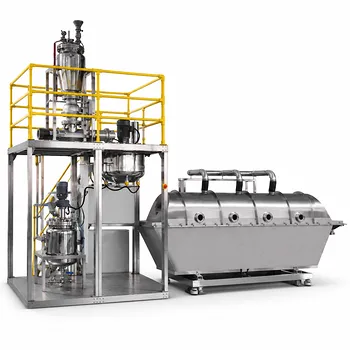
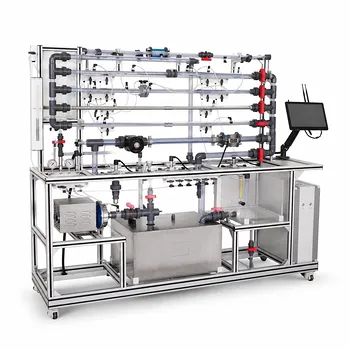
The answer lies not in scaling up a single reaction, but in simulating the entire plant environment before a single pipe is welded. Modern unit operations pilot plants for chemical engineering education directly address the jump from laboratory microprocessing to industrial integration by providing scaled-down, modular, fully instrumented systems that replicate real-world process flows. These platforms move students beyond isolated glassware reactions into a world of interconnected unit operations—reaction, separation, recycling, and post-treatment—all governed by industrial control systems, advanced sensorics, and bus-based communication architectures. The goal is to compress years of expensive trial-and-error scale-up into a semester of hands-on validation, economic evaluation, and process control mastery.
The transition from micro-structured lab devices to an integrated industrial plant is a problem of physics, complexity, and risk—not just size. Educational pilot plants solve this by giving students a living model of a whole chemical process, where they can confront fluid dynamics, heat transfer limitations, and control system integration at an intermediate scale that faithfully predicts full-plant behavior.
Why Laboratory-Scale Microengineering Falls Short
The elegance of microstructured devices comes with a dangerous blind spot. Reactions that run flawlessly at the milliliter-per-minute scale often collapse under the surface-area-to-volume ratios and mixing regimes of a production environment.
The Physics Change, Not Just the Volume
Microreactors live in a laminar, diffusion-dominated world. Heat dissipates instantly. Concentration gradients vanish.
Moving to even a pilot scale introduces chaotic fluid dynamics, hot spots, and mass transfer limitations that are invisible on the bench. An exothermic reaction that seemed harmless in a glass chip can run away in a kilo-scale vessel if mixing and heat removal are not properly designed.
The Integration Challenge Is Invisible in Isolation
A laboratory setup focuses on one transformation. An industrial plant is a chain of interdependent units.
In a real plant, the performance of your distillation column depends on the upstream reactor’s output. Your solvent recovery loop impacts raw material economics. Working with isolated glassware never teaches you how a poorly controlled reaction phase ripples into a purification nightmare.
The Educational Pilot Plant as a Miniature Industrial Ecosystem
This is where modern unit operations pilot plants transform education. They are not just bigger reactors; they are complete, reconfigurable process trains built to mirror industrial reality.
A Platform for Whole-Process Development
Instead of studying unit operations in silos, students operate an entire chemical plant in miniature. The primary reference highlights that these systems integrate docking platforms, bus systems, advanced sensorics, and process control interfaces to create a single cohesive environment.
This allows operators to validate control concepts, perform economic evaluations, and study whole-process development—activities that directly translate to the industry’s “right-first-time” imperative. You don’t just learn what a pump does; you learn how a faulty temperature loop in the preheater causes a 15% drop in final product purity.
Bridging the Scale Gap with Physical Fidelity
Supplementary references emphasize that these pilot plants fill the critical knowledge void between gram-scale lab work and industrial production. They operate in the kilo lab and semiworks range, where the physics of heat and mass transfer start to dominate in ways that cannot be extrapolated from a textbook.
Throughput is no longer theoretical. Modern vocational pilot plants can incorporate large-capacity microstructured mixers and heat exchangers capable of several cubic meters per hour—right in the classroom. This lets students feel the pressure drop, hear the cavitation, and see the fouling that only real flow can deliver.
How Modular Design Replicates Real-World Complexity
To mimic an industrial facility, educational pilot plants are organized into modular unit operations that map directly to standard process engineering: raw material preparation, catalytic reaction, product separation (distillation, absorption, extraction), recycling, and post-treatment.
Manipulating the Butterfly Effect in Real Time
Students can adjust temperature, pressure, flow rates, and space velocity at any module and instantly observe the cascade of consequences. If you raise the reactor temperature to boost conversion, you might immediately see an overload in the downstream distillation column on the process display.
This live feedback loop teaches the interdependence of unit operations in a way no simulation can. It forces students to think like plant managers, not bench chemists.
Incorporating Process Intensification Hardware
The bridge to microprocess engineering is not abandoned. These pilot plants often feature advanced mixing geometries: multi-laminating interdigital, turbulent interdigital, and split-and-recombine structures. Students explore how these microstructured internals handle throughputs that reach cubic meters per hour while maintaining pressure drops below 10 bar, preparing them for the hybrid world of process intensification now common in industry.
Validating Theory with Physical Data
It’s tempting to believe a digital twin can replace a pilot plant. But models are only as good as their assumptions.
From Black-Box Simulation to Verified Models
Process simulation tools are vital for estimating capacity and eliminating bottlenecks, yet their predictions are worthless without empirical grounding. Educational pilot plants generate the real-world data on heat transfer coefficients, pressure drops, and kinetic constants that students then feed back into Aspen or gPROMS models.
This closes the loop between theory and reality. Students see exactly how a flawed assumption in a model leads to a column that floods in the lab, teaching them skepticism and validation habits that prevent multi-million-dollar mistakes.
Accelerating the “Right-First-Time” Timeline
Industry no longer can afford iterative, trial-and-error scale-up over years. Modern practice uses scale-down techniques and predictive engineering. By practicing on pilot plants, students learn to use intermediate-scale data to rapidly verify if a reaction is scale-sensitive—and then optimize the parameters that will define the commercial reactor. This aligns academic training with the demand for safer, faster, and more economic process delivery.
Understanding the Trade-offs
No teaching tool is a perfect mirror. Acknowledging the limitations of educational pilot plants is essential for genuine learning.
Cost and Complexity Versus Conceptual Purity
A fully integrated pilot plant is expensive to build, maintain, and operate. It requires staff who understand distributed control systems (DCS) and industrial safety protocols.
For early-stage reaction screening, a simple microreactor rig is faster and cheaper. The risk is that without the pilot plant experience, students may never internalize the integration mindset required for plant design.
Physical Constraints Versus Digital Flexibility
A pilot plant is a fixed physical asset with limited capacity. You cannot run 50 design variants in a day as you can with a process simulator. The educational value emerges when physical runs are combined with pre-simulation, so each experiment becomes a hypothesis test. Use the plant to confirm, not to explore blindly.
Making the Right Choice for Your Curriculum
To bridge the gap from laboratory microengineering to industrial integration effectively, the educational approach must be matched to the learning objective.
- If your primary focus is teaching whole-process integration: A modular, fully instrumented pilot plant that links reaction to separation and recycle is irreplaceable. Students must manage the entire flowsheet.
- If your primary focus is validating mathematical models: Select a pilot plant with open data interfaces and robust sensor arrays, so the focus is on collecting high-quality transport data to test simulation accuracy.
- If your primary focus is process safety and scale-up risks: Choose a system capable of handling exothermic reactions and pressure buildup at kilo scale, where runaway scenarios can be studied under controlled but realistic conditions.
- If your primary focus is process intensification fundamentals: Opt for a pilot plant that integrates large-capacity microstructured mixers and heat exchangers, demonstrating how microgeometry maintains performance at commercial throughputs.
The ultimate power of these educational platforms is that they transform scale-up from a mysterious art into a methodical engineering discipline—one where the next generation of chemical engineers builds the confidence to go right first time.
Summary Table:
| Aspect | Lab-Scale Microengineering | Educational Pilot Plants | Industrial-Scale Integration |
|---|---|---|---|
| Flow & Mixing | Laminar, diffusion-dominated | Chaotic fluid dynamics, mass transfer | Highly turbulent, complex flow profiles |
| System Scope | Isolated, single-unit reactions | Modular, interconnected unit operations | Fully integrated, commercial-scale loops |
| Control Systems | Manual or simple bench software | Industrial DCS, advanced sensorics, bus systems | Distributed control rooms, fully automated |
| Purpose | Catalyst screening, basic kinetics | Scale-down validation, economic evaluation | Continuous, high-volume production |
Transform Your Process Training and Research with LABPARK
Are you looking to bridge the gap between bench-scale theory and industrial reality?
LABPARK provides premium Educational and Vocational Unit Operations Pilot Plants tailored for universities, research institutes, and enterprises. We specialize in cutting-edge systems for:
- Chemical Engineering (Distillation, extraction, reaction, and process control)
- Bioprocess & Biotech (Fermentation, bioreactors, and downstream processing)
- Environmental & Water Treatment (Membrane filtration, wastewater treatment, and purification)
Equip your lab with modular, fully instrumented pilot plants that teach students to manage real-world process flows, mitigate scale-up risks, and master advanced control systems.
Contact LABPARK today to build your custom pilot plant solution!
Related Products
- Carbon Dioxide Hydrogen Methanol Synthesis Educational Unit Operations Pilot Plant
- Multi-Reactor Educational Pilot Plant for Reaction Engineering Unit Operations
- Ethyl Acetate Synthesis Unit Operations Pilot Plant for Practical Training
- Multi Pump Fluid Transport Process Piping Unit Operations Training Pilot Plant
- Natural Product Extraction Unit Operations Training Pilot Plant
People Also Ask
- How do temp & pressure affect methanol synthesis pilot plants? Optimize equilibrium and catalyst performance.
- Why is a purge system necessary when operating a gas recirculation loop in a methanol synthesis pilot plant? (Guide)
- Why do modern methanol pilot plants operate at lower pressures? Catalyst & Feed Requirements Explained
- What are the operational requirements for catalyst activation? Safe Methanol Pilot Plant Operation
- Why is the chemical plant startup schedule crucial? De-risk scale-up with pilot plants.