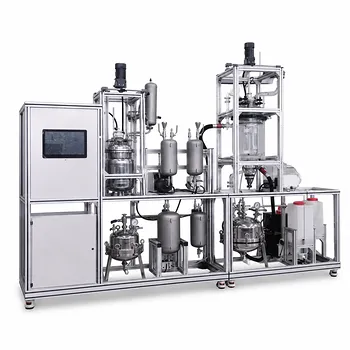
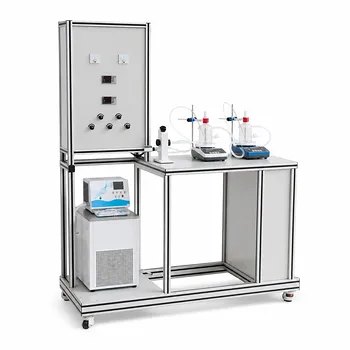
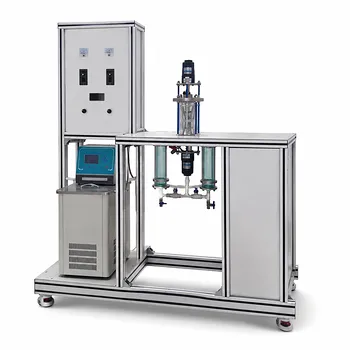
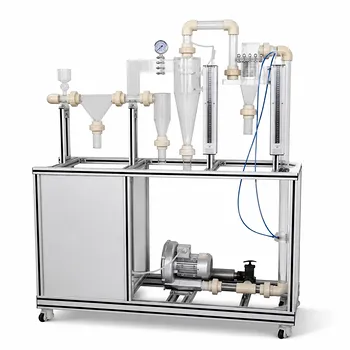
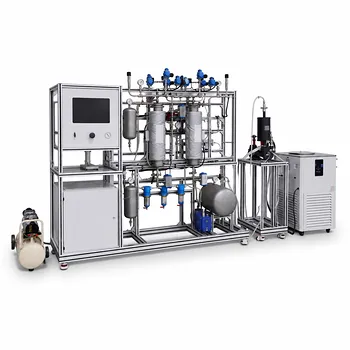
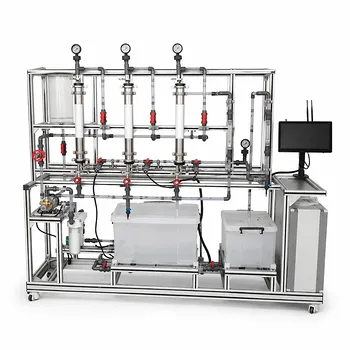
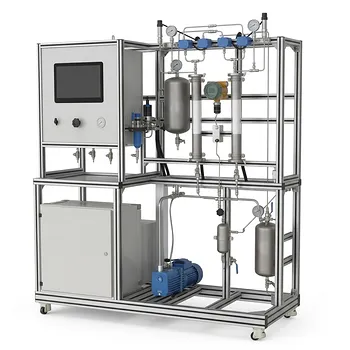
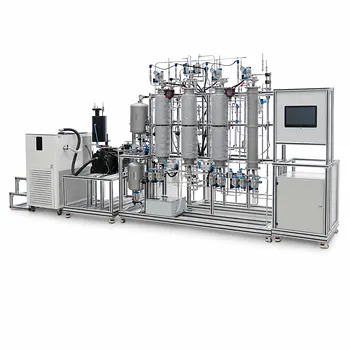
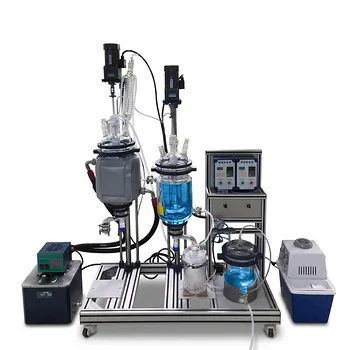
When you need to truly understand how to break a stubborn water-in-oil emulsion, a pilot plant isn't just a helpful tool—it's an absolute necessity.
It acts as a controlled experimental bridge, allowing you to systematically manipulate and measure the core physical variables—temperature, residence time, and chemical dosing—that govern settling kinetics. By providing a transparent, instrumented environment, these units let you directly observe droplet behavior and validate theoretical settling equations like Arnold and Stewart's, moving beyond theoretical estimates to gather the empirical data required for confident industrial scale-up.
The fundamental challenge of studying emulsion breaking is that it's a dynamic, multi-variable problem. A liquid-liquid separation pilot plant solves this by transforming theoretical settling equations from academic concepts into a practical, visual, and measurable experimental platform, allowing you to isolate the exact impact of each variable on the speed and completeness of phase separation.
How Pilot Plants Unlock the Variables of Settling Kinetics
The surface-level answer reveals the pilot plant's role, but the deep need is to understand how it generates the specific, trustworthy data you need to design or fix a full-scale process. The value lies in the experimental rigor and direct observation these systems provide.
Isolating the Core Variables of Gravity Settling
A well-designed pilot plant allows you to hold all variables constant except for the one you are testing. This is the only way to derive a reliable kinetic model.
The Crucial Role of Temperature and Viscosity
The primary reference correctly highlights that temperature is a powerful lever because it directly impacts the continuous phase's viscosity ($\mu$) and the specific gravity difference ($SG$) between oil and water. A pilot plant with a heating jacket and precise temperature control lets you measure a curve of settling rate versus temperature, not just a single data point. You can see exactly how much a 10°C increase drops the required residence time.
Validating the Settling Equation with Empirical Data
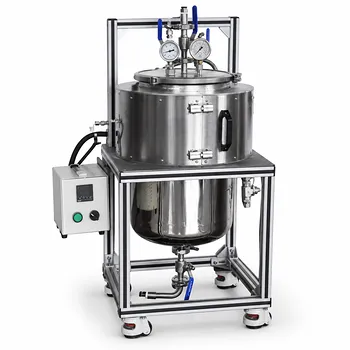
The Arnold and Stewart equation, $dL = \frac{438 Q_o \mu}{SG d_m^2}$, is the cornerstone of separator sizing, but its terms for effective length ($L$) and droplet size ($d_m$) are difficult to estimate theoretically. A horizontal pilot vessel is your direct experimental tool for solving this. By running the plant at steady state and measuring the actual water cut (BS&W) in the outlet oil, you can back-calculate the real effective droplet size your inlet conditions and any upstream mixers have created. This data is far more powerful than any textbook estimate.
Visualizing the Kinetics of Destabilization
The supplementary references introduce a critical layer that the primary reference only implies: the physical process of emulsion breaking is visually diagnosable.
Observing Droplet Coalescence and Flooding Limits
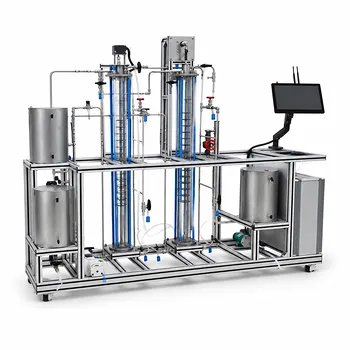
Transparent columns are a game-changer for research. You can visually identify the "rag layer," measure its thickness, and witness how it changes with a demulsifier injection rate. More importantly, you can directly observe the hydrodynamic failure modes discussed in the supplementary references, such as column flooding, where small droplets are entrained and carried out with the opposite phase, setting a hard operating limit.
Testing Advanced Remediation & Breaking Strategies
A flexible pilot plant lets you move beyond simple settling and investigate targeted solutions for stable emulsions, directly linking cause to effect.
Quantifying the Impact of Chemical Demulsifiers and Salts
The pilot plant is the perfect environment to test the "salting-out" effect or screen new demulsifiers. By injecting precise concentrations of an inorganic salt or a polymeric demulsifier upstream of the settler, you can quantitatively measure the resulting change in separation efficiency. This allows you to build a dose-response curve that is valid for your specific crude oil and water chemistry, a task impossible to do with any accuracy through simulation alone.
Integrating Mechanical and Electrostatic Enhancement
You can reconfigure the pilot plant to add a centrifugal separator or an electrostatic grid. The supplementary references note a powerful synergistic effect when combining an electric field with a polymeric adsorber. In a pilot plant, you can demonstrate that at a high flow rate where an electrostatic treater alone fails, the addition of a polyHIPE polymer adsorber restores complete separation. This direct, continuous-flow demonstration provides the proof needed to justify a novel process design.
Understanding the Trade-offs and Limitations of Pilot Testing
While a pilot plant is an essential tool, treating its data uncritically is a major pitfall. You must be aware of what a pilot plant does not do.
The Scale-Up Challenge
The most honest takeaway from the references is that a pilot plant provides the constants for the equations, but the equations themselves are needed for scale-up. A droplet settling at a certain rate in a 4-inch diameter column will not behave identically in a 10-foot vessel due to wall effects and flow distribution. Pilot plant data validates the mechanism and provides the kinetic parameters (like effective droplet size), not the final industrial dimensions.
The Trap of Short-Term Testing
A pilot plant test may run for a few hours or days. It might never capture the long-term accumulation of stable intermediate rag layers that can take weeks to build in a field separator. It also may fail to replicate the effect of production upsets, well shut-ins, or the slow change in incoming fluid properties. Your pilot plant results are a high-fidelity snapshot, not the entire movie. Accordingly, the supplementary reference's point about extended settling times—up to 24 hours for some separations—is a physical constraint that a high-flow-rate pilot test can easily overlook, leading to an underestimation of the required industrial residence time.
Making the Right Choice for Your Pilot Study
Your experimental design should directly target the specific knowledge gap you are trying to fill. The configuration of the pilot plant and the data you collect will vary dramatically.
- If your primary focus is validating a separator's design model: Focus on a horizontal vessel with precise level controls and variable internals. Your goal is to experimentally determine the effective droplet diameter ($d_m$) and use it to calibrate the Arnold and Stewart equation for your specific fluids.
- If your primary focus is screening chemical demulsifiers or remediation techniques: Use a transparent column or a small, well-instrumented mixer-settler. Your goal is to generate dose-response curves for temperature, salt, or commercial chemicals, directly measuring their impact on the thickness of the rag layer and outlet BS&W.
- If your primary focus is demonstrating a new, intensified process: Modify the pilot plant to integrate the novel technology, such as an electrostatic treater with a solid-state adsorber. Your goal is to generate comparative data at challenging high flow rates to prove the synergistic performance advantage over a conventional setup.
A pilot plant doesn't just answer the question what variables matter; it provides the empirical foundation to answer how much they matter, turning emulsion breaking from a troubleshooting art into a predictable, scalable science.
Summary Table:
| Variable | Pilot Plant Testing Method | Impact on Settling Kinetics |
|---|---|---|
| Temperature | Controlled heating jackets | Reduces viscosity; accelerates settling rate |
| Chemical Dosing | Upstream demulsifier/salt injection | Promotes droplet coalescence; breaks rag layers |
| Droplet Size ($d_m$) | Outlet water cut (BS&W) analysis | Calibrates sizing models (e.g., Arnold & Stewart) |
| Flow Rate | Variable pumping speed adjustment | Defines residence time & system flooding limits |
Bridge the Gap from Lab to Industrial Scale-Up with LABPARK
Are you looking to master complex separation processes and achieve predictable scale-up? LABPARK provides premium Educational and Vocational Unit Operations Pilot Plants in chemical engineering, bioprocess & biotech, and environmental & water treatment.
Specially designed for universities, research institutes, and enterprises, our systems enable you to isolate key physical variables, validate empirical equations, and study settling kinetics with absolute precision.
Ready to elevate your research and process design? Contact our technical experts today to find the perfect pilot plant solution for your lab!
Related Products
- Gallium and Indium Selective Extraction Educational Pilot Plant
- Comprehensive Liquid-Liquid Extraction Pilot Plant for Engineering Education
- Ternary Liquid-Liquid Equilibrium Educational Pilot Plant
- Hot Filtration Educational Unit Operations Pilot Plant Laboratory System
- Liquid-Liquid Mass Transfer Coefficient Determination Educational Pilot Plant
People Also Ask
- How do pilot plants differentiate physical vs chemical extraction? Enhance Chemical Engineering Training
- What is the significance of the isopycnic line in liquid-liquid extraction? Avoid Column Flooding
- How do droplet motion states affect kD in extraction pilot plants? Optimize Mass Transfer
- Why is predicting multicomponent LLE from binary data more challenging than VLE? Master your pilot plant design.
- How are ternary phase diagrams and LLE data applied in extraction experiments? Optimize Pilot Plant Scale-up