Knowledge Chemical Engineering Education How do internal structures, such as draught tubes or stages, affect gas holdup in multiphase bubble column pilot plants?
Author avatar

Tech Team · LABPARK

Updated 1 month ago

How do internal structures, such as draught tubes or stages, affect gas holdup in multiphase bubble column pilot plants?


The short answer is clear: internal structures like draught tubes, multistage distributors, and external loops have a negligible impact on overall gas holdup in multiphase bubble column pilot plants. For standard air-water systems, the effect of such internals on the volume fraction of gas is minimal, meaning engineers and researchers can confidently apply standard single-stage bubble column correlations to estimate holdup—even in columns with complex internal geometries.

While gas holdup is highly sensitive to superficial gas velocity, sparger design, and liquid properties, the presence of internal flow-directing structures (draught tubes, stages, or loops) does not significantly alter the overall gas volume fraction. As a result, pilot-plant data from columns equipped with internals can be reliably scaled up using classic holdup models, provided the column diameter exceeds 0.15 m and the system operates outside extreme coalescence-inhibiting regimes.

The Real Drivers of Gas Holdup in Pilot Plants

Before explaining why internals like draught tubes and stages rarely matter, it’s essential to understand what does control gas holdup. Three parameters dominate, and knowing them keeps your pilot-plant work grounded in fact.

Superficial Gas Velocity Sets the Stage

The superficial gas velocity – the volumetric gas flow rate divided by the column’s cross‑sectional area – is the primary determinant of gas holdup. As velocity rises, the volume fraction of gas increases predictably. This relationship governs whether the column operates in a homogeneous bubbly flow (low velocities, typically <0.05 m/s) or transitions into slug/churn-turbulent regimes.

The Overlooked Influence of Sparger Design

While draught tubes and stages may be top of mind, the gas sparger itself is an internal that does significantly influence holdup—especially at low gas throughput. A single‑nozzle sparger produces large bubbles and yields lower holdup compared to multinozzle or porous‑plate designs that generate many small bubbles. In the slug‑flow regime at higher velocities, however, even the sparger’s effect disappears.

This contrast is critical for education and troubleshooting. If students measure a lower‑than‑expected holdup, the culprit is almost always the sparger or the liquid properties, not the presence of a draught tube.

Column Diameter and Independence from Internals

Once the column diameter exceeds about 0.15 m, gas holdup becomes virtually independent of both diameter and the presence of internals (for pressures up to 1.6 MPa). This means that a pilot plant with a well‑chosen diameter captures holdup data that translates directly to larger reactors, regardless of whether it contains internal baffles or loops.

When Internal Structures Do (and Don’t) Make a Difference

So why are draught tubes and stages often assumed to matter? The confusion stems from a misunderstanding of what these internals actually change in the flow field.

Draught Tubes and Multistage Distributors: A Second‑Order Effect

Draught tubes create a well‑defined internal circulation loop that modifies liquid velocity profiles. Multistage distributors break the column into compartments and re‑distribute gas at each level. Yet, for overall gas holdup, these changes are minor. The bubble rise velocity, coalescence rate, and gas residence time remain dominated by the same superficial velocity and system properties. Standard single‑stage correlations therefore remain accurate as a first approximation.

The Exception for Non‑Coalescing Media

A subtle nuance appears in non‑coalescing media (e.g., electrolyte solutions or surfactants). Some multistage designs can show slightly higher gas holdup because they disrupt bubble coalescence more effectively. Even then, the increase is modest, and for standard systems like air‑water the impact fades into the experimental noise.

Understanding the Trade‑offs

Choosing to include internals in a pilot plant is primarily a decision about mixing, heat transfer, or phase residence time, not about altering gas holdup itself. The trade‑off is clear:

  • If your goal is to alter holdup: Focus instead on gas velocity, sparger type, or liquid properties (viscosity, surface tension). Adding a draught tube will not move the needle.
  • If your goal is to improve liquid circulation or staging: Accept that the gas holdup will remain predictable, and use standard correlations. This simplifies scale‑up and avoids over‑complicating your data interpretation.

On the flip side, neglecting the true drivers—especially the sparger and the liquid’s physical properties—can lead to misleading holdup estimates. High liquid viscosity, for example, suppresses bubble breakage, lowers holdup, and degrades the mass transfer coefficient. An educational pilot plant that varies liquid properties while keeping internals constant will reveal these physics far more clearly than one that changes baffle configurations.

Making the Right Choice for Your Pilot‑Plant Study

Your decision about whether to incorporate draught tubes, multistage distributors, or external loops should hinge on your learning or scale‑up objective, not on fears about corrupted holdup data.

  • If your primary focus is demonstrating classic bubble column behavior: Use a column diameter larger than 0.15 m, a well‑characterized air‑water system, and a porous sparger. The presence or absence of internals will not distort your gas holdup results, letting students confidently validate empirical correlations.
  • If your primary focus is studying mass transfer under different flow regimes: Vary superficial gas velocity systematically while keeping the sparger and liquid properties constant. Internals can be added to illustrate circulation patterns, but remind users that the holdup numbers remain governed by the gas throughput and coalescence behavior.
  • If your primary focus is bioprocess training with viscous, non‑coalescing broths: Acknowledge that multistage configurations might give a small holdup boost, but still treat it as a second‑order refinement. The substantial gains in oxygen transfer will come from optimizing the sparger and understanding the liquid’s rheology.

When you recognize that gas holdup is overwhelmingly set by velocity, sparger design, and liquid properties—not by draught tubes or stages—you free yourself to design pilot plants that teach the fundamentals of reactor engineering with clarity and confidence.

Summary Table:

Factor / Structure Impact on Gas Holdup Key Mechanism & Role
Superficial Gas Velocity High Primary determinant; governs bubbly vs. churn-turbulent flow.
Liquid Properties High Viscosity and surfactants dictate bubble coalescence rates.
Sparger Design Medium to High Influences initial bubble size distribution at lower velocities.
Draught Tubes & Stages Negligible Primarily alters liquid circulation, not overall gas volume fraction.
Column Diameter (>0.15m) Negligible Holdup becomes independent of diameter, simplifying scale-up.

Optimize Your Scale-Up and Educational Research with LABPARK

Bridge the gap between laboratory scale and industrial reality. LABPARK provides state-of-the-art Educational and Vocational Unit Operations Pilot Plants in chemical engineering, bioprocess & biotech, and environmental & water treatment.

Designed specifically for universities, research institutes, and enterprises, our systems offer:

  • Reliable Scale-Up Data: Validate empirical correlations with robust, industrial-grade pilot columns.
  • Flexible Configurations: Customizable spargers and internals to teach or test real-world multiphase hydraulics.
  • Turnkey Educational Value: Empower students and researchers with hands-on unit operations training.

Ready to elevate your laboratory capabilities? Contact our engineering experts today to find the perfect pilot plant solution for your needs!

Related Products

People Also Ask

Related Products

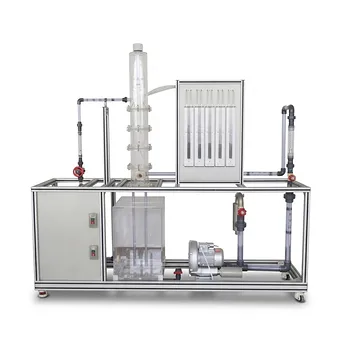
Plate Column Hydrodynamics Tray Demonstration Educational Pilot Plant

Plate Column Hydrodynamics Tray Demonstration Educational Pilot Plant

Advanced transparent educational pilot plant for chemical engineering labs demonstrates plate column hydrodynamics with industrial sieve bubble cap serrated valve trays for visual observation of gas-liquid contact pressure drop measurement and operational limit analysis including flooding weeping entrainment

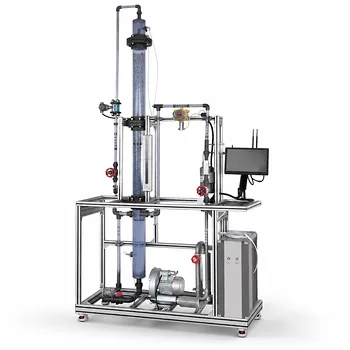
Multimodal Absorption and Desorption Pilot Plant for Unit Operations Training

Multimodal Absorption and Desorption Pilot Plant for Unit Operations Training

Multimodal absorption and desorption pilot plant for higher education labs. Bridges theory and industrial practice with transparent packed columns, three operational modes (real-material, simulated, semi-physical), and SCADA control. Students explore mass transfer, column hydraulics, and process control. Customizable.

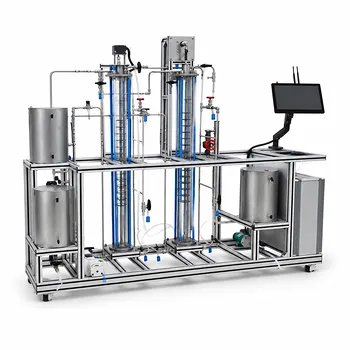
Multi-Functional Special Distillation Educational Pilot Plant

Multi-Functional Special Distillation Educational Pilot Plant

Versatile multi-functional special distillation pilot plant for chemical engineering education. Supports continuous, vacuum, azeotropic, reactive, extractive distillation. Transparent glass columns enable real-time visual observation of hydrodynamics and separation processes.

Multi-Modal Distillation Unit Operations Training Pilot Plant

Multi-Modal Distillation Unit Operations Training Pilot Plant

Multi-modal distillation pilot plant for practical unit operations training in chemical engineering education. Features real, analog, and semi-physical simulation modes, industrial construction, customizable for university labs. Hands-on fractionation columns, SCADA control, safety systems. Includes sight glasses, sampling ports, closed-loop recycling.

Absorption and Desorption Educational Unit Operations Pilot Plant

Absorption and Desorption Educational Unit Operations Pilot Plant

Dual packed column absorption and desorption pilot plant for chemical engineering education, offering real-time mass transfer coefficient measurement, durable mobile frame, industrial touch-screen interface, and customizable design for varied laboratory curricula, enabling hands-on study of gas absorption and stripping.

Comprehensive Liquid-Liquid Extraction Pilot Plant for Engineering Education

Comprehensive Liquid-Liquid Extraction Pilot Plant for Engineering Education

Comprehensive liquid-liquid extraction pilot plant for engineering education, integrating rotary and vibratory columns for hands-on observation of phase behavior, flooding limits, and mass transfer efficiency, enabling precise HTU and mass transfer coefficient calculations.

Packed Bed Absorption Educational Unit Operations Pilot Plant

Packed Bed Absorption Educational Unit Operations Pilot Plant

Study gas-liquid absorption, pressure drop, flooding, and mass transfer coefficients with this pilot plant. Transparent packed column, industrial touchscreen, real-time sensor data, automated analysis. Investigate two-phase flow, loading points, column efficiency. Comprehensive data logging and assessment software included.

Continuous Batch Extractive Distillation Educational Pilot Plant

Continuous Batch Extractive Distillation Educational Pilot Plant

Versatile pilot plant for continuous, batch, and extractive distillation training. High-borosilicate glass column for visualizing hydraulics, 15.6-inch touchscreen with data logging, precise reflux ratio control 1-99, and durable corrosion-resistant frame. Ideal for chemical engineering education and process research.

Dual-Mode Rectification Pilot Plant for Practical Training Unit Operations

Dual-Mode Rectification Pilot Plant for Practical Training Unit Operations

Industrial-scale dual-mode rectification pilot plant for chemical engineering practical training. Features real-material and simulated-material operation modes, sieve-plate column with sight glasses for visual observation of hydrodynamics, and customizable SCADA control for safe, hands-on learning of unit operations and mass transfer.

Multi-Stage Stirred Tanks in Series Residence Time Distribution and Mixing Performance Determination Educational Pilot Plant

Multi-Stage Stirred Tanks in Series Residence Time Distribution and Mixing Performance Determination Educational Pilot Plant

Explore residence time distribution and mixing performance in series stirred tanks with this educational pilot plant. Real-time conductivity sensors, interactive 3D simulation, and industrial-grade PC for chemical engineering lab training. Customizable to curricula.

Multi-Reactor Educational Pilot Plant for Reaction Engineering Unit Operations

Multi-Reactor Educational Pilot Plant for Reaction Engineering Unit Operations

Integrated bench-scale educational pilot plant for chemical engineering teaching featuring fixed bed fluidized bed and stirred tank reactors with web-based digital twin controls and safety interlocks for hands-on unit operations and reaction engineering comparative studies in one compact system.

Bench Scale Dual Column Gas Separation and Capture Educational Pilot Plant

Bench Scale Dual Column Gas Separation and Capture Educational Pilot Plant

This dual-column educational pilot plant provides hands-on teaching of gas adsorption, separation, and capture processes. It features stainless steel columns, regeneration up to 400°C, and a 15.6-inch touchscreen PLC for TSA and PSA studies in chemical engineering curricula, process simulation.

Rising and Falling Film Evaporation Educational Unit Operations Pilot Plant

Rising and Falling Film Evaporation Educational Unit Operations Pilot Plant

Hands-on educational pilot plant for studying rising and falling film evaporation, flow regimes, and heat transfer. Customizable for university labs with industrial instrumentation and data acquisition. Enables comparative evaluation of evaporation modes and energy efficiency.

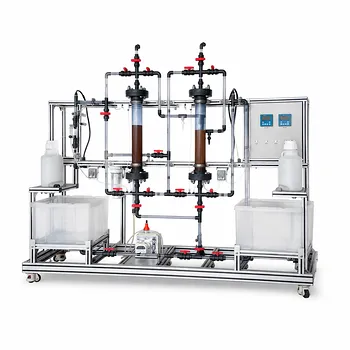
Ion Exchange Water Purification Educational Pilot Plant for Engineering Unit Operations

Ion Exchange Water Purification Educational Pilot Plant for Engineering Unit Operations

This bench-scale ion exchange pilot plant trains engineering students in water purification. Dual transparent columns simulate industrial softening and demineralization. Students observe fluid dynamics, perform resin regeneration, and analyze breakthrough curves. The corrosion-resistant frame ensures durability in unit operations experiments.

Multi Functional Catalytic Reaction and Reactor Evaluation Educational Unit Operations Pilot Plant

Multi Functional Catalytic Reaction and Reactor Evaluation Educational Unit Operations Pilot Plant

Bench-scale educational pilot plant for catalytic reaction and reactor evaluation, integrating fixed bed, fluidized bed, and stirred tank reactors. Students compare reactor designs, evaluate catalysts, and study reaction kinetics and hydrodynamics. Perfect for unit operations labs in chemical engineering curricula.

High-Gravity Emulsification and Mass Transfer Educational Pilot Plant

High-Gravity Emulsification and Mass Transfer Educational Pilot Plant

This integrated educational pilot plant utilizes rotating packed bed technology to demonstrate high-gravity emulsification and mass transfer, providing engineering students with hands-on experience in process intensification and unit operations through a modular, customizable design with digital monitoring.

Supercritical High-Gravity Flash Evaporation Educational Unit Operations Pilot Plant

Supercritical High-Gravity Flash Evaporation Educational Unit Operations Pilot Plant

Bench-scale integrated teaching system for advanced separation and mass transfer, combining supercritical high-gravity flash evaporation with heating, chemical reaction, and material collection, featuring modular design, Stainless Steel 316L construction, transparent visualization, touchscreen control, and safety systems for chemical engineering education.

Educational Unit Operations Pilot Plant for Intraparticle Diffusion Effective Factor Measurement

Educational Unit Operations Pilot Plant for Intraparticle Diffusion Effective Factor Measurement

Designed for chemical engineering university labs, this pilot plant allows hands-on determination of catalyst particle intraparticle diffusion effective factors and gas-solid reaction kinetics using a fixed-bed tubular reactor with industrial touchscreen control, bridging theory and practical reactor design.

Constant Pressure Filtration Educational Unit Operations Pilot Plant

Constant Pressure Filtration Educational Unit Operations Pilot Plant

Hands-on educational pilot plant for constant pressure filtration. Classic plate and frame filter press allows students to study kinetics, determine specific cake resistance, perform cake washing and evaluate washing rates. Ideal for chemical engineering curriculum. Mobile, customizable, safety-compliant design.

Two-Dimensional Fluidization Hydrodynamics Educational Pilot Plant for Unit Operations Training

Two-Dimensional Fluidization Hydrodynamics Educational Pilot Plant for Unit Operations Training

Explore gas-solid and liquid-solid fluidization hydrodynamics with our transparent 2D educational pilot plant. Ideal for chemical engineering unit operations labs, it demonstrates fixed to fluidized bed regimes, measures pressure drop, and integrates QR-code digital learning for enhanced student training.


Leave Your Message