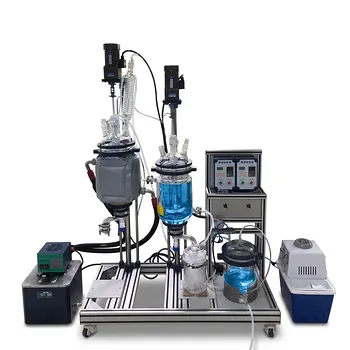
The crystallization of molecular sieves is not just a chemical reaction—it’s a delicate dance between water, heat, and pressure. In hydrothermal synthesis, elevating the temperature above 100°C under autogenous pressure transforms water into a powerful solvent: its ion product surges while density and viscosity drop, accelerating the dissolution of silicate and aluminate precursors and driving their assembly into ordered zeolite frameworks. To study this process in a chemical engineering pilot plant, you need corrosion-resistant autoclaves with precise heating jackets, robust pressure-relief systems, and real-time monitoring—all engineered to safely contain superheated water and capture the subtle interplay of synthesis parameters.
Mastering hydrothermal synthesis means recognizing that water above 100°C becomes a transformative medium—its enhanced ion product speeds up crystallization kinetics, while reduced density and viscosity improve mass transfer. A pilot plant built for this purpose must function like a precision pressure cooker: thoroughly instrumented, fail-safe, and designed to reveal how subtle shifts in temperature and pressure dictate the final molecular sieve architecture.
How Temperature and Pressure Transform Water into a Crystallization Engine
The Changing Face of Water Above 100°C
In a sealed hydrothermal environment, water remains liquid far beyond its normal boiling point.
As the temperature climbs, the density and viscosity of liquid water decrease significantly.
Simultaneously, the ion product (Kw) increases sharply, meaning water dissociates into H⁺ and OH⁻ much more readily.
This combination turns water into an aggressive solvent that can dissolve, transport, and reorganize silicate and aluminate species.
Accelerating Silicate and Aluminate Assembly
The higher ion product directly accelerates hydrolysis and condensation reactions.
Silicate and aluminate precursors dissolve faster, reach supersaturation more quickly, and nucleate into the metastable gel phases that seed zeolite growth.
Lower viscosity enhances molecular diffusion, allowing these species to migrate and assemble into the periodic, microporous frameworks characteristic of molecular sieves like 4A zeolite.
The result is a dramatic shortening of crystallization time and often improved crystallinity compared to low-temperature routes.
Pressure as the Critical Enabler
Pressure in hydrothermal synthesis is autogenous—generated by the vapor pressure of water itself at the chosen temperature.
It maintains the liquid phase and prevents boiling, but its direct effect on crystallization is subtle.
Higher pressure modestly increases density, which can influence the hydration spheres around ions and the equilibrium between different silicate oligomers.
In practice, pressure acts primarily as the enabler of the superheated liquid state, allowing the chemical effects of temperature to operate without interruption.
Engineering a Pilot Plant to Harness Hydrothermal Forces
The Heart of the System: The Autoclave
The pilot plant’s core is a corrosion-resistant pressure vessel—an autoclave—crafted from materials like stainless steel or, for alkaline synthesis mixtures, Teflon-lined or nickel-based alloys.
It must be sealed to contain pressures that can reach tens of megapascals, yet allow for easy assembly and cleaning between runs.
A precise heating jacket (electric or fluid-based) encases the vessel, enabling uniform wall temperatures and reproducible thermal profiles.
Safety and Control: Real-Time Monitoring and Relief
Because superheated water stores immense energy, the design must integrate robust pressure relief systems (rupture discs or safety valves) that vent safely if limits are exceeded.
Real-time temperature and pressure sensors—thermocouples inside the autoclave and pressure transducers on the head—feed data to a control system.
This allows operators to track the crystallization environment continuously, log data for kinetic analysis, and trigger automated shutdowns if parameters drift outside safe windows.
Beyond the Vessel: What Crystallization Science Demands
While many molecular sieve syntheses are batch processes, a well-designed pilot plant goes beyond the autoclave.
Feed characteristics and concentration control are essential to establish the desired supersaturation that drives nucleation and growth.
The system should allow precise variation of the heating and cooling rates, as these determine the generation rate of supersaturation and the duration of the crystal growth phase.
Agitation mechanisms—stirrers or rocking autoclaves—can be incorporated to study the effect of shear on crystal size distribution, but they must be sealed to maintain autogenous pressure.
Finally, sampling ports or rapid quenching cells enable researchers to withdraw intermediate samples and “freeze” the crystallization at different stages for ex-situ analysis of particle size, crystallinity, and morphology.
Understanding the Trade-offs and Common Pitfalls
The Danger of Solubility Misestimation
Predicting the solubility of precursor species under hydrothermal conditions is critical for calculating supersaturation.
A common thermodynamic shortcut—Assumption A, which sets the heat capacity difference between liquid and solid to zero—systematically overestimates the free energy difference, leading to an underprediction of solubility.
In a pilot plant, relying on such an underestimation can cause unexpected early precipitation, fouling of the autoclave, or inaccurate material balances.
Operators must validate solubility data with targeted measurements or use more rigorous thermodynamic models to avoid these hidden errors.
Balancing Nucleation and Growth Kinetics
Temperature and pressure influence nucleation and crystal growth differently.
A high-temperature ramp may produce a burst of nucleation, giving many fine crystals that are difficult to filter, whereas a slow ramp may yield fewer, larger crystals.
Pressure adjustments can shift the equilibrium of silicate condensation, altering the type of zeolite phase that forms.
A pilot plant must allow for systematic variation of these parameters and provide the means to capture the outcome—otherwise, you risk optimizing one output (e.g., yield) at the expense of product quality (e.g., purity or particle size).
Scale-Up and Heat Transfer Limitations
Data from a small laboratory autoclave often fail to translate directly to larger vessels.
As volume increases, heat transfer becomes non-uniform, creating hot or cold spots that lead to inhomogeneous crystallization.
Mixing can become sluggish, causing gel sedimentation and inconsistent product.
A pilot plant should therefore replicate industrial aspect ratios and incorporate internal temperature mapping, so that researchers can identify and mitigate scale-up risks early.
Making the Right Choice for Your Research Goal
The optimal pilot plant configuration depends entirely on what you need to learn from the hydrothermal synthesis.
- If your primary focus is mechanistic understanding: Choose an autoclave with in-situ spectroscopy (e.g., Raman or FTIR) or rapid-sampling ports that let you track the evolution of the gel and crystalline phases in real time.
- If your primary focus is optimizing yield and purity: Implement precise, programmable temperature ramps and automated feed preparation to control supersaturation profiles. Add in-line pH or conductivity sensors to monitor reaction progress.
- If your primary focus is industrial scale-up: Use a series of autoclaves with geometrically scaled dimensions and identical heating profiles. Include internal thermocouple arrays to map thermal gradients and validate computational fluid dynamics models.
By grounding your pilot plant design in the fundamental physics of hydrothermal water and the nuanced control of crystallization parameters, you transform a high-pressure vessel into a revealing window on zeolite genesis—and a reliable compass for process development.
Summary Table:
| Parameter / Component | Role in Hydrothermal Synthesis | Pilot Plant Design Requirement |
|---|---|---|
| Temperature (>100°C) | Lowers density/viscosity, increases ion product, speeds up reactions | Precise heating jackets, uniform wall temperature control |
| Pressure (Autogenous) | Maintains liquid phase, prevents boiling, influences hydration spheres | High-pressure autoclaves (SS/Teflon-lined), safety rupture discs |
| Mass Transfer & Mixing | Affects nucleation, crystal growth, and scale-up homogeneity | Agitation mechanisms (stirrers/rocking), geometric aspect ratios |
| Monitoring & Sampling | Tracks kinetics and freezes crystallization states for analysis | Real-time T/P sensors, rapid quenching cells, sampling ports |
Optimize Your Hydrothermal Synthesis Research with LABPARK
Scaling up molecular sieve crystallization requires precise, reliable, and safe equipment. LABPARK provides state-of-the-art Educational and Vocational Unit Operations Pilot Plants in chemical engineering, bioprocess & biotech, and environmental & water treatment.
Whether you are a university, research institute, or enterprise, we deliver custom-engineered autoclaves and pilot systems designed to help you master process parameters and accelerate scale-up.
Contact LABPARK Today to get started!
Related Products
- Multi Functional Membrane Crystallization Educational Unit Operations Pilot Plant
- Continuous Sieve-Plate Distillation Pilot Plant for Unit Operations Laboratory Education
- Potassium Salt Thermal Dissolution and Crystallization Separation Educational Unit Operations Pilot Plant
- Dual-Mode Rectification Pilot Plant for Practical Training Unit Operations
- Multi-Functional Special Distillation Educational Pilot Plant
People Also Ask
- Why is precise temperature control critical in crystallization pilot plants? Key to Scale-Up Success
- Control Crystallization Pilot Plant Secondary Nucleation: 4 Key Adjustments
- What key factors should be considered when configuring a crystallization unit operations pilot plant?
- How Crystal vs Amorphous Solids Guide Crystallization Pilot Plant Objectives
- What are the benefits of integrating online PAT tools like ATR-FTIR into crystallization unit operations pilot plants?