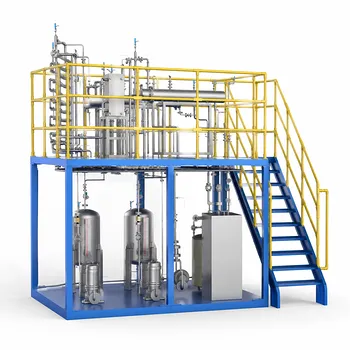
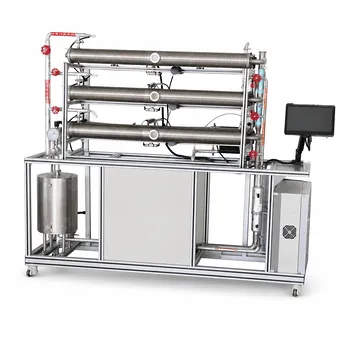
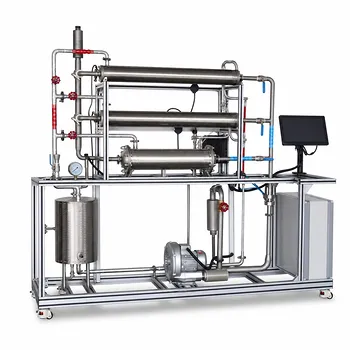
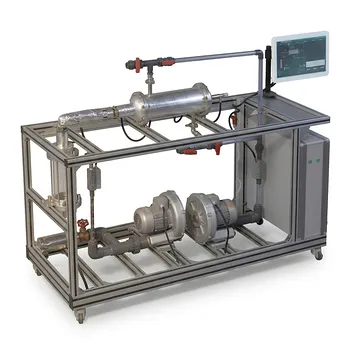
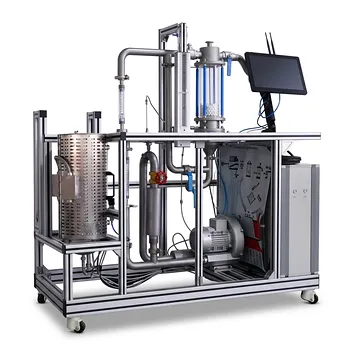
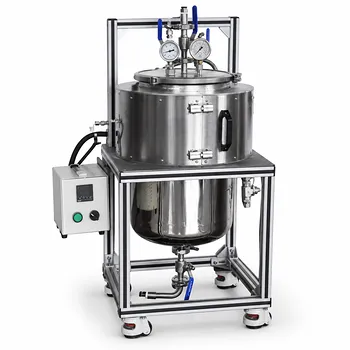
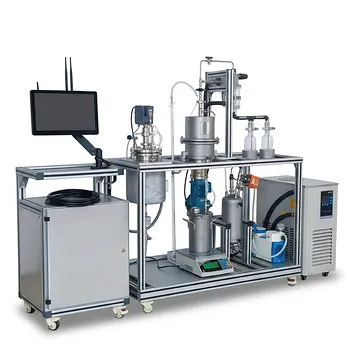
Heat transfer unit operations pilot plants allow the safe study of boiling heat transfer regimes by providing precise, incremental control over heat flux and real-time temperature monitoring, so you can approach the critical heat flux without crossing into dangerous film boiling or risking equipment damage. These systems keep the process firmly in the high-efficiency nucleate boiling zone while teaching operators to recognize and avoid the vapor‑blanket regime that causes sudden overheating. The combination of finely adjustable heating systems, rapid heat removal capability, and robust physical enclosures transforms what would be a hazardous experiment in glassware into a controlled, educational mapping exercise.
The core insight is that pilot plants turn boiling curve exploration from a high‑stakes gamble into a safe, repeatable measurement. By using jacketed vessels, circulating heating media, and sophisticated instrumentation, they let you slowly ramp up heat flux, detect the onset of the critical point, and instantly dial back before film boiling ever takes hold—all while protecting both the equipment and the operator.
Why Film Boiling Is a Critical Safety Concern
The Danger of Crossing the Critical Heat Flux
Boiling is not a single phenomenon. As heat flux increases, a heated surface passes through natural convection, then kicks into nucleate boiling—the regime where bubbles form vigorously, enhance fluid mixing, and produce an extremely high heat transfer coefficient. This is where most industrial reboilers and evaporators are designed to operate.
Beyond a specific critical heat flux (CHF) , however, the vapor generation becomes so intense that it merges into a continuous insulating film over the surface. This film boiling regime drops the heat transfer coefficient by an order of magnitude. Because the same amount of energy is still being dumped into the surface, the wall temperature rockets upward—a phenomenon known as burnout. In a glass flask or uncontrolled heater, that temperature spike can melt metal, crack glass, or ignite organic fluids in seconds.
Real‑World Consequences of Film Boiling
Even a brief excursion into film boiling can ruin expensive equipment, release toxic vapors, or cause fires. In educational settings, the risk is amplified because students are often learning the boundaries by trial and error. A single uncontrolled overshoot can destroy a heating element, contaminate a batch, and create a serious safety incident. That is why safe mapping of the boiling curve is not a luxury but a necessity before scaling any boiling‑based process.
How Pilot Plants Enable Controlled Mapping of Boiling Regimes
Precise Heat Flux Adjustment and Feedback Control
Educational and R&D pilot plants replace the crude heating mantle with jacketed vessels heated by circulating media (steam, thermal oil, or hot water) or with explosion‑proof electric immersion heaters that are tightly regulated by a process control system. This allows the operator to increase the heat input in tiny, pre‑determined steps. A PID loop can hold a set point to within a fraction of a degree, so you can creep toward the expected CHF with no sudden jumps. The moment the boiling regime begins to shift, you have full authority to reduce power immediately.
High‑Resolution Temperature Monitoring
The pilot plant’s instrumentation suite is the true guardian. Multiple thermocouples are placed directly on the heating surface and in the bulk liquid, while pressure transducers and flow meters track the system state. As the wall superheat (the temperature difference between the heater surface and the fluid’s saturation temperature) approaches the critical value, the data acquisition system visualizes a clear inflection. Often, a small but sudden rise in heater surface temperature—visible on a trend screen—signals that transition boiling has almost started. This gives the operator a few seconds of warning before a vapor film can fully form.
Rapid Heat Removal Capabilities
One of the most powerful safety features is the ability to swiftly remove heat from the process. Because the jacket can be instantly switched from heating medium to cooling water, or because emergency cooling coils can be activated, the system can “slam on the brakes” when approaching CHF. This rapid quenching dissipates the energy before the vapor blanket can stabilize, restoring nucleate boiling in moments. In a simple glass setup, you typically have no way to extract heat quickly; the pilot plant’s dual‑purpose jacket makes it an inherently safer platform.
Safe Physical Enclosure and Jacketed Design
Unlike laboratory mantles that wrap glass directly and risk electric shock if a boil‑over occurs, pilot plants use double‑walled, insulated vessels and enclosed heating circuits. Pressure relief valves handle any sudden vapor surge, while drainage and venting systems safely manage condensate and vapor. The design eliminates exposed electrical elements and contains any accidental froth or liquid ejection. As a result, even if a student momentarily misjudges the power input and enters film boiling, the consequence is a controlled shutdown and a teachable moment—not a shattered vessel or a burn injury.
Understanding the Trade‑offs and Limitations
Even the most advanced pilot plant cannot perfectly replicate the behavior of a full‑scale reboiler. In large equipment, natural circulation patterns and two‑phase flow instabilities can alter the local CHF, so the safe operating window mapped at the pilot scale may need adjustment. Additionally, repeated boiling tests can slowly foul the heating surface, which changes its heat transfer characteristics and can shift the critical flux point without warning. Operators must therefore calibrate the system frequently and interpret the temperature trends, not just rely on a single historical number. Finally, the protective reliance on jet‑fast cooling requires that the operator remain attentive—if automation lags or the cooling loop is unable to absorb the transient, a thermal excursion is still possible. Proper training and a well‑defined emergency procedure are non‑negotiable.
Making the Right Choice for Your Application
Pilot plants can be configured very differently depending on what you need to learn. Here is how to align the technology with your primary goal.
- If your primary focus is safe student education on boiling regimes: Select a system with a transparent vessel section (often a borosilicate glass column with a jacket) and a slow‑ramp controller. Visual bubble observation combined with real‑time temperature curves reinforces the theory better than any simulation, and the jacket’s rapid cooling guarantees that a mistake won’t lead to equipment loss.
- If your primary focus is developing a new reboiler process: Invest in a pilot plant with multi‑function heating (electric and steam) and high‑resolution heater‑surface thermocouples. Map the entire boiling curve for your actual process fluid, noting not just the CHF but also the onset of nucleate boiling and any hysteresis in the transition region. This data feeds directly into the safety margin for your full‑scale design.
- If your primary focus is validating scale‑up safety before construction: Run the pilot plant with the same heat flux per unit area that you intend to use at production scale, but deliberately push it to the edge. Use the plant’s fast‑response shutdown circuits to prove that your control philosophy can detect an approaching film‑boiling condition and arrest it in time, giving your operations team a proven safety envelope.
When you give operators a platform that lets them apply heat one thoughtful step at a time, watch the wall temperature respond in real time, and instantly pull back, the high‑stakes mystery of film boiling becomes a measurable, manageable transition—and you walk away with the confidence to operate safely at any scale.
Summary Table:
| Pilot Plant Feature | Functionality | Safety Benefit |
|---|---|---|
| Precise Heat Flux Control | PID-regulated jacketed heating & electrical elements | Prevents sudden heat spikes and allows micro-adjustments near CHF |
| High-Res Temperature Monitoring | Multiple thermocouples on heater surface & bulk fluid | Provides early visual warning of transition boiling on trend screens |
| Rapid Heat Removal | Dual-purpose jacket (instant switch to cooling water) | Instantly quenches thermal excursions, restoring nucleate boiling |
| Physical Enclosure | Double-walled, insulated vessels & pressure relief valves | Safely contains accidental vapor surges, liquid ejections, or leaks |
Take the Risk Out of Heat Transfer Training with LABPARK
Ensure absolute safety and precision when teaching or researching complex thermal processes. LABPARK designs and delivers high-performance Educational and Vocational Unit Operations Pilot Plants in chemical engineering, bioprocess & biotech, and environmental & water treatment. Engineered specifically for universities, research institutes, and enterprises, our systems offer the advanced controls and safety features needed to explore boiling regimes without risk.
Ready to elevate your engineering lab? Contact LABPARK today to request a quote or discuss your custom pilot plant specifications.
Related Products
- Comprehensive Multi-Modal Heat Transfer Unit Operations Pilot Plant for Engineering Training
- Three-Tube Heat Transfer Educational Pilot Plant for Unit Operations Training
- Dual Mode Heat Transfer Pilot Plant for Unit Operations Training
- Comprehensive Heat Transfer Coefficient Determination Educational Unit Operations Pilot Plant
- Shell and Tube Heat Exchanger Heat Transfer Coefficient Determination Educational Pilot Plant
People Also Ask
- When is ε-NTU preferred over LMTD in pilot plants? Predict heat exchanger performance without iteration.
- How does thermal conductivity affect pilot plant performance? Optimize heat transfer & accuracy
- How can a heat transfer pilot plant demonstrate waste heat recovery? Learn to optimize industrial thermal systems.
- Why is emissivity critical in heat transfer pilot plants? Bridge the Gap Between Theory & Industrial Design
- How does cascade control achieve superior disturbance rejection in heat transfer pilot plants?