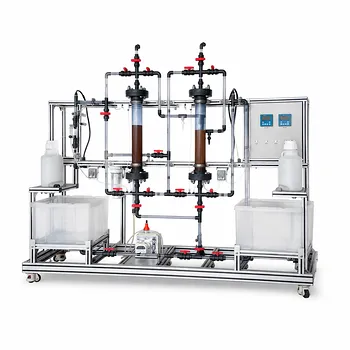
The shape of an adsorption isotherm is the single most decisive factor in a column’s performance.
In a chemical engineering unit operations training plant, a favorable isotherm creates a self-sharpening concentration front that maximizes bed utilization and delivers a steep breakthrough curve, but makes regeneration much harder. An unfavorable isotherm spreads the concentration wave, causing earlier breakthrough and lower adsorbent efficiency, yet simplifies the regeneration step. Trainees who learn to read this thermodynamic signature can correctly select regeneration temperatures, pressures, and solvent flows for any pilot-scale adsorption process.
The adsorption isotherm is not just a laboratory curve—it is the master switch that determines whether your column will be adsorption-efficient or regeneration-friendly. Understanding that favorable isotherms trade easy loading for difficult unloading is the first lesson in designing real adsorption cycles in a pilot plant.
The Heart of Column Dynamics: How Isotherms Shape the Concentration Front
Favorable Isotherms: The Self-Sharpening Shock Wave
When the isotherm is favorable, its slope decreases as the fluid-phase concentration rises.
This means higher-concentration regions of the front travel faster than lower-concentration regions, catching up to them and creating a sharp, shock-wave-like profile.
The result is a self-sharpening concentration front that advances through the bed with almost no spreading.
Trainees observe a steep breakthrough curve: the column effluent stays nearly adsorbate-free until the front hits the outlet, then the concentration jumps rapidly.
This behavior leads to maximum bed utilization because the mass-transfer zone is extremely thin.
In a pilot plant, favorable systems allow shorter columns or higher throughput while still meeting purity targets.
However, this thermodynamic favorability comes at a cost.
Because the adsorbate binds so strongly, regeneration becomes the bottleneck.
Desorption now requires a large disturbance—high temperature, deep vacuum, or a strong chemical displacement agent.
Students quickly learn that the same affinity that makes the adsorption step efficient demands far more energy or chemicals to reverse it.
Unfavorable Isotherms: The Broadening Dispersive Wave
An unfavorable isotherm exhibits a slope that increases with concentration.
Now, high-concentration fluid elements move slower than low-concentration ones, spreading the front into a progressively wider mass-transfer zone.
Trainees see a gradual, smeared breakthrough curve: detectable adsorbate appears early, long before the bed is saturated.
This wave broadening sharply reduces bed capacity utilization.
Because the front stretches out, a large portion of the adsorbent remains only partially saturated at the breakthrough point.
For a unit operations lab exercise, this teaches a critical lesson: you cannot simply assume the nominal capacity is usable—you must measure the actual dynamic capacity under the prevailing isotherm.
The silver lining is regeneration simplicity.
The weak adsorbate‑adsorbent interactions that cause the broadening also mean that only a mild stimulus—slightly elevated temperature, a modest pressure reduction, or a gentle solvent wash—can strip the bed.
Trainees can regenerate an unfavorable column quickly and with minimal energy, a clear advantage in low-cost, high-cycle-frequency operations.
Bridging Theory and Pilot Plant Operation: What Students Must Control
Diagnosing Isotherm Type from Breakthrough Data
In a teaching pilot plant, students can run a saturation experiment and record the breakthrough curve.
A sharp “S” curve that rises abruptly signals a favorable isotherm.
A long, gradual curve that begins to break through almost immediately points to an unfavorable isotherm.
This simple diagnosis is the gateway to all subsequent process decisions.
Once trainees know which shape governs their system, they can predict whether they will struggle with capacity or with regeneration—and plan accordingly.
Tuning Regeneration Parameters
For a favorable isotherm, a standard hot nitrogen purge or low-pressure swing may be insufficient.
Trainees must increase the regeneration temperature, prolong the regeneration time, or switch to a stronger desorbent.
For example, in a temperature-swing adsorption (TSA) module, a favorable system like water on alumina might require heating to 200–250 °C, while an unfavorable moisture-adsorption pair might fully regenerate at just 120 °C with a fraction of the purge gas.
For an unfavorable isotherm, students can design a regeneration protocol that uses much lower temperatures or shorter cycles.
They learn to quantify the trade‑off: lower capacity but faster, cheaper regeneration.
This becomes a powerful decision‑making tool when scaling a process from the bench to a pilot plant.
Understanding the Trade-offs
The Capacity‑Regeneration Balance
The fundamental conflict in adsorption design is that the easier a molecule is to catch, the harder it is to release.
Favorable isotherms give you high dynamic capacity but demand intensive regeneration.
Unfavorable isotherms offer easy regeneration but leave a large fraction of the bed unused.
A thorough pilot-plant curriculum puts numbers to this trade‑off.
Students can measure bed utilization (e.g., 85 % versus 45 %) and regeneration energy (e.g., MJ/kg adsorbate) for both systems, then calculate the total process cost.
This builds the economic intuition that is essential for industrial column operation.
When Kinetics Mask the Isotherm
In some pilot‑plant systems, slow mass transfer can mimic an unfavorable isotherm by artificially broadening the breakthrough curve.
This is especially relevant for polymer adsorption or when large molecules must diffuse into fine pores.
Trainees must learn to distinguish thermodynamic broadening (real isotherm shape) from kinetic broadening by varying liquid hourly space velocity and observing whether the front sharpens at lower flow rates.
If the front remains broad even at very low throughput, the isotherm itself is truly unfavorable.
If it sharpens, then the culprit is a mass‑transfer limitation—and the remediation is not a change in regeneration strategy, but a redesign of the adsorbent particle size or bed configuration.
Making the Right Choice for Your Training Goal
The best pilot‑plant experiment is the one that connects theory to hard operational decisions. Here is how to focus the lesson depending on the learning objective.
- If your primary focus is maximizing separation efficiency and adsorbent usage: Choose an adsorbate‑adsorbent pair with a highly favorable isotherm. Students will see excellent bed utilization but must then solve the difficult regeneration problem, just as they would in industry.
- If your primary focus is minimizing energy consumption and simplifying regeneration: Select a system with a mildly unfavorable or nearly linear isotherm. Trainees will observe the capacity penalty but can design a regeneration cycle that uses minimal steam, electricity, or solvent.
- If your primary focus is teaching the real‑world trade‑off: Run back‑to‑back experiments with the same column hardware but different adsorbate‑adsorbent pairs. Have students plot breakthrough curves, compare dynamic capacities, and measure the exact temperature or desorbent quantity needed for complete regeneration. The numerical comparison drives the lesson home.
By mastering the relationship between isotherm shape and process performance, trainees develop the engineering judgment to optimize any adsorption‑based separation, long after they leave the pilot‑plant hall.
Summary Table:
| Isotherm Type | Concentration Front | Bed Utilization | Regeneration | Breakthrough Curve |
|---|---|---|---|---|
| Favorable | Self-sharpening (Shock wave) | High (Maximum efficiency) | Difficult (High energy/temp needed) | Steep (Sudden rise) |
| Unfavorable | Broadening (Dispersive wave) | Low (Partial saturation) | Easy (Mild stimulus/low energy) | Gradual (Early breakthrough) |
Bring Real-World Chemical Engineering to Your Lab
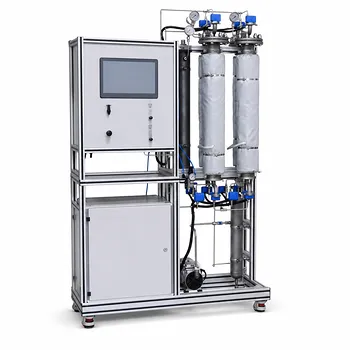
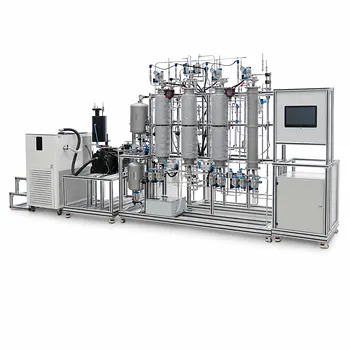
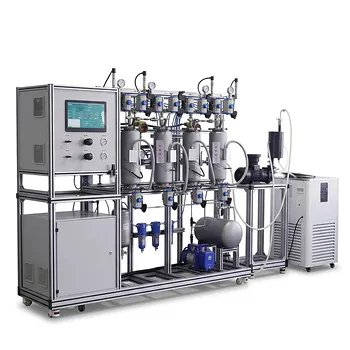
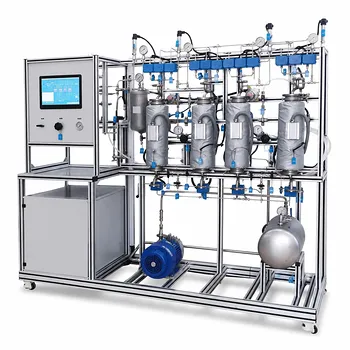
Bridge the gap between thermodynamic theory and practical column operation with premium training systems. LABPARK provides high-quality Educational and Vocational Unit Operations Pilot Plants in chemical engineering, bioprocess & biotech, and environmental & water treatment.
Designed for universities, research institutes, and enterprises, our pilot plants empower trainees to master complex concepts like adsorption kinetics, breakthrough dynamics, and regeneration cycles hands-on.
Contact LABPARK today to upgrade your training facility!
Related Products
- Packed Bed Absorption Educational Unit Operations Pilot Plant
- Absorption and Desorption Educational Unit Operations Pilot Plant
- Pressure Swing Adsorption Educational Unit Operations Pilot Plant
- Bench Scale Dual Column Gas Separation and Capture Educational Pilot Plant
- Multimodal Absorption and Desorption Pilot Plant for Unit Operations Training
People Also Ask
- How Do Flow Regimes Transition in Packed Bed Pilot Plants? Key Scale-up Insights
- How does reactant concentration determine absorption column control? Gas-film vs. dual-film.
- How is the packing height of an absorption column calculated? Master HTU & NTU Concepts
- How does static vs. operating holdup affect pilot plant calibration? Avoid Critical Scale-Up Errors
- Why is counter-current flow selected for gas absorption? Maximize Pilot Plant Efficiency