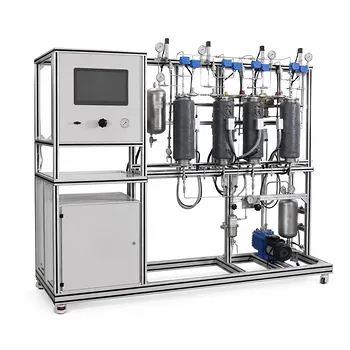
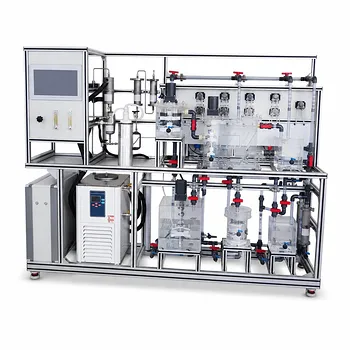
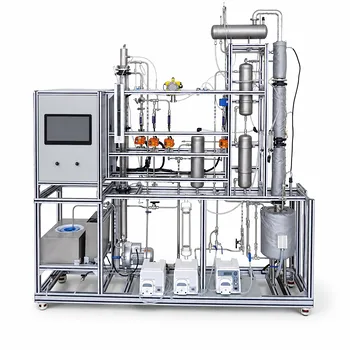
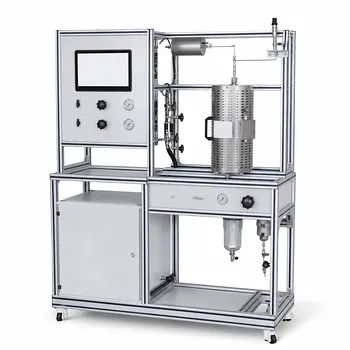
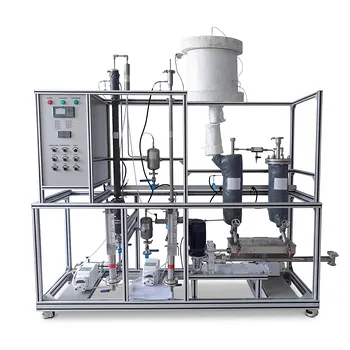
Gasification condensate pilot plants simulate purification by assembling a sequential treatment train—gravity clarifiers, fine filtration, chemical dosing, and gas stripping—that mirrors full-scale industrial wastewater plants, allowing controlled experimentation on the very contaminants that make these streams so hazardous.
Treating gasification wastewater is not one operation but a logical cascade: removing bulk tars and oils, capturing sub-micron solids, neutralizing acidic gases, stripping volatile toxics, and chemically polishing what remains. A pilot plant packages this entire sequence into an observable, tunable loop where every parameter can be tested and the data used to design real-world systems.
The Contaminant Cocktail: What Makes Gasification Condensate So Difficult
Gasification transforms carbon-rich feedstocks into syngas, but the resulting quench and cleanup steps generate a wastewater stream that carries a long list of pollutants. Understanding this profile is the first step to simulating its treatment.
A Toxic Mix of Organics, Solids, and Gases
Raw condensate from a gasifier typically contains condensed unreacted water, fly ash, carbon fines, dissolved hydrogen sulfide (H₂S), ammonia (NH₃), carbon dioxide (CO₂), phenols, and a spectrum of tarry and oily organic phases. Some of these, like tars, are viscous and separate gravimetrically, while others, like H₂S and ammonia, stay dissolved and create aggressive pH swings and odor hazards.
Why Single-Step Treatment Fails
No single unit operation can handle this cocktail. Light organics float, heavy tars sink, micron-sized particulates remain suspended, and dissolved gases escape only when forced. A pilot plant must therefore recreate the integrated sequence that industry relies on—demonstrating why each contaminant demands a different removal mechanism and why the order of operations matters for process stability.
The Unit Operations That Power the Simulation
Environmental water treatment pilot plants replicate the purification of gasification condensates through a series of discrete, interconnected stages. Each stage targets a specific class of contaminant and contributes data that can be used to design or optimize a full-scale facility.
1. Gravity Separation: Removing Bulk Organics and Solids
The first step in a pilot plant typically involves a sedimentation clarifier or oil-water separator. Heavier tars and solids settle to the bottom as a sludge, while lighter oils and residual tars rise to the surface and can be skimmed. This gravity-based separation not only reduces the load on downstream equipment but also closely mimics the large primary clarifiers found in real petrochemical wastewater plants.
2. Filtration: Capturing Sub-Micron Particulates
Even after clarification, fine fly ash and carbon particles remain suspended. Pilot units incorporate multimedia filters or membrane filtration stages designed to remove these sub-micron solids. By monitoring differential pressure and turbidity across the filter, students and researchers can evaluate filtration media, backwashing cycles, and the impact of particulate loading on system hydraulics.
3. Chemical Treatment Loops: Neutralizing and Precipitating
Gasification condensate is often acidic due to dissolved CO₂ and H₂S. A chemical treatment loop continuously doses an alkaline agent (like sodium hydroxide or lime) into a well-mixed tank to stabilize the pH between 6 and 9. In many simulations, this step also includes precipitation chemistry: if heavy metals are present, raising the pH can form insoluble hydroxides that are removed by the clarifier or filters. The pilot plant’s automated dosing pumps and pH probes allow mapping of the exact titration curve and chemical consumption rates—data that directly informs full-scale chemical cost models.
4. Gas Stripping: Driving Off Volatile Toxics
Dissolved H₂S and ammonia cannot be removed by filtration alone. The pilot plant therefore routes the chemically adjusted wastewater into a stripping column, where steam or air is introduced countercurrently. Volatile compounds transfer from the liquid to the gas phase and are vented or captured. This unit operation is critical: without it, the remaining liquid would overwhelm downstream biological processes and violate discharge limits for sulfides and ammonia. The pilot system allows measurement of mass transfer coefficients under varying temperature and air-to-water ratios, making it a powerful tool for scaling up stripper designs.
5. Advanced Polishing (Optional but Insightful)
Many pilot plants also include adsorption columns (activated carbon) or ion exchange units to remove trace organics and recalcitrant pollutants that survived the primary train. Running breakthrough curves on these columns reveals how long the media can operate before regeneration, offering a practical look at the economics of final polishing before discharge or reuse.
Understanding the Trade-offs and Pilot-Scale Limitations
No simulation is perfect, and gasification condensate pilot plants come with inherent constraints that must be recognized before using their data for design decisions.
- Scale-down effects on hydraulics: Short-circuiting and wall effects in small clarifiers can give overly optimistic or pessimistic separation results compared to full-scale vessels.
- Fouling acceleration: Pilot filters and stripping columns often foul faster because the feed is not as steady and well-conditioned as in an industrial plant, requiring careful interpretation of pressure drop and cleaning cycle data.
- Synthetic vs. real condensate: Many educational pilot plants use synthetic mixtures to avoid hazardous vapors (H₂S, ammonia). While safe, this can smooth out the unpredictable slugs of tar and solids that challenge real operations.
- Neglected thermal integration: In a real gasification plant, heat from the syngas quench is often used for stripping or evaporation; a standalone pilot may not replicate these energy synergies, skewing cost-benefit analyses.
How to Apply This to Your Project
Whether you are an educator, a researcher, or an engineer planning a treatability study, the structure of the pilot plant should align with your primary objective.
- If your primary focus is physical separation design: Prioritize a pilot skid with a high-quality clarifier and variable-grade filtration, and schedule runs that deliberately vary inlet solids loading and oil content to map removal efficiency boundaries.
- If your primary focus is dissolved contaminant removal: Ensure the pilot includes both a chemical dosing loop with pH control and a stripper column that permits adjustment of air/steam flow; collect off-gas data to validate Henry’s law constants and ammonia removal rates.
- If your primary focus is meeting discharge limits: Extend the train with an activated carbon or ion exchange polishing stage and measure COD, BOD, sulfide, and heavy metal concentrations after each unit operation to pinpoint which step delivers the critical push to compliance.
- If your primary focus is cost optimization: Run back-to-back cycles while logging chemical consumption, energy input to the stripper, and filter changeout frequency; use this data to build a pilot-validated operating cost model.
The real power of a gasification condensate pilot plant lies not in any single operation, but in its ability to reveal how those operations interact as a system—giving you the confidence to scale up a treatment chain that is both robust and explainable to regulators.
Summary Table:
| Unit Operation | Target Contaminants | Key Simulation Objective |
|---|---|---|
| Gravity Separation | Heavy tars, oils, bulk solids | Replicate primary clarification and sludge removal |
| Filtration | Sub-micron fly ash, carbon fines | Evaluate media performance and fouling rates |
| Chemical Treatment | Acidic gases (H₂S, CO₂), heavy metals | Optimize pH adjustments and chemical dosing costs |
| Gas Stripping | Dissolved H₂S, ammonia (NH₃) | Determine mass transfer and air-to-water ratios |
| Advanced Polishing | Trace organics, residual toxins | Establish adsorption breakthrough curves for media longevity |
Bring Industrial-Scale Wastewater Treatment to Your Lab
Are you looking to optimize industrial purification processes or provide students with hands-on training in environmental engineering?
LABPARK offers state-of-the-art Educational and Vocational Unit Operations Pilot Plants across chemical engineering, bioprocess & biotech, and environmental & water treatment. Designed specifically for universities, research institutes, and enterprises, our modular pilot systems provide:
- Accurate Scale-Down Simulations: Replicate complex, multi-stage industrial processes (such as gravity separation, chemical dosing, and stripping) in a controlled laboratory setting.
- Data-Driven Process Optimization: Monitor, adjust, and validate operating parameters to accurately predict full-scale performance and operating costs.
- Robust Engineering & Safety: Built with industrial-grade components and automated controls to support reliable research and curriculum-aligned education.
Empower your students and researchers with industry-ready pilot plants. Contact LABPARK today to discuss your custom project requirements!
Related Products
- Fixed-Bed Chemical Reaction and Gas Dust Tar Removal Unit Operations Pilot Plant
- Bench Scale Carbon Dioxide Capture Educational Unit Operations Pilot Plant
- Solid Waste Pyrolysis and Refining Educational Pilot Plant for Unit Operations
- Thermal Desorption Exhaust Gas and Tail Water Treatment Educational Pilot Plant
- Carbon Dioxide Absorption and Desorption Educational Pilot Plant for Carbon Capture Studies
People Also Ask
- When to transition from PID to adaptive control in pilot plants? Key process indicators.
- How do deviations in estimating latent heat impact pilot plant thermal systems? Avoid hardware mis-sizing.
- Why Compare Predicted and Experimental Excess Enthalpy? Key to Accurate Pilot Plant Scale-up
- Why Use PTFE & Hastelloy in Chemical Pilot Plants? Prevent Corrosion & Ensure Safety
- How to study gasification in pilot plants? Compare exit gas composition & efficiency