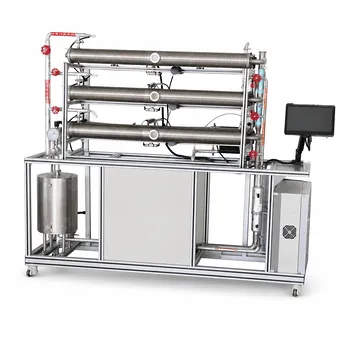
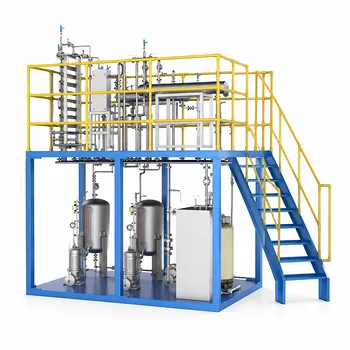
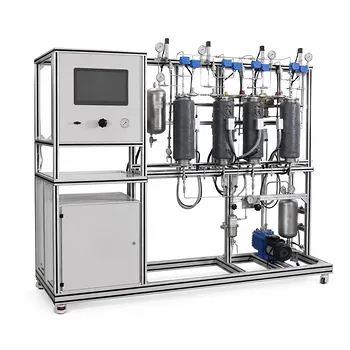
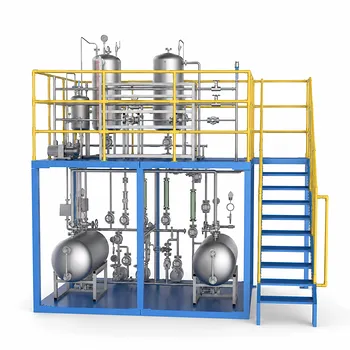
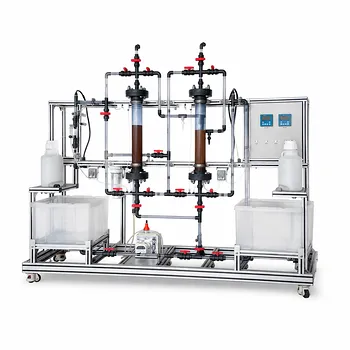
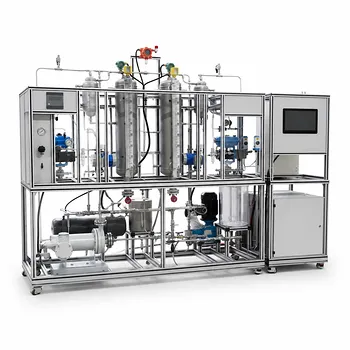
The answer starts here. Pilot plants model this treatment by replicating a precise two-stage industrial sequence: a neutralization reactor continuously adjusts the wastewater’s pH using automated chemical dosing, followed by a steam stripping column that volatilizes and recovers residual organic solvents. This hands-on simulation lets engineers and researchers directly observe reaction dynamics, fine-tune control loops, and generate the mass transfer data required to scale up a reliable, cost-effective full-scale system.
The true value of a pilot plant lies not just in treating a beaker of wastewater, but in providing a controlled, instrumented environment to quantify the invisible. It transforms a simple neutralization-and-strip recipe into a predictive engineering model by generating the kinetic rates, mass transfer coefficients, and process control insights that desktop simulations alone cannot guarantee.
The Unique Character of Esterification Wastewater
Industrial esterification—whether producing ethyl acetate or plasticizers like dioctyl phthalate (DOP)—creates an effluent stream quite unlike a generic acid spill. It is a complex, warm broth of organic acids, residual alcohols, and often dissolved catalyst residues. Treating it to a standard that permits safe biological polishing or discharge demands more than a simple base addition.
Why a Simple Titration Isn’t Enough
Neutralizing this stream is chemically straightforward, but operationally treacherous. The mixture contains weak organic acids like acetic acid, and the point of neutrality does not mean a perfect pH of 7. Because the neutralization reaction forms a conjugate base (like acetate ions), the endpoint of a theoretical perfect dose leaves the solution slightly alkaline.
A pilot plant reveals this sensitivity in real time. The pH transition near the equivalence point is extraordinarily steep when a strong base like sodium hydroxide is used, often causing control oscillation if the dosing algorithm isn’t dampened. This hands-on observation prevents future mis-calibration of industrial sensors and wasteful overdosing.
Stage 1: Replicating Precision Neutralization at Pilot Scale
The first unit in the pilot plant is a continuously stirred neutralization tank, instrumented to mimic the heart of an industrial treatment skid. Acidic wastewater from the esterification process is fed in at a controlled rate, and an alkaline neutralizing agent is metered in through automated dosing pumps. The goal: stabilize the effluent within a discharge-safe window, typically pH 6 to 9.
Selecting and Dosing the Neutralizing Agent
The primary reference uses sodium carbonate as the alkaline agent, a choice that reflects a practical industrial balance. Unlike lime (calcium oxide), sodium carbonate produces soluble sodium salts, which do not create heavy sludge like gypsum (calcium sulfate). While the supplementary references highlight that lime can be economically attractive and can reduce Total Dissolved Solids (TDS) through precipitation, its resulting solids handling problem is a critical trade-off.
The pilot plant allows a direct comparison. By swapping reagents—say, comparing sodium carbonate with ammonia—researchers can measure precipitation kinetics, study the impact on downstream membrane filters, and even assess the feasibility of generating a saleable byproduct like ammonium sulfate. The pH sensors and control feedback loops provide the time-series data needed to model reaction completion and confirm that equilibrium constants (K values on the order of 10^9 for weak acid-neutralization) are being fully exploited.
Tuning the Control Philosophy
Real-time pH monitoring is the brain of this operation. The near-vertical inflection point in the titration curve makes proportional-integral-derivative (PID) tuning a delicate art. A pilot plant reveals the exact dead time and gain margins for the system, preventing the violent pH swings that would shock a downstream biological treatment plant. This hands-on tuning transforms a textbook control loop into a validated operating envelope.
Stage 2: Modeling the Stripping of Residual Organics
Once neutralized, the water still carries a significant load of volatile organic compounds like unreacted ethanol, octanol, or other entrainers. These must be removed before the water can be safely sent to a conventional biotreater, as alcohols represent a massive oxygen demand and can be toxic to microorganisms. The pilot plant’s second major unit operation is a wastewater stripping column.
How the Pilot Stripping Column Works
The neutralized, pre-heated effluent is fed to the top of a packed or tray column, while steam or hot stripping gas enters from the bottom. As the two phases contact counter-currently, heat and mass transfer drive the volatile organics out of the liquid phase. The overhead vapors, now enriched in alcohols, can be condensed and sent for recovery—turning a waste liability back into a reusable raw material.
The pilot column is heavily instrumented. Thermocouples along its height and sample ports at multiple trays allow the construction of a real operating line on a McCabe-Thiele diagram. This directly yields mass transfer coefficients (KLa) and Height Equivalent to a Theoretical Plate (HETP) values for the specific wastewater chemistry, data that cannot be reliably predicted from pure-component laboratory experiments alone.
Going Beyond the Simple Column
The stripping column also becomes a research platform for weak electrolyte behavior. Although the wastewater is now neutralized, the stripping process itself can alter pH as dissolved carbon dioxide or volatile acid traces are removed. The pilot plant’s integrated pH and temperature controls, as highlighted in the supplementary references on gas cleanup, ensure the stripping model accounts for the shifting ionic equilibria that often frustrate simple distillation simulations.
Integrating the Model: From Data to Design
The true power of the pilot plant emerges when both stages operate in a continuous, integrated flow. This reveals interactions that batch beaker experiments can never capture. For example, a slight overdose of sodium carbonate might form a carbonate buffer that suppresses pH at first, only to release CO2 in the hot stripper and cause an unexpected acidity spike at the column inlet.
Calculating VOC Recovery Efficiency
Researchers use the pilot system to conduct mass balances around the entire train. They measure the organic concentration in the liquid feed, the stripped effluent, and the recovered condensate. With this data, they calculate the removal efficiency for each target compound, verify the minimal liquid entrainment in the overhead vapor, and establish the energy consumption per cubic meter treated. These numbers form the bedrock of a defensible process design package and a reliable economic model.
Understanding the Trade-offs and Real-World Pitfalls
Modeling at pilot scale exposes the harsh economic and operational compromises that are invisible in a theoretical flow sheet.
The Reagent Cost vs. Sludge Dilemma
Sodium hydroxide offers fast, complete neutralization and minimal solids but is often more expensive and can create extremely sensitive pH control. Lime is cheap and can precipitate sulfate as gypsum, but the resulting sludge management costs (dewatering, disposal) can negate the reagent savings. The pilot plant lets you run a week-long material balance to see exactly which option delivers the lowest total cost of ownership for your specific water chemistry.
The Energy Penalty of Stripping
Stripping with live steam is effective but energy-intensive. You are, in effect, boiling water to remove parts-per-million levels of organics. The pilot plant can test alternative configurations—like using low-pressure waste heat, operating under slight vacuum to lower boiling points, or evaluating a hybrid air-stripping approach for the most volatile components. Each tweak’s impact on transfer efficiency and product recovery is measured directly, avoiding the risk of a full-scale plant that permanently consumes unsustainable amounts of steam.
Process Stability and Control Fighting
The biggest hidden pitfall is often the interaction between the two stages. A pressure surge in the stripper can back-flow into the neutralization tank, or a slug of highly acidic catalyst residue can overwhelm the neutralization dosing pump’s response time. The pilot plant safely induces these upset conditions to develop a robust control matrix that prevents a cascading failure in the real plant.
Making the Right Choice for Your Pilot Plant Goal
The specific configuration and depth of study depend entirely on what problem you are solving. The pilot plant adapts to your priority.
- If your primary focus is generating scale-up data for a new esterification plant: Invest heavily in the stripping column’s mass transfer instrumentation. Derive precise HETP and KLa correlations for your specific alcohol/water/organic-acid mixture so your full-scale column design is not a guess.
- If your primary focus is optimizing operating costs of an existing wastewater facility: Use the pilot plant to run a side-by-side reagent comparison. Track not only pH control stability but also total sludge production, salt loading (TDS), and heat exchanger fouling tendencies over days of continuous operation.
- If your primary focus is environmental compliance and byproduct valorization: Configure the pilot stripper with a high-efficiency overhead condenser. Quantify the purity of the recovered alcohol stream and assess its direct reuse potential, turning a treatment cost into a raw material credit.
- If your primary focus is training and process control development: Intentionally introduce upsets—cold starts, doubled organic loads, simulated pump failures. Develop and validate the automation logic that will keep an industrial plant stable and operator-safe without requiring constant manual intervention.
Ultimately, the environmental pilot plant is the industrial treatment process in embryo. It bridges the gap between a chemical equation and a constructed asset, guaranteeing that when steel is finally welded and concrete is poured, the acid stream from your esterification reactor will meet the receiving waters exactly as predicted, long before any biological oxygen demand test is ever failed.
Summary Table:
| Stage | Primary Equipment | Core Process Goal | Key Control & Design Metrics |
|---|---|---|---|
| Stage 1: Neutralization | Continuously Stirred Tank Reactor (CSTR) | Stabilize pH within discharge-safe range (pH 6–9) | Reagent optimization (e.g., sodium carbonate vs. lime), PID loop tuning, pH sensor calibration |
| Stage 2: Stripping | Packed or Tray Column (Counter-current steam/gas) | Volatilize, separate, and recover residual VOCs (alcohols/solvents) | Mass transfer coefficients ($K_La$), Height Equivalent to a Theoretical Plate (HETP), removal efficiency |
| System Integration | Combined continuous flow loop | Map interactive effects, buffer dynamics, and energy demand | Total organic mass balance, energy usage per $m^3$, control matrix validation |
Optimize Your Process Engineering Training and Research with LABPARK
Bridging the gap between laboratory chemistry and full-scale industrial operations requires robust, highly instrumented systems. LABPARK provides premium Educational and Vocational Unit Operations Pilot Plants in chemical engineering, bioprocess & biotech, and environmental & water treatment designed specifically for universities, research institutes, and enterprises.
Whether you need to generate precise mass transfer data, optimize reagent consumption, or train students and operators in complex pH and thermal control loops, our pilot plants deliver the realistic environments needed to validate theoretical models.
Ready to elevate your research capabilities? Contact LABPARK today to find the perfect pilot plant solution for your lab!
Related Products
- Solid Waste Pyrolysis and Refining Educational Pilot Plant for Unit Operations
- Fixed-Bed Chemical Reaction and Gas Dust Tar Removal Unit Operations Pilot Plant
- Three-Tube Heat Transfer Educational Pilot Plant for Unit Operations Training
- Dual Mode Heat Transfer Pilot Plant for Unit Operations Training
- Bench Scale Carbon Dioxide Capture Educational Unit Operations Pilot Plant
People Also Ask
- How do educational unit operations pilot plants bridge theory and design? Bridge the Engineering Gap
- How do educational unit operations pilot plants address safety and waste management when scaling up?
- When to transition from PID to adaptive control in pilot plants? Key process indicators.
- Why is the chemical plant startup schedule crucial? De-risk scale-up with pilot plants.
- Why Use PTFE & Hastelloy in Chemical Pilot Plants? Prevent Corrosion & Ensure Safety