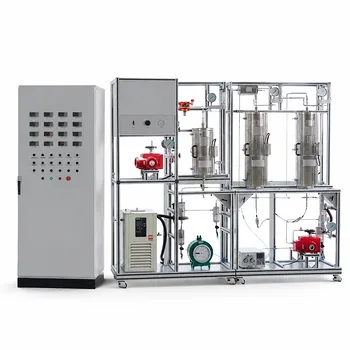
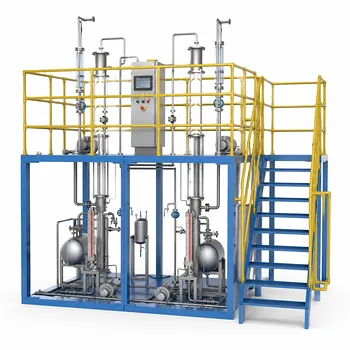
The defining challenge of demonstrating halogen electrolysis safely comes down to containing one of the most reactive classes of elements on the periodic table. Electrochemical pilot plants address this by constructing the entire reaction environment from a specific set of inert, corrosion-resistant materials and embedding the process within a multi-layered safety system designed to neutralize hazards at their source.
While the goal is educational demonstration, the core safety philosophy is identical to industrial chemical engineering: a defense-in-depth strategy. The primary barrier is the selection of materials like PTFE, nickel, and specialized alloys that can passively resist corrosive attack, while the active safety layer uses controlled pressure cascades and immediate chemical scrubbing to prevent toxic or explosive releases.
The Material Barrier: Building for Chemical Inertness
Halogens like chlorine and fluorine are aggressively reactive. A pilot plant’s physical survival, and therefore its safety, depends on choosing materials that won't become fuel or fail structurally upon contact.
The Non-Reactive Core: Plastics and Fluoropolymers
For the most critical wetted parts—reactor linings, piping, gaskets, and dip tubes—the standard is total inertness. PTFE (Teflon) is the backbone of these systems. It resists attack across the board, from wet chlorine gas to anhydrous hydrofluoric acid, preventing the material degradation that leads to leaks. This non-metallic approach is crucial because trace metallic impurities like iron or aluminum can act as catalysts, altering reaction pathways or degrading product quality. By using inert plastics, the plant eliminates a source of contamination that could lead to process upsets.
The Engineered Metals: Passive Protection Layers
When a metal is required for structural strength or electrode function, the process chemistry is turned into an advantage. For electrodes, titanium or nickel alloys are standard for chlorine production. For the more extreme reactivity of fluorine, copper or nickel-copper alloys are preferred, not because they are inert, but because they react to form a protective barrier. Upon contact with fluorine, these metals instantly form a tightly adhered, passive fluoride layer (e.g., copper fluoride). This ceramic-like skin halts further corrosion entirely, making the component safe and durable. The strategy is to use base metals that armor themselves.
The Safety Ecosystem: Containment and Neutralization
Material choice provides passive safety. The active safety systems form a protective envelope around the process to prevent any escaped hazard from reaching the user.
Chemical Scrubbing at the Source
The most immediate safety measure is the destruction of toxic gases before they can accumulate. Pilot plants integrate chemical scrubbers directly into the exhaust stream. A sodium hydroxide or activated carbon trap will neutralize generated chlorine gas on contact. For an academic setting, this means the gas is converted to a safe salt before it ever reaches a student’s breathing zone, transforming a theoretical Faraday’s law experiment into a practical exercise in industrial hygiene.
Mastering Pressure to Separate Explosives
In processes like chlor-alkali electrolysis, the cell simultaneously generates chlorine gas at the anode and hydrogen gas at the cathode. Mixing them creates an explosive environment. Safety is achieved through a strict pressure cascade. The anode chamber is kept under a slight negative pressure (−20 to −30 Pa), ensuring that toxic chlorine is drawn into a treatment system rather than leaking out. Simultaneously, the cathode chamber must maintain a stable positive pressure to prevent any outside air from entering and mixing with the hydrogen. This physical separation, enforced by precise pressure control, eliminates the risk of forming an explosive mixture simply through operational discipline.
Absolute Moisture Exclusion for Fluorine
When handling fluorine, water is a catastrophic contaminant. Moisture reacts with fluorine to form highly corrosive hydrofluoric acid, creating a violent and destructive cycle. The pilot plant's safety protocol demands hermetic sealing and robust moisture exclusion. This involves feed gas drying units and a design philosophy that prevents any atmospheric humidity from entering the system. The plant is not just a reactor; it’s a sealed environment where the absence of water is a primary safety feature.
Understanding the Trade-offs and Limitations
This defense-in-depth approach is highly effective but introduces specific constraints that must be managed.
Cost and Availability: Constructing a plant from PTFE, nickel alloys, and glass-lined steel is exponentially more expensive than one made from standard carbon steel. Specialized components like Kalrez gaskets and pressure-rated transparent sections for visualization increase both capital and maintenance costs. Emergency Transient Response: The passive fluoride layer on nickel and copper works perfectly at steady state. However, rapid humidity spikes or a loss of pressure control can disrupt this layer, potentially leading to accelerated, localized corrosion before the system can be safely shut down. Operational Complexity: Maintaining a precise −20 Pa vacuum on one chamber while holding another at a positive pressure requires sophisticated instrumentation and control logic. This creates a training burden that, if not met, can lead to the very safety breaches the system is designed to prevent.
Making the Right Choice for Your Goal
The configuration of a halogen electrolysis pilot plant must be tailored to its primary demonstration or training objective. The material and safety logic shifts based on the specific halogen.
- If your primary focus is demonstrating chlor-alkali principles: Prioritize a pilot plant with a transparent cell for visual observation, a robust pH control loop for brine feed, and a clearly visible sodium hydroxide scrubbing system. The key learning objective is managing the pressure differential between the hydrogen and chlorine sides, so demand that the control system has dedicated alarm interlocks for these pressure sensors.
- If your primary focus is training on advanced halogenation with fluorine: The non-negotiable design feature is a hermetically sealed, all-nickel or copper flow path with a verified moisture exclusion protocol. The plant's value is its demonstration of passive corrosion protection through the fluoride layer, so the operational procedures should include coupon analysis to prove that the metal loss has stopped after initial passivation.
The goal of these pilot plants is not just to demonstrate a chemical reaction, but to materialize the safety philosophy that makes industrial chemistry possible under hazardous conditions.
Summary Table:
| System Component | Material / Method | Key Safety & Compatibility Function |
|---|---|---|
| Wetted Parts & Piping | PTFE (Teflon) | Prevents corrosion and eliminates metallic impurities |
| Electrodes & Metals | Titanium, Nickel, Copper | Forms a passive protective barrier against aggressive halogens |
| Exhaust Treatment | NaOH Chemical Scrubbing | Neutralizes toxic gases like chlorine before release |
| Chamber Pressure | Negative & Positive Cascade | Prevents toxic leaks and stops hydrogen-halogen explosive mixing |
Bring Safe, Industrial-Scale Halogen Electrolysis to Your Institution
Ensure maximum safety and hands-on learning with LABPARK. We provide advanced Educational and Vocational Unit Operations Pilot Plants in chemical engineering, bioprocess & biotech, and environmental & water treatment for universities, research institutes, and enterprises. Our systems are engineered to meet the highest safety standards and material compatibility requirements.
Ready to upgrade your laboratory? Contact us today to discuss your project requirements!
Related Products
- Electrochemical Water Treatment Educational Unit Operations Pilot Plant
- Electrolytic Hydrogen Production Educational Unit Operations Pilot Plant
- Alkaline Membrane Water Electrolysis Educational Pilot Plant Unit Operations Training System
- Electrolyte Distillation Purification and Formulation Educational Pilot Plant
- Water Electrolysis Hydrogen Production and Storage Educational Pilot Plant
People Also Ask
- What design features do educational electrochemical pilot plants utilize to manage gas liberation and water loss?
- How can unit operations pilot plants show lead-acid concentration vs state of charge? Real-time monitoring guide.
- How do educational electrochemical pilot plants scale up electrolysis? Master industrial engineering.
- How to Estimate Sulfate in Water Treatment Pilot Plant Deposits: Gravimetric Guide
- How can foaming be managed during steam generation experiments in water treatment unit operations pilot plants? Tips