Condenser temperature isn’t just a setpoint—it’s the switch that determines whether you harvest a fine dust or a pool of liquid metal.
In industrial zinc metallurgy, the condenser’s temperature relative to zinc’s melting point (419.3°C) directly dictates product form: below it you get impure zinc dust, above it you draw off liquid zinc (spelter). Distillation unit operation pilot plants bring this high‑stakes thermal boundary to life. By adjusting cooling water flow and monitoring temperature profiles, students see how a few degrees of heat transfer control can flip the phase of a product—reinforcing the very same principles that govern critical separations in metal refining.
The essential lesson: a condenser is not just a heat exchanger—it is a phase‑control device. Pilot‑scale distillation units transform the abstract 419.3°C threshold into a tangible, measurable experience, proving that phase change is a process variable you can steer, not simply a fixed chemical property.
The Zinc Condensation Crossroads: Why One Degree Matters
In pyrometallurgical zinc extraction, zinc vapour leaves the furnace and must be condensed. If the condenser surface temperature drops below 419.3°C, the vapour solidifies as zinc dust—a finely divided powder that traps metallic impurities and zinc oxide. If the condenser is held above that temperature, the vapour collapses into a liquid zinc pool (spelter), which naturally rejects many impurities and can be further refined.
This extreme sensitivity turns the condenser into a binary outcome switch. It is a perfect, real‑world demonstration that product phase and purity are functions of heat transfer, not just feed composition. Understanding this sharp boundary is the gateway to mastering thermal separations at any scale.
The Pilot Plant as a Thermal Sandbox
University‑grade distillation pilot plants are engineered to make this principle safe, observable, and repeatable.
Reproducing the Phase‑Boundary Principle
Instead of 900°C zinc vapour, these columns work with organic or aqueous mixtures. Yet the core phenomenon is identical: every compound has a condensation curve, and the operating temperature of the condenser decides whether you obtain a liquid, a solid, or a mixed‑phase fog.
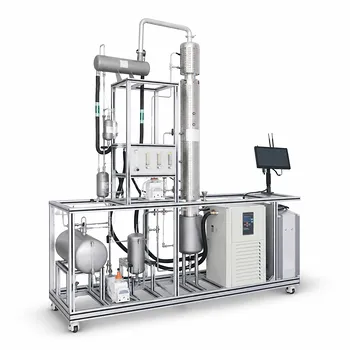
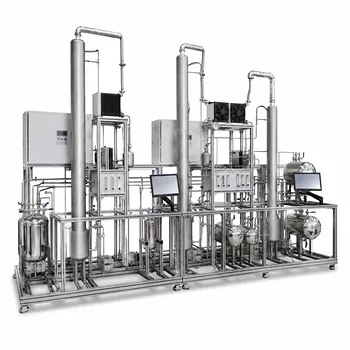
The pilot unit provides:
- Fractional distillation columns with multiple temperature sensors,
- Precise heating mantles to generate vapour,
- Reflux controllers to manage internal flows,
- Chilled‑water loops that mimic industrial coolant circuits.
When a student increases the cooling water flow rate, they watch the condenser’s internal temperature slide downward on a digital dashboard. If that temperature crosses the dew point of the heaviest component too aggressively, fog or solid nucleation can appear—exactly analogous to zinc dust when the boundary is breached. By holding the temperature inside a narrow, pre‑calculated window, they harvest a clean liquid distillate.
Turning Abstraction into Intuition
Textbooks state that “condenser temperature dictates product phase.” On a pilot plant, students experience the causality firsthand. They see the phase change as a thermal event, not just a chapter heading. The instrumentation closes the gap between theory and true process understanding: a dip in the outlet temperature below the calculated condensation point immediately shows up as cloudy distillate or pressure fluctuations.
From the Controls Panel to the Condenser Wall: How Learning Unfolds
Mapping the Temperature Profile
Students systematically manipulate cooling water setpoints and log the temperature at each thermocouple along the condenser’s length. They plot the heat transfer gradient and identify the exact location where vapour starts to condense. If the coolant flow is too intense, the entire tube runs cold and subcooled—product solidifies. If the flow is too weak, vapour escapes uncondensed. This hands‑on mapping builds a direct link between coolant flow, heat flux, and the resulting phase state.
Linking Thermal Boundaries to Purity
When a student operates in the “sub‑melting‑point” regime of their test mixture, the distillate contains trapped low‑boiling impurities—just as zinc dust traps copper or lead. By contrast, when they keep the condenser temperature above the component’s freezing point and apply a modest reflux ratio, a cleaner, liquid product accumulates. They learn that temperature control is a purification lever: the liquid phase allows redistribution of impurities through internal reflux, while a solid phase locks contaminants in place.
Taming Real‑Time Disturbances
A pilot plant’s heating duty may drift, or the building’s chilled water pressure may fluctuate. Students quickly discover that holding a condenser temperature exactly at a phase boundary is a dynamic balancing act. They tune a PID controller or manually adjust a needle valve, competing against upstream variations. This mirrors the industrial challenge of a zinc condenser, where a momentary cooling water upset can turn a twenty‑ton liquid heel into an unplanned mountain of dust. In the lab, it’s water‑ethanol; in the smelter, it’s zinc—but the control mindset is identical.
Understanding the Trade‑offs and Common Pitfalls
Pilot‑plant work also exposes students to the cost of poor thermal management.
- Overcooling: A condenser that runs too cold may increase heat duty, waste energy, and trigger solid deposition—blocking flow paths or causing pressure spikes. In zinc metallurgy, overcooling is the direct route to unwanted zinc dust.
- Undercooling: Failing to extract enough heat leads to vapour breakthrough, product loss, and safety hazards. The industrial zinc condenser must avoid both extremes simultaneously.
- Reaction Quench vs. Phase Control: In fuel‑processing reactors (a related high‑temperature field), microchannel heat exchangers use tight temperature gradients to quench reactions without crossing undesired phase boundaries—another demonstration that temperature profiles are the primary design variable, not secondary setpoints.
The pilot plant forces students to confront the reality that the “correct” condenser strategy is often a tightrope walk, not a simple threshold. The lesson transfers directly to metallurgical processes where the window between liquid spelter and solid dust may be only a few degrees wide.
How to Apply This to Your Curriculum or Training Goal
- If your primary focus is teaching phase change fundamentals: Design experiments where students deliberately cross a known condensation point and observe the immediate phase shift. Use the 419.3°C zinc story as a memorable, high‑contrast anchor case.
- If your primary focus is developing process control skills: Create disturbance scenarios (fluctuating coolant temperature, variable reboiler duty) and challenge students to keep the condenser within a 1‑2°C target range. Emphasize the analogy to holding a zinc bath above its melting point.
- If your primary focus is bridging metallurgy and chemical engineering: Pair a brief thermal separation lecture on zinc with a lab session on the distillation pilot plant, explicitly mapping condenser temperature bands to the dust‑vs‑spelter outcome.
Mastering condensation on a pilot‑scale column gives students the thermal intuition to understand why, in a zinc smelter, a single degree can determine the difference between a pourable metallic product and a cloud of worthless dust.
Summary Table:
| Condenser State | Industrial Zinc Outcome (at 419.3°C) | Pilot Plant Equivalent | Educational Value |
|---|---|---|---|
| Below Melting Point | Impure Zinc Dust (Solid) | Solidification / Blockage | Teaches over-cooling risks |
| Above Melting Point | Pure Liquid Spelter (Liquid) | Clean Liquid Distillate | Demonstrates phase control |
| Insufficient Cooling | Uncondensed Vapour | Vapour Breakthrough | Shows energy balance trade-offs |
Bring Industrial Realities to Your Lab with LABPARK
Looking to bridge the gap between textbook theory and industrial process control for your students or team? LABPARK provides high-quality Educational and Vocational Unit Operations Pilot Plants in chemical engineering, bioprocess & biotech, and environmental & water treatment.
Our advanced pilot plants help universities, research institutes, and enterprises:
- Deliver Hands-on Experience: Allow students to safely manipulate thermal boundaries and master phase control in real time.
- Mimic Real-World Operations: Replicate complex industrial scenarios like zinc metallurgy condensation in a safe environment.
- Enhance Research & Training: Equip your facility with robust, highly instrumented process systems designed for safety and repeatability.
Contact LABPARK today to discover how our pilot plants can elevate your curriculum and training programs!
Related Products
- Continuous Sieve-Plate Distillation Pilot Plant for Unit Operations Laboratory Education
- Multi-Modal Distillation Unit Operations Training Pilot Plant
- Green Anhydrous Ethanol Purification Extractive Distillation Unit Operations Training Pilot Plant
- Dual-Mode Rectification Pilot Plant for Practical Training Unit Operations
- Ethyl Acetate Synthesis Unit Operations Pilot Plant for Practical Training
People Also Ask
- How to select the right activity coefficient model (Wilson, NRTL, UNIQUAC) for distillation pilot plants?
- How does catalyst water concentration affect distillation pilot plant design? Key separation train choices.
- What are the primary reflux ratio control strategies? Master Distillation Unit Operations
- Why is vacuum operation capability an essential feature for a distillation unit operations pilot plant? Unlock Efficiency
- How can real-time carbon number prediction improve distillation pilot plants? Optimize control.