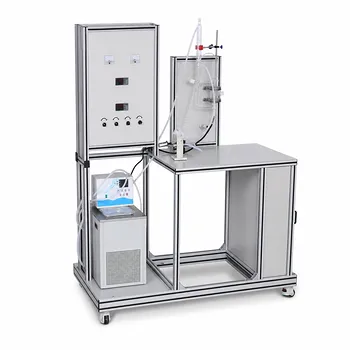
Distillation relies on phase-change purification, while ion exchange uses chemical adsorption to remove ions. For Grade 2 water (conductivity ≤ 0.10 mS/m), both methods can work independently. However, for Grade 1 water (≤ 0.01 mS/m)—critical for HPLC, sensitive bioprocess analytics, and trace-level synthesis—neither method is enough alone. The standard (GB/T 6682-2008) explicitly requires coupling either double distillation or ion exchange with a mixed-bed polish and a 0.2 μm membrane to meet that ultrapure bar.
The core distinction isn’t whether distillation or ion exchange can technically reach a grade—it’s what they leave behind. Grade 2 tolerates either’s shortcomings, but Grade 1 demands a hybrid train that compensates for each method’s blind spots in ionic, organic, and particulate purity.
How Each Unit Operation Works at the Molecular Level
Phase-Change Purification: Distillation’s Mechanism
Distillation separates water from contaminants by turning it to steam and then condensing it. Non-volatile ions, heavy metals, and most organic molecules stay behind in the boiling chamber. The process also kills bacteria and breaks down endotoxins through heat—a major advantage in bioprocess settings where pyrogens can ruin cell cultures.
However, volatile organics with boiling points near water can carry over. A single distillation stage typically lowers conductivity only to 0.1–0.3 mS/m. Double distillation pushes that down further, but still can’t reliably hit ≤ 0.01 mS/m without subsequent deionization and filtration.
Chemical Adsorption: Ion Exchange’s Mechanism
Ion exchange resins swap hydrogen and hydroxide ions for dissolved cations and anions, stripping charged species like Na⁺, Cl⁻, and silica. This drives conductivity down to 0.055 μS/cm (0.0055 mS/m) at the outlet of a strong mixed-bed, easily exceeding Grade 1 ionic requirements. It’s electrically driven chemistry, not phase change.
The missing piece: Ion exchange does nothing for non-ionic particulates, bacteria, or endotoxins. Resin beds can even shed fine particles or leach organic amines, which then require downstream 0.2 μm filtration to meet particulate specifications.
Why Grade 1 Demands a Post-Treatment Mindset
The Mixed-Bed Step: Closing the Ionic Gap
For distillation-based trains, the mixed-bed column intercepts the residual ionic load that even a double still can’t eliminate. In ion-exchange trains, it serves as the final, high-efficiency polishing bed to guarantee the 0.01 mS/m edge.
This is a non-negotiable unit operation if your application—think high-sensitivity LC-MS or mammalian cell culture media—has zero tolerance for ionic background noise.
The 0.2 μm Membrane: A Universal Finish Line
Both routes must end with a 0.2 μm micro-filtration membrane. Grade 1 standards mandate particulate control. The filter physically blocks bacteria, resin fines, and any airborne dust that entered during transfer. In bioprocess engineering, this membrane also serves as a microbial barrier, protecting downstream bioreactors from contamination.
Without it, even perfect ionically pure water would fail specification and risk batch failure in a GMP environment.
Understanding the Trade-offs in Process and Operational Cost
Consumable Costs vs. Energy Footprint
Distillation consumes enormous amounts of electricity for heating and cooling. A double still running continuously can be the largest energy sponge in a pilot plant. The consumable cost is minimal—just water and periodic descaling.
Ion exchange relies on consumable resins that exhaust and require chemical regeneration or replacement. Direct cost is in resin inventory and regeneration chemicals (HCl, NaOH). However, the energy footprint is near zero—only pumping and maybe UV lamp operation.
Organic and Endotoxin Removal Profiles
Distillation inherently eliminates non-volatile organics and destroys endotoxins (> 99.9% reduction with a properly designed still). That makes it a safer baseline for cell-sensitive bioprocess applications where pyrogen-free water is mandatory even before final polishing.
Ion exchange alone cannot remove endotoxins or total organic carbon (TOC). Facilities using only IX for Grade 2 or as a pre-step to Grade 1 must add activated carbon, UV oxidation, or ultrafiltration upstream to manage organics. The 0.2 μm final filter adds an endotoxin rejection layer but isn’t absolute.
Maintenance and Scalability
Stills require cleaning to remove scale, a constant headache in hard‑water areas. Yet they are mechanically simple units with decades‑long lifespans. Ion exchange beds need careful monitoring of breakthrough and scheduled regeneration, which demands chemical handling infrastructure. For large‑scale chemical engineering pilot plants, the ability to scale resin columns is often easier and less energy‑intensive than building bigger evaporators.
Making the Right Choice for Your Goal
Your decision tree should start with the final water quality target and the contaminant you fear most.
- If your primary focus is ultrapure Grade 1 water for analytical trace work: Combine ion exchange (for the lowest ionic baseline) with a mixed-bed polisher and 0.2 μm cartridge. Add upstream UV or activated carbon to slash TOC.
- If your primary focus is pyrogen-free water for bioprocess cell culture: Start with double distillation to kill endotoxins, then polish only the ionic side with a small mixed-bed and final filtration. This splits the purification logic cleanly between heat and chemistry.
- If your primary focus is minimizing operating cost in a high‑throughput pilot plant: Use ion exchange as the workhorse, regenerating resins in‑house, but budget for robust TOC and particle control. Skip the still unless regulations demand it.
- If your primary focus is a flexible, multi‑grade system with low chemical handling: Install a single still for Grade 2, and bolt on a mixed‑bed + 0.2 μm loop only when you need Grade 1. This decouples the two grades and spares the resin from raw‑water fouling.
Ultimately, the highest‑performing water systems treat distillation and ion exchange not as competitors but as sequential purification tactics, each doing what the other cannot. That layered design is what converts a Grade‑2 stream into reliable, compliant Grade‑1 water for your most sensitive bioprocess and chemical engineering applications.
Summary Table:
| Parameter | Distillation (Phase-Change) | Ion Exchange (Chemical Adsorption) |
|---|---|---|
| Mechanism | Boiling & condensation | Ion-selective resin exchange |
| Primary Targets | Inorganics, organics, bacteria, endotoxins | Dissolved cations and anions |
| Weakness | Volatile organic carryover | Organics, bacteria, & particulates |
| Grade 1 Suitability | Requires mixed-bed + 0.2 μm polish | Requires TOC removal + 0.2 μm filter |
| Operating Cost | High electricity & cooling water | Consumable resins & regeneration chemicals |
| Scalability | High energy footprint at scale | Easily scaled via resin columns |
Optimize Your Lab's Water Purification Training
Are you looking to equip your laboratory or training center with advanced purification systems? LABPARK provides premium Educational and Vocational Unit Operations Pilot Plants in chemical engineering, bioprocess & biotech, and environmental & water treatment designed specifically for universities, research institutes, and enterprises.
Whether you need to demonstrate the principles of phase-change distillation or chemical ion exchange, our pilot plants deliver hands-on learning and precise experimental control.
Contact LABPARK Today to discuss your pilot plant needs and get a tailored solution for your institution!
Related Products
- Ion Exchange Water Purification Educational Pilot Plant for Engineering Unit Operations
- Continuous Sieve-Plate Distillation Pilot Plant for Unit Operations Laboratory Education
- Multi-Modal Distillation Unit Operations Training Pilot Plant
- Dual-Mode Rectification Pilot Plant for Practical Training Unit Operations
- Green Anhydrous Ethanol Purification Extractive Distillation Unit Operations Training Pilot Plant
People Also Ask
- How to Prevent Ion Exchange Channeling? Expert Solutions for Pilot Plants
- How does ion exchange work in water treatment pilot plants? Cost & process guide.
- What operational precautions should lab operators take for resin volume changes and air pockets? Key Guide
- How to use ion exchange pilot plants to verify alkalinity? A hands-on guide for engineering students.
- How can students use ion exchange pilot plants for column sizing? Master Wastewater Design