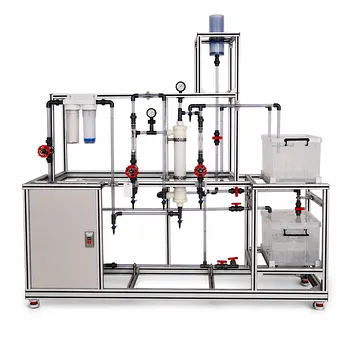
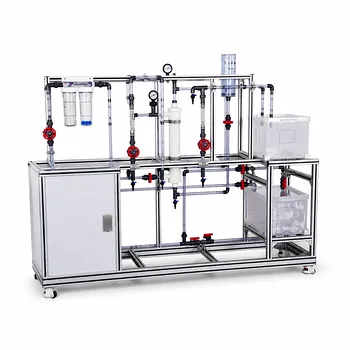
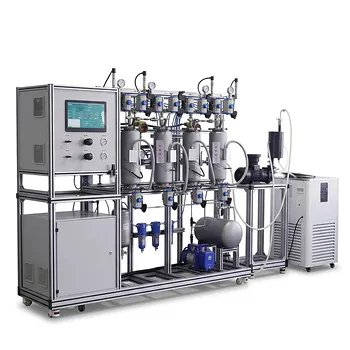
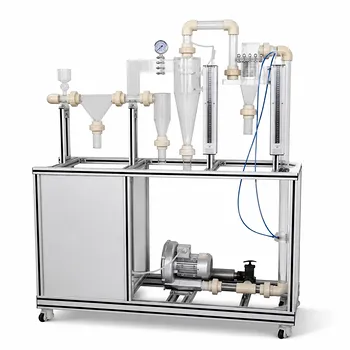
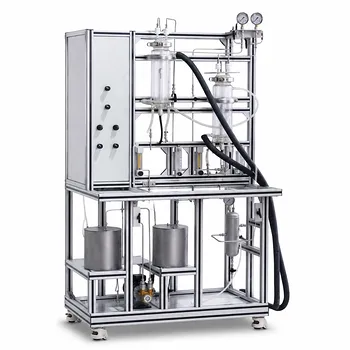
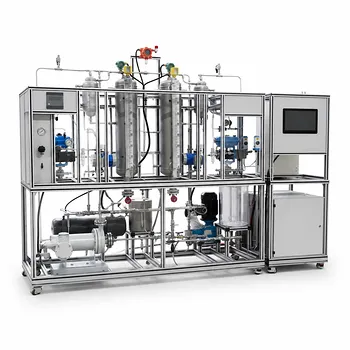
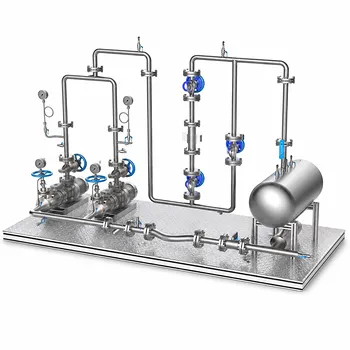
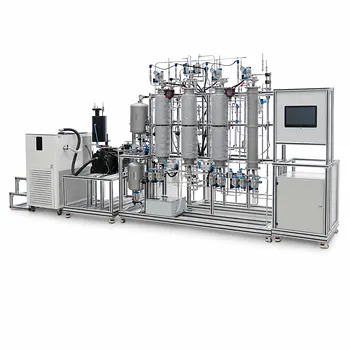
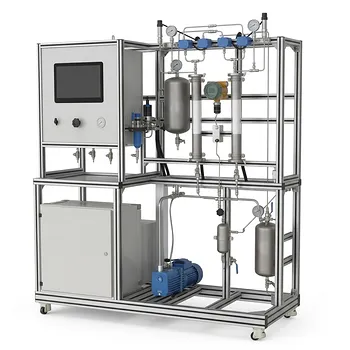
Matching the membrane material and module geometry to the gas separation goal is the first principle of designing an educational pilot plant. Hydrogen recovery applications demand membranes with high diffusivity selectivity for small molecules like H₂ over larger hydrocarbons, leading to the use of glassy polyimide materials. Carbon dioxide removal applications, where the membrane is constantly exposed to acidic and potentially swelling gases, prioritize chemical stability and thus favor cellulose acetate. In a chemical engineering training system, this diversity of requirements is best met by interchangeable membrane modules—allowing students to swap not only materials but also module configurations to observe how feed composition, pressure, and flow dynamics dictate performance.
Different gas separations impose unique demands on membrane material and module geometry. A training system that forces a single module on all applications teaches the wrong lesson. The right approach uses interchangeable spiral-wound, hollow-fiber, and even tubular modules to let students experience firsthand why hydrogen recovery picks a high-surface-area, low-fouling-tolerant design while CO₂ removal often needs a geometry that can handle plasticization and still maintain selectivity under real mixed-gas conditions.
Decoding the Material Selection: What the Gas Tells You
The feed gas mixture dictates the fundamental polymer chemistry. The primary reference for an instructional unit must teach that material choice is not arbitrary—it follows from the molecular interactions between the permeating species and the membrane matrix.
Hydrogen Recovery and the Diffusivity Advantage
Hydrogen recovery from ammonia purge gas or refinery off-gases relies on separating a very fast, small molecule (H₂) from larger, slower ones like methane and nitrogen.
In these cases, the diffusion coefficient difference through a dense glassy polymer is the dominant separation mechanism. Glassy polyimide membranes exhibit high chain stiffness and a narrow free-volume distribution that discriminates strongly based on kinetic diameter. This yields H₂/CH₄ diffusivity selectivities far exceeding those of rubbery polymers.
For a training system, using a polyimide module lets students see how increasing feed pressure raises the hydrogen flux without proportionally increasing methane permeation—a direct demonstration of solution-diffusion in the glassy state.
CO₂ Removal and the Stability Imperative
Applications like acid gas treating, enhanced oil recovery, and landfill gas upgrading require membranes to operate in the presence of high CO₂ partial pressures and often water vapor.
Here, the chief danger is plasticization—CO₂ dissolves into the polymer, swells the chains, and causes a catastrophic loss of selectivity. Cellulose acetate membranes are the historical and practical choice because they offer a balance of acceptable CO₂/CH₄ selectivity and far greater resistance to this CO₂-induced swelling compared to many glassy alternatives.
A training module equipped with cellulose acetate flat sheets in a spiral-wound housing lets students observe how the permeate composition drifts if the feed pressure pushes the membrane past its plasticization threshold, teaching the critical concept of material operating limits.
Module Geometry: The Engineering Shape of the Problem
Selecting the right physical configuration is just as crucial as the material. The geometry dictates the specific surface area, pressure drop, fouling control, and cleaning accessibility—all parameters a training system must illuminate.
Spiral-Wound: The Balanced Workhorse
Spiral-wound modules package flat-sheet membranes around a perforated permeate tube, offering high packing density (800–1000 m²/m³) with moderate pressure drop.
They are the industry standard for gas separation and reverse osmosis. In a pilot plant, a spiral-wound module serves as the baseline for teaching commercial-scale operation. Its robust nonwoven backing handles the compression of high-pressure gases, making it ideal for demonstrating hydrogen recovery or CO₂ removal in a realistic, compact form.
Hollow Fiber: High Density, Low Tolerance
Hollow-fiber modules pack thousands of self-supporting fibers into a shell, achieving extreme surface area (~10⁴ m²/m³) at low cost, but with a high pressure drop on the bore side and virtually no tolerance for fouling.
For clean gas streams—such as dried, particulate-free ammonia purge gas—hollow fibers can show exactly why packing density matters. However, a training system that uses them with a humid CO₂ mix will quickly teach the lesson of irreversible fouling. They should be offered as a module option specifically labeled for clean feeds, alongside clear experimental warnings.
Tubular and Plate-and-Frame: When Fouling Rules
Tubular modules (low area, <80 m²/m³) and plate-and-frame units (moderate area, 400–600 m²/m³) exist for high-fouling, high-solids streams.
While less common in core gas separation, they serve a critical pedagogical role in a unit operations lab. Running the same VOC recovery experiment with a spiral-wound and then a plate-and-frame module shows how the trade-off between surface area and cleanability plays out when droplets or particles are present. This teaches students that “best” is application-dependent.
Designing the Training System for Active Discovery
A training system that merely demonstrates a single module type fails to build the engineering judgment required for scale-up. The hardware must support direct A/B comparison.
Interchangeable Modules for Comparative Insight
Quick-connect module housings that accept spiral-wound, hollow-fiber, and tubular cartridges let students test the same gas mixture under identical pressure and temperature using different membrane areas and geometries.
This reveals how selectivity and permeance figures obtained on small flat-sheet coupons translate (or fail to translate) to a high-flux spiral element, highlighting the roles of concentration polarization and axial pressure drop.
Multi-Stage Configurations Highlight Yield-Purity Trade-offs
Single-stage systems often waste product or deliver insufficient purity. Incorporating a two-stage recycle loop—where, for example, CO₂-rich permeate from the second stage is recirculated to the feed—allows students to optimize methane recovery while maintaining pipeline-quality gas.
Training systems with interchangeable modules that can be plumbed in series make these mass-balance studies possible. They turn abstract textbook equations into a measurable reality.
Understanding the Trade-offs
No single module can excel on all fronts. A responsible training program must teach these limitations explicitly.
- Permeability vs. Selectivity: High-flux membranes often sacrifice selectivity. A polyimide that shows excellent H₂/CH₄ selectivity may have a lower absolute permeance than a thin-film composite, forcing a choice between membrane area and purity.
- Packing Density vs. Fouling Resistance: The hollow fiber’s 10⁴ m²/m³ advantage disappears if a minor particle load plugs the fibers. Spiral-wound modules offer a middle ground but can still suffer from spacer fouling.
- Material Aging and Plasticization: Glassy “superglassy” polymers like PMP may show phenomenal initial butane/methane selectivity (14 vs. 5 for PDMS), but physical aging and chemical instability can cause rapid performance decline in a training plant if not properly blanketed and maintained. A cellulose acetate module for CO₂, while less spectacular in selectivity, provides a stable baseline that teaches the value of operational robustness.
Making the Right Choice for Your Training Goals
Different educational objectives will push the module selection in distinct directions. Use these priorities to guide the module inventory.
- If your primary focus is hydrogen recovery and petrochemical separations: Equip the system with a glassy polyimide spiral-wound module that can demonstrate high-pressure diffusion-controlled separation and allow pressure-ratio studies.
- If your primary focus is CO₂ removal and acid gas treating: Start with a cellulose acetate flat-sheet membrane in a spiral-wound housing, and add a hollow-fiber module for clean synthetic mixtures to contrast fouling susceptibility and plasticization behavior.
- If your primary focus is broad versatility across VOCs, dewpointing, and biogas: Include a set of interchangeable module geometries—spiral-wound, tubular, and a small plate-and-frame—along with a multi-stage piping kit so students can explore recycle loops and the impact of module configuration on recovery and purity.
- If your primary focus is teaching scale-up principles: Invest in instrumentation that measures permeate and retentate flows, pressures, and compositions at multiple points, and require students to compare their experimental selectivities against published material data, explicitly accounting for concentration polarization and pressure drop differences between modules.
A well-configured training system doesn’t just demonstrate gas separation; it forces the user to confront the very choices an engineer makes when moving from chemistry to hardware.
Summary Table:
| Application | Target Gas | Material | Recommended Geometry | Key Advantage |
|---|---|---|---|---|
| Hydrogen Recovery | H₂ from CH₄/N₂ | Glassy Polyimide | Spiral-Wound / Hollow-Fiber | High diffusivity selectivity for small molecules |
| CO₂ Removal | CO₂ from CH₄ | Cellulose Acetate | Spiral-Wound | Resists plasticization and acid gas swelling |
| High-Fouling Streams | VOCs, wet gases | Varying | Tubular / Plate-and-Frame | Low packing density but highly resistant to fouling |
Optimize Your Unit Operations Training with LABPARK
Equip your laboratory with the flexibility to teach real-world engineering trade-offs. LABPARK provides state-of-the-art Educational and Vocational Unit Operations Pilot Plants in chemical engineering, bioprocess & biotech, and environmental & water treatment.
Designed specifically for universities, research institutes, and enterprises, our modular systems feature interchangeable membrane configurations (spiral-wound, hollow-fiber, and tubular) to help students analyze and solve complex gas separation challenges.
Ready to elevate your training capabilities? Contact us today to design your custom pilot plant!
Related Products
- Multi-Functional Membrane Separation Educational Pilot Plant for Unit Operations Lab
- Ultrafiltration Membrane Separation Educational Pilot Plant
- Hollow Fiber Ultrafiltration Membrane Separation Educational Pilot Plant
- Multifunctional Membrane Separation Educational Pilot Plant with Ultrafiltration, Nanofiltration, Reverse Osmosis
- Bench Scale Dual Column Gas Separation and Capture Educational Pilot Plant
People Also Ask
- What are the key differences in membrane configurations? Choose the Right Unit Operations Pilot Plant
- How Do Pervaporation, Vapor, and Gas Permeation Differ in Pilot Plants? Key Comparison
- What are the advantages of membrane separation pilot plants? Energy-saving process intensification.
- Pervaporation vs. Vapor Permeation: Handling Suspended Solids in Membrane Pilot Plants
- How do PEI, PVDF, and PSU membranes compare in pilot plants? Find the best fit.