Crystal morphology is the silent architect of your powder’s fate. Whether your material cascades smoothly from a hopper or jams into a solid arch depends overwhelmingly on the shape of its individual particles. Equant, block-like, or bipyramidal crystals deliver high bulk densities (typically above 0.3 g/cm³), minimal compressibility, and a Hausner ratio below 1.2, all of which signal excellent flow. In stark contrast, acicular (needle) or thin blade morphologies produce powders with bulk densities below 0.2 g/cm³ and Hausner ratios above 1.3, a combination that spells poor flow, high compressibility, and persistent scale-up nightmares.
The central challenge of scaling up solid handling operations does not lie in simply measuring these properties, but in recognizing that morphology-driven flow failures—like rat-holing and segregation—become qualitatively more severe once you transition from a lab bench to a pilot-plant hopper. Equant shapes forgive; needle shapes punish.
The Direct Link Between Shape and Powder Behavior
Crystal habit determines how individual particles interlock, how they pack under their own weight, and how much they consolidate when vibrated or compressed. These three factors—flowability, bulk density, and compressibility—are the critical quality attributes for any solid handling unit operation.
Flow Properties and the Hausner Ratio
Particles that are roughly equidimensional, like blocks or bipyramids, resist mechanical interlocking. They roll past each other with minimal friction, which translates to a Hausner ratio under 1.2—a textbook indicator of free-flowing powder.
Needle-like or plate-like crystals, by contrast, behave like a pile of tiny jacks. Their high aspect ratios create countless mechanical contact points that lock the bed together, raising the Hausner ratio above 1.3.
This difference is not academic. A Hausner ratio above 1.3 means the powder is cohesive and will struggle to discharge consistently from any hopper or feeder without external assistance.
Bulk Density and Packing Efficiency
The same geometric principle governs packing density. Equant crystals, with their low surface-area-to-volume ratio, can nest into an efficient, high-density arrangement, routinely exceeding 0.3 g/cm³.
Acicular or blade-like crystals, on the other hand, bridge across each other, trapping enormous void volumes. The resulting bulk density often falls below 0.2 g/cm³. This lower density directly shrinks the effective working volume of a hopper or a bin, forcing more frequent refills or larger equipment footprints.
Compressibility and Its Scale-Up Consequences
Compressibility measures how much a powder’s volume shrinks under applied pressure, such as the weight of the powder column above it in a silo. A high Hausner ratio is a proxy for high compressibility, because tapped density significantly exceeds aerated bulk density.
For an acicular powder, this means the material at the bottom of a hopper consolidates into a firmer, often cohesive arch. That consolidation is the root cause of “rat-holing” and core flow, where only the powder directly above the outlet moves, leaving the rest stationary and stagnant.
Why Morphology Matters More at Scale
Lab-scale characterization often masks the true severity of morphology effects. At the multi-kilogram or pilot scale, gravity and time conspire to amplify every imperfection.
From Lab Beaker to Pilot Plant Hopper
In a small beaker, a needle-like powder might appear to flow adequately with a little tapping. But in a pilot-scale feed hopper, the overburden pressure can consolidate the bed so thoroughly that the powder forms a stable rathole that completely halts continuous feeding.
This disruption is disastrous for processes requiring tight control of feed rate, such as continuous mixing or direct compression tableting. Loss of flow consistency directly compromises dose uniformity and can force an entire batch to be scrapped.
The Domino Effect on Downstream Operations
Poor flow cascades into every subsequent step. An erratic feed stream produces inconsistent mixer fill levels, leading to blend heterogeneity. Even if the active ingredient’s morphology is later modified through granulation, the initial handling failure creates a bottleneck that erodes overall equipment effectiveness.
While morphology also influences filtration and drying, as seen when sodium chloride adopts an octahedral habit in the presence of urea instead of its usual cube, it is the solid-handling stages where the penalty for unfavorable shapes is most immediate and unforgiving.
Controlling Crystal Shape: A Process Lever
Crystal habit is not a fixed property; it emerges from crystallization conditions. Understanding and exploiting this sensitivity can prevent scale-up problems before they start.
Growth Conditions and Additives
The classic demonstration is sodium chloride: cubes from pure aqueous solution, but octahedrons when urea is present as an additive. Temperature, supersaturation, and solvent composition all shift the relative growth rates of crystal faces, altering the final habit.
For process developers, this means morphology can often be engineered during the isolation step. A pilot plant is the ideal environment to evaluate whether a modified crystallization recipe yields the equant, high-flow crystals that robust downstream handling demands.
The Design Space for Scale-Up
Investing time in morphology screening at the pilot scale de-risks the entire process transfer. It allows you to confirm that the habit observed in small batches persists in larger crystallizers and that the resulting powder flows consistently through the intended hopper and feeder geometry.
When a favorable habit cannot be achieved, the early warning from pilot trials gives you time to specify appropriate handling aids rather than discovering a plant shutdown on the first production batch.
Understanding the Trade-offs
An honest assessment requires acknowledging that chasing a perfect equant crystal is not always a free adjustment.
Is the Perfect Equant Crystal Always the Goal?
For solid handling, the answer is emphatically yes. But crystallization is a unit operation with its own constraints, and some active molecules naturally nucleate as needles under all practical conditions. In those cases, attempting to force a block habit might come at the cost of unacceptably low yield or an unfavorable polymorphic form.
The immediate trade-off is between crystallization simplicity and downstream processability. If needle-like morphology is unavoidable, the burden shifts entirely to equipment design and operational strategy.
The Pitfall of Assuming Lab-Scale Behavior
The most dangerous error in scale-up is to observe that “it flowed well enough on the bench.” Even a small fraction of acicular crystals in a predominantly equant sample can create the interlocking network responsible for bridging and rat-holing at larger dimensions.
Scale exacerbates segregation, too. Needles tend to sift and concentrate in different regions of a hopper, so the flow properties you measured for the bulk powder may not represent what exits the feeder at any given moment. Pilot-scale trials are the only reliable way to expose these insidious mode of failure.
Making the Right Choice for Your Goal
Your response to crystal morphology must match your process objectives and the degrees of freedom you actually have over the crystallized solid.
- If your primary focus is maximizing flow and minimizing handling risk: Engineer the crystallization to favor equant, block-like or bipyramidal habits, and confirm a Hausner ratio below 1.2 with a bulk density above 0.3 g/cm³ before scale-up.
- If your primary focus is maintaining dose uniformity in continuous blending or tableting: Eliminate needle or blade morphologies entirely; even a minor presence can cause erratic hopper discharge and unacceptable blend variability.
- If your primary focus is scaling up an existing, needle-like product with no crystallization rework possible: Design your hopper with steep cone angles and vibratory aids, and add a pre-processing step like dry granulation or slugging to convert the cohesive powder into a free-flowing granular intermediate.
When you treat crystal morphology as an integral part of your process design—not as a fixed raw material attribute—you transform a common scale-up pain point into a controllable engineering parameter.
Summary Table:
| Crystal Morphology | Bulk Density | Hausner Ratio | Compressibility | Flow Behavior & Scale-Up Risk |
|---|---|---|---|---|
| Equant / Block-like | > 0.3 g/cm³ | < 1.2 | Low | Excellent flow; low risk of hopper blockages |
| Acicular / Needle-like | < 0.2 g/cm³ | > 1.3 | High | Poor flow; high risk of bridging & rat-holing |
Optimize Your Solid Handling Unit Operations
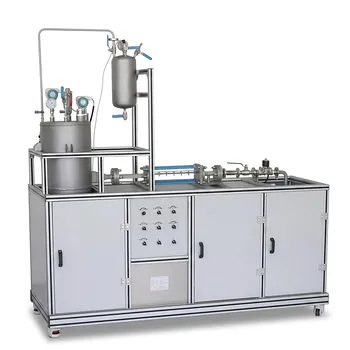
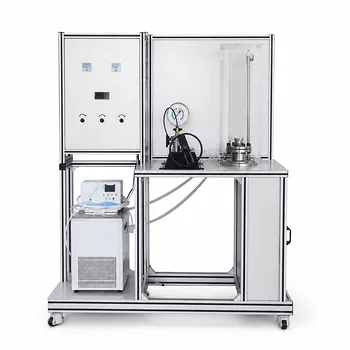
Scaling up from lab trials to pilot-scale solid handling requires precise control over crystal morphology and powder behavior. LABPARK provides state-of-the-art Educational and Vocational Unit Operations Pilot Plants in chemical engineering, bioprocess & biotech, and environmental & water treatment. We help universities, research institutes, and enterprises bridge the gap between bench-scale research and industrial production.
Ready to enhance your process engineering curriculum or de-risk your scale-up workflows? Contact LABPARK today to discover our tailored pilot plant solutions!
Related Products
- Multi Functional Membrane Crystallization Educational Unit Operations Pilot Plant
- Gas-Solid Heterogeneous Separation Demonstration Educational Unit Operations Pilot Plant
- Solid Waste Pyrolysis and Refining Educational Pilot Plant for Unit Operations
- Potassium Salt Thermal Dissolution and Crystallization Separation Educational Unit Operations Pilot Plant
- Two-Dimensional Fluidization Hydrodynamics Educational Pilot Plant for Unit Operations Training
People Also Ask
- Control Crystallization Pilot Plant Secondary Nucleation: 4 Key Adjustments
- Why is precise temperature control critical in crystallization pilot plants? Key to Scale-Up Success
- What key factors should be considered when configuring a crystallization unit operations pilot plant?
- What are the benefits of integrating online PAT tools like ATR-FTIR into crystallization unit operations pilot plants?
- How to use crystallization pilot plant agitation speed to identify diffusion vs reaction growth?