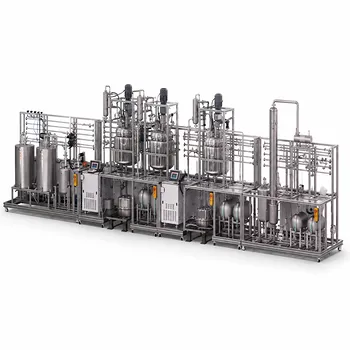
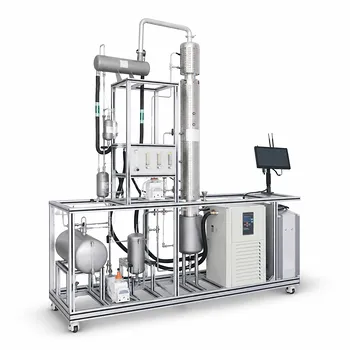
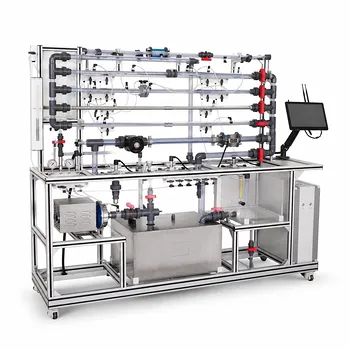
You can’t learn the difference from a textbook alone. Chemical engineering unit operations pilot plants transform the abstract concepts of process design and operational optimization into a tangible, physical experience. They let researchers and students move beyond theoretical models to manipulate real equipment, revealing that design optimization sets the physical boundaries of what’s possible, while operational optimization is the art of maximizing performance within those fixed limits.
The core lesson a pilot plant teaches is that a perfectly designed process on paper is a rigid set of hardware. Operational optimization is the dynamic strategy to extract maximum value from that hardware every single day. A pilot plant forces you to collide with the physical constraints of your design choices, making the distinction between the two types of optimization not just clear, but unavoidable.
The Two Faces of Optimization
The first critical lesson a pilot plant imparts is that “optimization” isn’t one monolithic task. It splits into two distinct engineering phases with completely different goals.
Design Optimization: Defining the Sandbox
Design optimization is the act of determining the physical equipment itself. It answers the question: “How big, tall, or robust must this unit be to meet our production goals?” This involves calculating the required heat transfer area, column height, or reactor volume.
In a pilot plant, a design calculation determines what you build. For example, when you specify the height and diameter of a distillation column, you are making a design optimization decision that permanently sets its maximum throughput and separation potential.
Operational Optimization: Playing in the Sandbox
Operational optimization, in contrast, assumes the equipment is unchangeable. It answers: “How do I run this specific, fixed-size pilot plant right now to get the best result?” This involves tuning variables like feed flow rate, temperature, pressure, and reflux ratio.
When a student adjusts the reflux ratio on a pilot-scale column, they aren’t changing the column’s design. They are performing an operational calculation to predict how the product purity and energy consumption will shift. This is a real-time strategy game played within the boundaries set by the original design.
The Pilot Plant as a Laboratory for Truth
The deep need is to understand why this distinction matters. A pilot plant bridges the chasm between mathematical models and physical reality, exposing the critical friction between the two forms of optimization.
Confronting the Flaws in Theoretical Models
Computer simulations are cost-effective but rely on assumptions. A pilot plant exposes where these assumptions break down. Real-world constraints like fluid dynamics, heat loss, and fouling create discrepancies that pure math can oversimplify.
By running a physical process, you must collect real mass and energy balances and reaction kinetics. This physical verification shows that an operational plan that looks perfect in a simulation may be impossible in reality due to an overlooked design limitation, such as low heat transfer coefficients.
The Bottleneck Becomes the Teacher
A multi-step pilot plant with reactors, filters, and dryers makes optimization tangible through scheduling. By tracking the idle and occupancy times of each unit, a researcher can identify the scheduling bottleneck—the single piece of equipment that dictates the entire process's cycle time.
This is a profound lesson: you can operationally optimize all other units to be 99% efficient, and it won’t improve overall output by a single percent. The bottleneck—a design constraint—dominates productivity. The only true fix is a design change, like adding an extra auxiliary unit operation to shift the constraint.
Validating Long-Term, Real-World Stability
Lab-scale experiments often use pure materials and short run-times, overlooking the accumulation of impurities in recycle streams and long-term catalyst deactivation. A pilot plant enables continuous, closed-loop operation over days or weeks.
This operational reality reveals how a design optimized for a clean, short run can fail over time. Seeing catalyst coking or by-product buildup firsthand demonstrates that a successful design must account for these dynamic, long-term operational events.
Understanding the Trade-offs
A pilot plant’s greatest gift is teaching the multi-objective reality of engineering, where optimizing one variable often compromises another.
Ideal Performance vs. Safe Operation
A process can be mathematically optimized for maximum output but be impossible to operate safely. In a pilot plant, a student trying to push a column to its theoretical limit may immediately encounter downcomer flooding or pressure drop limits.
This is the moment the deep lesson clicks. The operational optimization goal of “maximum throughput” crashes directly into the design and safety constraint of “no flooding.” They learn that the true optimal operating point is a trade-off that prioritizes safety, reliability, and operability alongside economic efficiency.
Waste Reduction Through Operational Control
Operational optimization is also the primary tool for real-time waste reduction. When researchers use a pilot plant to manipulate dependent processing steps or test new catalysts, they are exploring how operational changes control waste generation at its source. This hands-on manipulation demonstrates how operational strategy directly dictates the process’s environmental and raw material efficiency footprint, a variable not fixed by the initial equipment design but by how you choose to run it.
Making the Right Choice for Your Goal
Applying this knowledge depends on whether you are in the design phase or the operational phase of a project. A pilot plant provides the data to excel at both.
- If your primary focus is creating a new process: Use the pilot plant to generate the empirical data—heat transfer coefficients, kinetic rates, real-world pressure drops—needed to perform accurate design calculations. Your goal is to build a sandbox that is physically capable and safe, using risk assessments like Failure Mode and Effects Analysis (FMEA) to identify Critical Process Parameters (CPPs) before they become problems at scale.
- If your primary focus is running an existing process: Use the pilot plant as a high-fidelity simulator for operational calculations. Experiment with manipulating variables to find the sweet spot that maximizes yield and purity while minimizing energy costs, all without triggering a safety limit like flooding. This is training for process control and troubleshooting.
Ultimately, a unit operations pilot plant is a crucible where theoretical elegance is tempered by physical reality, forging engineers who understand that designing the perfect machine and running it perfectly are two profoundly different, yet inseparable, disciplines.
Summary Table:
| Feature | Design Optimization | Operational Optimization |
|---|---|---|
| Core Focus | Defining physical equipment dimensions | Manipulating variables of existing equipment |
| Key Variables | Vessel volume, column height, heat transfer area | Feed flow rate, temperature, reflux ratio |
| Flexibility | Fixed once built (rigid boundaries) | Dynamic and adjustable in real time |
| Primary Goal | Define process capabilities and safety limits | Maximize yield, purity, and efficiency |
Bring Hands-On Optimization to Your Lab
Bridging the gap between process design and operational reality requires the right physical tools. LABPARK provides high-quality Educational and Vocational Unit Operations Pilot Plants in chemical engineering, bioprocess & biotech, and environmental & water treatment. Designed specifically for universities, research institutes, and enterprises, our pilot plants empower students and researchers to master real-world constraints, validate simulation models, and optimize process safety.
Ready to elevate your engineering training and research capabilities? Contact LABPARK today to find the perfect pilot plant solution for your facility!
Related Products
- Carbon Dioxide Hydrogen Methanol Synthesis Educational Unit Operations Pilot Plant
- Multi-Reactor Educational Pilot Plant for Reaction Engineering Unit Operations
- Ethyl Acetate Synthesis Unit Operations Pilot Plant for Practical Training
- Multi Pump Fluid Transport Process Piping Unit Operations Training Pilot Plant
- Natural Product Extraction Unit Operations Training Pilot Plant
People Also Ask
- How do temp & pressure affect methanol synthesis pilot plants? Optimize equilibrium and catalyst performance.
- Why is a purge system necessary when operating a gas recirculation loop in a methanol synthesis pilot plant? (Guide)
- Why do modern methanol pilot plants operate at lower pressures? Catalyst & Feed Requirements Explained
- What are the operational requirements for catalyst activation? Safe Methanol Pilot Plant Operation
- Why is the chemical plant startup schedule crucial? De-risk scale-up with pilot plants.