Knowledge Chemical Engineering Education How do pilot plants demonstrate zeolite catalyst regeneration in hydrocarbon conversion? A Practical Guide
Author avatar

Tech Team · LABPARK

Updated 1 month ago

How do pilot plants demonstrate zeolite catalyst regeneration in hydrocarbon conversion? A Practical Guide


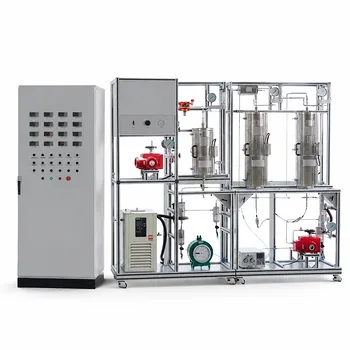
Pilot plants are the proving ground where textbook chemistry meets industrial reality. In hydrocarbon conversion processes, zeolite catalysts like ZSM-5 inevitably deactivate due to carbon deposition (coking). Pilot plants demonstrate their maintenance and regeneration by replicating this coking, then applying controlled regeneration cycles—such as heating the catalyst to 570°C under pressure to burn off the carbon—often while the main process continues through a dual-reactor switching system. This hands-on approach teaches practitioners exactly how to restore activity without compromising production.

Zeolite catalyst deactivation is a predictable economic variable, not a mystery. Pilot plants provide a safe, controlled environment to master the regeneration techniques, timing, and trade-offs that determine whether a chemical process remains profitable at scale.

Simulating the Inevitable: How Pilot Plants Replicate Zeolite Deactivation

Coking is not a laboratory anomaly; it’s a guaranteed industrial challenge in gas-phase alkylation and similar high-temperature reactions. Pilot plants bridge the gap by creating deactivation conditions that lab glassware cannot.

Injecting Reality into the Feed Stream

A pilot plant can precisely dose trace impurities (like carbon monoxide or sulfur compounds) into the benzene-and-ethylene feed.

This accelerates catalyst poisoning in a measurable, repeatable way.

Operators then monitor the steady decline in conversion efficiency and product selectivity over extended runs.

Watching the Active Sites Disappear

As carbon builds on the zeolite’s acidic active sites, the reactor’s output tells a clear story.

The pilot plant’s instrumentation continuously logs the drop in yield and the increase in unwanted byproducts.

This data is the direct link between physical coking and the economic need for regeneration.

The Regeneration Toolkit in a Pilot Plant Environment

Once the catalyst is deactivated, the pilot plant becomes a hands-on classroom for recovery. The specific regeneration method demonstrated depends on the reactor design and industrial goals.

Thermal Burn-Off in Dual-Reactor Systems

For processes like gas-phase benzene alkylation, pilot plants often use dual-reactor switching.

One reactor stays online while the other undergoes regeneration.

The system heats the deactivated zeolite bed to approximately 570°C at around 1.05 MPa, using a controlled air or oxygen-containing stream to burn the coke to CO₂, completely restoring surface activity.

Hydrogen Gasification for Fixed-Bed Units

In multitubular fixed-bed reactors, online catalyst replacement is impossible.

Here, pilot plants demonstrate an alternative: regenerating with hydrogen.

The unit introduces a hydrogen-rich stream to gasify the carbon deposits into methane ($C + 2H_2 \rightarrow CH_4$), a method that avoids the harsh thermal cycling of a burn-off.

Continuous vs. Periodic Catalyst Management

Pilot plants with fluidized-bed or slurry-phase reactors show a completely different philosophy.

They illustrate continuous catalyst withdrawal, regeneration in a separate vessel, and reinjection without ever shutting down.

This side-by-side demonstration cements the operational trade-offs between reactor complexity and uptime.

Decoding the Economics: Regeneration Schedules and Lifespan

The true value of a pilot plant demonstration is translating technical steps into financial logic.

Measuring the True Cost of Downtime

Each regeneration cycle—whether through a switching system or a full shutdown—has an energy, time, and labor cost.

Students can calculate these costs directly from the pilot plant’s utility consumption and cycle duration.

They learn that a longer catalyst lifespan through gentler operation isn’t always the most profitable choice if it sacrifices throughput.

Predicting Lifespan from Gradual Deactivation Curves

By running the plant until regeneration is unavoidable, operators plot the catalyst’s activity over time.

They can then forecast how many regeneration cycles a catalyst batch can endure before permanent deactivation sets in.

This predictive skill is core to planning industrial maintenance budgets and reactor turnarounds.

Understanding the Trade-offs and Pitfalls

No demonstration is complete without a clear-eyed view of the limitations. Pilot plants make these trade-offs tangible.

The Impurity Blind Spot in Scale-Up

A pilot plant that runs on perfectly pure feeds will give a falsely optimistic picture of catalyst lifespan.

Industrial streams always contain trace poisons.

Training must emphasize that skipping impurity-dosing in the pilot phase can lead to a catastrophic overestimation of regeneration intervals at commercial scale.

Regeneration Is Not Resurrection

Each regeneration cycle, especially thermal burn-offs, can slowly degrade the zeolite’s crystalline structure.

The pilot plant data will show a declining “recoverable activity” after multiple cycles.

This teaches the hard reality that eventually, the catalyst must be replaced entirely, and the process must be designed for that eventuality.

Safety and Energy Intensity of Burn-Offs

Regenerating at high temperature and pressure demands precise control to avoid runaway exotherms.

Pilot plants incorporate these safety interlocks, demonstrating that a regeneration strategy is as much a process safety exercise as a chemical one.

The energy cost of heating a mass of catalyst to 570°C is a direct line item in the process economics.

Making the Right Choice for Your Training or R&D Goal

The design of the pilot plant experience must match your learning objectives.

  • If your primary focus is mastering non-stop industrial operations: Choose a dual-reactor switching system that demonstrates continuous production through parallel regeneration cycles.
  • If your primary focus is understanding catalyst deactivation mechanisms: Ensure the pilot plant is configured to introduce and adjust trace impurity levels while logging the real-time decline in conversion.
  • If your primary focus is optimizing long-term process economics: Use the pilot plant to run multiple coking-and-regeneration cycles, directly comparing the cumulative cost of hydrogen regeneration, thermal burn-offs, and fresh catalyst replacement.
  • If your primary focus is reactor selection for new processes: Operate comparative runs on fixed-bed and fluidized-bed pilot modules to internalize how the maintenance strategy dictates the reactor choice from day one.

With a well-designed pilot plant demonstration, the management of zeolite catalysts transforms from a theoretical nuisance into a mastered, predictable element of profitable process design.

Summary Table:

Regeneration Method Reactor System Process Mechanism Key Operational Advantage
Thermal Burn-Off Dual-Reactor (Switching) Coke combustion at ~570°C, 1.05 MPa Continuous uptime via parallel reactors
Hydrogen Gasification Fixed-Bed (Multitubular) Hydrogen stream gasifies carbon to $CH_4$ Avoids thermal stress on catalyst structure
Continuous Regeneration Fluidized / Slurry-Phase Continuous withdrawal, external regeneration Maximizes process efficiency and uptime

Accelerate Process Learning and R&D with LABPARK

Bridge the gap between theoretical chemistry and industrial scale-up. LABPARK provides state-of-the-art Educational and Vocational Unit Operations Pilot Plants for:

  • Chemical Engineering (including catalyst study & hydrocarbon conversion)
  • Bioprocess & Biotech
  • Environmental & Water Treatment

Whether you are a university training the next generation of engineers, a research institute validating new catalysts, or an enterprise optimizing process economics, our pilot units deliver the reliability, safety, and data accuracy you need.

Contact LABPARK today to discuss your customized pilot plant requirements!

Related Products

People Also Ask

Related Products

Methanol Synthesis and Catalyst Performance Evaluation Educational Unit Operations Pilot Plant

Methanol Synthesis and Catalyst Performance Evaluation Educational Unit Operations Pilot Plant

Bench-scale methanol synthesis and catalyst evaluation educational pilot plant for chemical engineering labs to study catalytic kinetics, high-pressure operations, process control, and unit operations under realistic conditions with industrial safety features, precision gas delivery, data acquisition, and intelligent monitoring.

Crude Benzene Hydrogenation Educational Unit Operations Pilot Plant

Crude Benzene Hydrogenation Educational Unit Operations Pilot Plant

Advanced pilot plant for higher education, enabling hands-on study of crude benzene hydrogenation and gas-liquid catalytic reactions. Triple-stage reactor system with precision flow and temperature control, AI-driven PID, remote monitoring, and comprehensive safety interlocks. Customizable for curriculum integration.

Micro-Scale Gas-Solid Catalytic Reaction Educational Pilot Plant

Micro-Scale Gas-Solid Catalytic Reaction Educational Pilot Plant

Explore heterogeneous catalysis with this micro-scale gas-solid catalytic reaction educational pilot plant. Designed for university labs, it enables hands-on study of reaction kinetics and transport phenomena in a benchtop packed bed reactor with high-precision flow control and touchscreen automation.

Educational Unit Operations Pilot Plant for Intraparticle Diffusion Effective Factor Measurement

Educational Unit Operations Pilot Plant for Intraparticle Diffusion Effective Factor Measurement

Designed for chemical engineering university labs, this pilot plant allows hands-on determination of catalyst particle intraparticle diffusion effective factors and gas-solid reaction kinetics using a fixed-bed tubular reactor with industrial touchscreen control, bridging theory and practical reactor design.

Fixed Bed Gas Solid Catalytic Reaction Educational Pilot Plant

Fixed Bed Gas Solid Catalytic Reaction Educational Pilot Plant

Fixed-bed gas-solid catalytic reaction unit operations pilot plant for chemical engineering education. Features split-furnace, mass flow controllers, PID control, safety interlocks. Ideal for heterogeneous catalysis, reactor dynamics, catalyst evaluation studies. Fully customizable configurations for university laboratories and academic research.

Ethylbenzene Dehydrogenation Educational Unit Operations Pilot Plant

Ethylbenzene Dehydrogenation Educational Unit Operations Pilot Plant

Ethylbenzene dehydrogenation educational pilot plant replicates industrial styrene production, offering hands-on experience with fixed-bed reactors, catalyst activation, regeneration, automated process control. Designed for university chemical engineering labs, it enables study of gas-solid catalysis, catalyst deactivation, steam regeneration, and safety interlocks.

Fluidized Bed Gas Solid Catalytic Reaction Educational Pilot Plant

Fluidized Bed Gas Solid Catalytic Reaction Educational Pilot Plant

Our educational fluidized bed gas-solid catalytic reaction pilot plant is ideal for chemical engineering labs. Students study fluidization dynamics, catalyst evaluation, and process control hands-on. Features include a customizable reactor, touchscreen HMI, and safety interlocks for safe, curriculum-aligned experiments.

Internal Circulation Gradient Free Catalytic Reaction Educational Pilot Plant

Internal Circulation Gradient Free Catalytic Reaction Educational Pilot Plant

Internal circulation gradient free catalytic reaction educational pilot plant for chemical engineering unit operations. Provides isothermal gradient free operation and hands on study of heterogeneous catalysis kinetics and mass transfer with precise control. Ideal for academic labs.

Fixed-Bed Chemical Reaction and Gas Dust Tar Removal Unit Operations Pilot Plant

Fixed-Bed Chemical Reaction and Gas Dust Tar Removal Unit Operations Pilot Plant

Integrated educational pilot plant for studying catalytic gas-solid reactions and downstream gas purification. Features dual fixed-bed reactor, three-stage heating, and touchscreen control for hands-on engineering training. Ideal for chemical and environmental engineering curricula.

Electrolyte Distillation Purification and Formulation Educational Pilot Plant

Electrolyte Distillation Purification and Formulation Educational Pilot Plant

Integrated bench-to-pilot scale educational pilot plant for electrolyte distillation, purification, and formulation with borosilicate glass construction, PLC automation, touchscreen HMI, and advanced industrial safety features for hands-on chemical process training, ideal for chemical engineering and materials science curricula.

Multi Functional Catalytic Reaction and Reactor Evaluation Educational Unit Operations Pilot Plant

Multi Functional Catalytic Reaction and Reactor Evaluation Educational Unit Operations Pilot Plant

Bench-scale educational pilot plant for catalytic reaction and reactor evaluation, integrating fixed bed, fluidized bed, and stirred tank reactors. Students compare reactor designs, evaluate catalysts, and study reaction kinetics and hydrodynamics. Perfect for unit operations labs in chemical engineering curricula.

Methane Cracking Educational Unit Operations Pilot Plant

Methane Cracking Educational Unit Operations Pilot Plant

This bench-scale methane cracking educational pilot plant provides hands-on catalytic conversion training with a 1000°C furnace, seven mass flow controllers, and real-time automation for safe, curriculum-aligned experiments. Designed for university teaching of unit operations and reaction engineering.

Solid Waste Pyrolysis and Refining Educational Pilot Plant for Unit Operations

Solid Waste Pyrolysis and Refining Educational Pilot Plant for Unit Operations

This pilot plant for solid waste pyrolysis and refining integrates pyrolysis, separation, distillation, and catalytic hydrogenation into one educational unit. It provides visual process observation, smart data logging, and industrial safety for hands-on learning of engineering unit operations.

100L Continuous Loop Hydrogenation Educational Unit Operations Pilot Plant

100L Continuous Loop Hydrogenation Educational Unit Operations Pilot Plant

This 100L continuous loop hydrogenation pilot plant is designed for chemical engineering education, featuring 316 stainless steel construction, advanced gas-liquid mass transfer components, explosion-proof safety systems, and a 15.6-inch touchscreen with 5G connectivity, cloud data logging, bridging theory and industry.

Natural Product Extraction Unit Operations Training Pilot Plant

Natural Product Extraction Unit Operations Training Pilot Plant

Integrated natural product extraction pilot plant for chemical engineering training bridges theory and industrial practice with modular extraction and evaporation/concentration units, hybrid touchscreen and manual control, realistic process simulation, and self-contained softened water and vacuum utilities.

Dual-Mode Rectification Pilot Plant for Practical Training Unit Operations

Dual-Mode Rectification Pilot Plant for Practical Training Unit Operations

Industrial-scale dual-mode rectification pilot plant for chemical engineering practical training. Features real-material and simulated-material operation modes, sieve-plate column with sight glasses for visual observation of hydrodynamics, and customizable SCADA control for safe, hands-on learning of unit operations and mass transfer.

Carbon Dioxide Hydrogenation Methanol Synthesis Educational Unit Operations Pilot Plant

Carbon Dioxide Hydrogenation Methanol Synthesis Educational Unit Operations Pilot Plant

Pilot-scale educational system for carbon dioxide hydrogenation to methanol. Designed for unit operations teaching, it features a fixed-bed reactor, three-stage heating, dual mass flow controllers, and a 15.6-inch touchscreen with data acquisition. Perfect for chemical engineering and sustainable energy courses.

Ethyl Acetate Synthesis Unit Operations Pilot Plant for Practical Training

Ethyl Acetate Synthesis Unit Operations Pilot Plant for Practical Training

Modular and customizable pilot plant for ethyl acetate synthesis practical training. Integrates esterification reaction, liquid-liquid extraction, neutralization, and sieve-plate distillation unit operations. Bridging theory and real-world industrial processes. Designed for university chemical engineering labs

Steam Methane Reforming Hydrogen Production and Purification Educational Pilot Plant

Steam Methane Reforming Hydrogen Production and Purification Educational Pilot Plant

This bench-scale educational pilot plant combines steam methane reforming with hydrogen purification, offering safe, hands-on unit operations training for university engineering laboratories. Its customizable design and high-precision monitoring enable real-time study of catalysis, phase separation, and process dynamics.

Carbon Dioxide Hydrogen Methanol Synthesis Educational Unit Operations Pilot Plant

Carbon Dioxide Hydrogen Methanol Synthesis Educational Unit Operations Pilot Plant

Hands-on educational pilot plant for methanol synthesis from carbon dioxide and hydrogen. Enables practical study of high-pressure catalysis, unit operations, and process control. Features real-time data acquisition, safety systems, and customizable experiment modules for undergraduate and graduate chemical engineering laboratories.


Leave Your Message