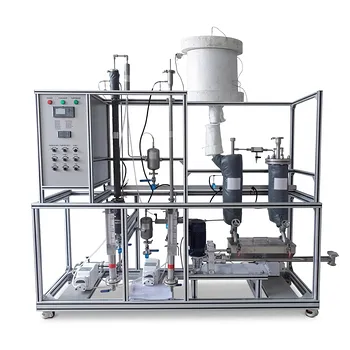
Fuel processing is a thermal tug-of-war. Pilot plants designed for fuel processing make this conflict visible by deploying fundamentally different reactor designs for each reaction stage.
For the highly endothermic steam reforming (>650°C), they demonstrate the critical need for an external heat supply, often using integrated combustor exhaust.
For the mildly exothermic water-gas shift (WGS, <400°C), they show how controlled, staged cooling is required to manage an equilibrium-limited reaction where hot kinetics fight cool thermodynamics.
For the highly exothermic preferential oxidation (PROX), they solve the extreme challenge of removing heat instantly to stop the runaway oxidation of hydrogen—the very product you’re trying to protect.
Chemical engineering pilot plants reveal that the key to efficient hydrogen production isn’t just catalyst chemistry; it’s mastering the distinct thermal signature of each reaction. They prove that the same microchannel architecture must behave as a furnace, a thermostat, and a quench cooler in a single, seamless sequence.
The Thermodynamic Trio: Unique Heat Demands in Hydrogen Production
The journey from hydrocarbon to hydrogen involves three reactions with radically different heat requirements. A unit operations pilot plant is built to expose and resolve these differences, not hide them.
Steam Reforming: The Heat-Hungry Furnace
This is the first and most thermally demanding step. The primary reference confirms the reaction is highly endothermic and operates at over 650°C, making heat transfer the rate-limiting mechanism.
Pilot plants demonstrate this by tightly integrating a catalytic combustor that burns a portion of the fuel or anode off-gas to supply the required energy. Supplementary references reinforce that, for methanol reforming as a model fuel, the enthalpy is lower (49 kJ/mol vs. 206 kJ/mol for methane) and the reaction temperature drops to 250–350°C, making the heat duty far easier to manage in a laboratory setting. Without this visible heat integration, the reactor core would simply quench, and no hydrogen would be produced.
Water-Gas Shift: The Thermostat’s Dilemma
The WGS reaction is mildly exothermic, and the pilot plant reveals a perfect thermal paradox. To speed up kinetics, you want high temperatures. But to push the equilibrium-limited conversion toward hydrogen and carbon dioxide, you need low temperatures.
A pilot plant demonstrates this by employing controlled, stepped cooling—often through a series of adiabatic beds with inter-stage cooling or, as the primary reference highlights, directly inside microchannel architectures. These microscale passages allow the reactor wall to act as a heat sink, gradually removing heat to follow a descending temperature profile that maximizes conversion before side reactions can take over.
Preferential Oxidation: The Runaway Reaction
The final cleanup step adds oxygen to oxidize trace CO to CO2 without consuming the hydrogen. The primary reference states that this reaction is highly exothermic and demands rapid heat removal.
In a pilot plant, this is not a gentle cooling curve. It’s an emergency stop. If heat accumulates, the temperature spike triggers the competitive oxidation of hydrogen, destroying product and creating a dangerous hotspot. The pilot plant demonstrates this challenge by implementing integrated microchannel heat exchangers directly adjacent to the catalyst layer, ensuring the heat of reaction is dissipated almost instantly, preserving selectivity for the CO oxidation pathway.
Making Thermo Visible: The Role of Microchannel Pilot Plants
A traditional fixed-bed reactor often masks these thermal dynamics in a cloud of hot spots and poor radial heat transfer. Modern unit operations pilot plants use microchannel technology to externalize each thermal challenge into a clear, measurable control strategy.
How the Architecture Defines the Thermal Solution
The primary reference specifically notes that microchannel architectures address the high heat and mass transfer demands of PROX. Supplementary references expand this to steam reforming, showing how close-coupling an endothermic reformer with an exothermic combustor, vaporizers, and recuperators in a single block can raise thermal efficiency from 45% to nearly 80%.
This same design language governs WGS and PROX. The pilot plant becomes a physical demonstration of a thermal cascade: the waste heat from the hot reformer can be recuperated to drive the endothermic reaction, while the cooler downstream stages (WGS and PROX) are designed with dedicated cooling channels that prevent heat from bleeding backward and destroying the equilibrium or selectivity.
Dynamic Energy Balances, Not Just Calorimeter Constants
Supplementary references contrast simple coffee-cup calorimetry with the pilot plant's ability to run dynamic energy balances. By instrumenting the reactor with precise flow meters, temperature sensors, and differential pressure transducers, students and researchers can directly measure the heat transfer coefficients and see how the path of heat removal (in WGS and PROX) directly alters the work output and product distribution—a concept that directly mirrors the thermodynamic lesson of single-step versus multi-step gas expansion.
Understanding the Trade-offs: When Thermal Management Fails
Objectively, mastering the heat does not mean the process becomes foolproof. Pilot plants expose the points where thermal management strategies can break down:
- Steam Reforming Coking: The same heat required to drive the endothermic reaction can cause thermal cracking of hydrocarbons, forming coke that deactivates the catalyst. Supplementary references note that moving to methanol as a fuel in a pilot plant (at 250–350°C) inherently avoids this, demonstrating that thermal management is also about fuel selection.
- WGS Equilibrium Limitations: If the stepped cooling fails—say, a cold spot forms prematurely—the kinetics freeze before equilibrium is reached, trapping CO in the stream. The pilot plant shows that thermal uniformity is non-negotiable.
- PROX Selectivity Loss: The margin for error is tiny. A lag of even seconds in heat removal can shift the exotherm into full hydrogen combustion. The microchannel solution is effective but introduces a higher pressure drop and a sensitivity to fluid maldistribution across thousands of parallel micro-passages.
- Integration Complexity: Close-coupling all these thermal zones into a single block maximizes efficiency but creates a nightmare of cross-talk. A disturbance in the combustor instantly ripples into the reformer, WGS, and PROX zones, requiring advanced model-based control—a challenge the pilot plant is built to teach.
Making the Right Choice for Your Pilot Plant Design
The way you configure the thermal management in your unit operations pilot plant must align with your learning or research objective.
- If your primary focus is industrial feasibility studies: Use the highest-fidelity thermal integration, with full endothermic-exothermic coupling (combustor to reformer) and multi-stage WGS at high pressure. Accept the complexity to generate scale-up data.
- If your primary focus is reaction kinetics and catalyst screening: Select a model fuel like methanol that reduces the thermal severity, allowing you to operate at safer temperatures (250–350°C) and separate the heat transfer problem from the catalytic chemistry, as highlighted in the supplementary references.
- If your primary focus is advanced process control: Deliberately decouple the thermal zones with independent electric heaters and cold-fluid loops. This provides the flexibility to inject controlled disturbances and safely practice thermal runaway mitigation for the highly exothermic PROX stage.
- If your primary focus is conceptual education: Use the microchannel block as a visual and instrumental tool to demonstrate the three distinct heat signatures (furnace, thermostat, quench) in a single, swift experimental run, reinforcing the core thermodynamic principle that the path of thermal energy dictates the outcome.
Engineering is the art of controlling what you can measure, and in a fuel processing pilot plant, heat is the variable you cannot afford to ignore.
Summary Table:
| Reaction | Thermal Nature | Operating Temp | Pilot Plant Control Strategy |
|---|---|---|---|
| Steam Reforming | Highly Endothermic | >650°C (Methane) | External heat integration via catalytic combustor |
| Water-Gas Shift (WGS) | Mildly Exothermic | <400°C | Controlled staged cooling / microchannel heat sinks |
| Preferential Oxidation (PROX) | Highly Exothermic | Rapid Cooling | Integrated microchannel heat exchangers (runaway prevention) |
Master Chemical Process Control with LABPARK
Are you looking to equip your lab with advanced systems that make complex thermodynamic concepts visible? LABPARK provides premium Educational and Vocational Unit Operations Pilot Plants in chemical engineering, bioprocess & biotech, and environmental & water treatment for universities, research institutes, and enterprises.
Our pilot plants feature high-precision instrumentation and microchannel architectures, allowing students and researchers to safely manage critical thermal dynamics like steam reforming, WGS, and PROX.
Ready to elevate your engineering lab?
Contact LABPARK Today to Request a Quote and explore our custom pilot plant solutions!
Related Products
- Steam Methane Reforming Hydrogen Production and Purification Educational Pilot Plant
- O-Xylene Oxidation to Phthalic Anhydride Educational Unit Operations Pilot Plant
- Dual-Mode Rectification Pilot Plant for Practical Training Unit Operations
- Fixed-Bed Chemical Reaction and Gas Dust Tar Removal Unit Operations Pilot Plant
- Thermal Desorption Exhaust Gas and Tail Water Treatment Educational Pilot Plant
People Also Ask
- How does integrating unit operations impact pilot plant thermal efficiency & CO management? Key design insights.
- How Do Temp, Pressure & S:C Ratio Affect Methane Reforming? Optimize Your Pilot Reactor
- In educational chemical engineering pilot plants, why use absorption and adsorption before reforming?
- SMR, POX, or ATR? Trade-offs in Hydrogen Production Educational Pilot Plants
- What are steam reforming pilot plant challenges? Master Feedstock Selection & Design