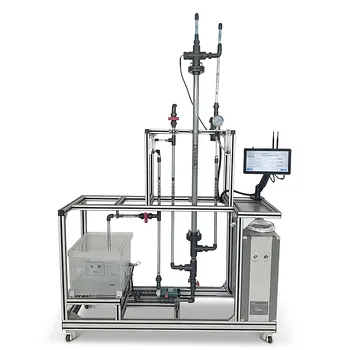
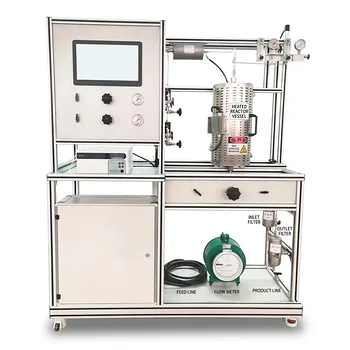
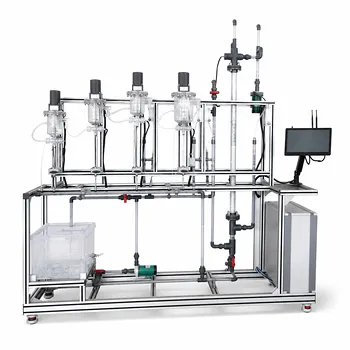
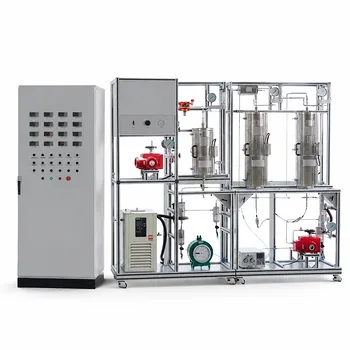
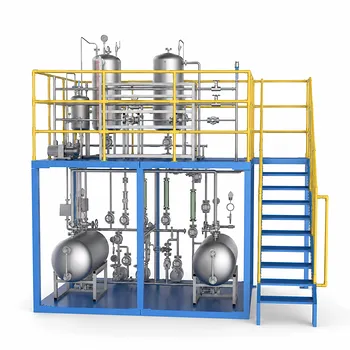
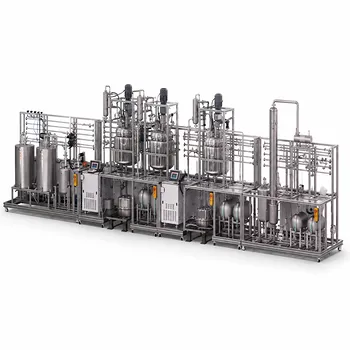
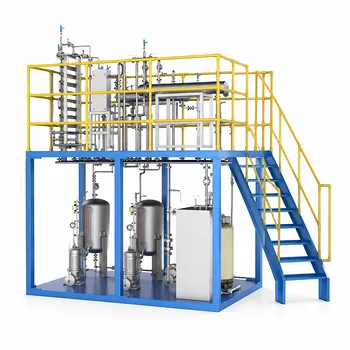
Pilot plants transform abstract reactor theory into hands-on engineering judgment. They let students physically configure industrial reactor types—like the cooled multitubular system for benzene hydrogenation or the heated radial bed for ethylbenzene dehydrogenation—and then directly manipulate the heat exchange and temperature curves that dictate conversion and selectivity. In a single practical session, they see why a 10°C deviation can slash yield in an exothermic reaction or stall an endothermic one, gaining an instinct that pencil-and-paper kinetics alone cannot provide.
The core insight: Chemical engineering unit operations pilot plants compress real-world reactor complexity into a safe, observable scale. By experimenting with different hardware setups and programmable temperature control, students learn to marry thermodynamic principles with mechanical design—understanding exactly why an exothermic benzene hydrogenation demands aggressive heat removal in a loop or tubular reactor, while an endothermic ethylbenzene dehydrogenation relies on radial flow and interstage heating to keep conversion on target.
From Textbook to Tangible: Reactor Selection Becomes Physical
Simulating Industrial Reactor Configurations at Scale
Pilot plants reproduce industrial reactor geometries—fixed-bed, fluidized-bed, loop, radial—on a benchtop or skid scale. Students physically swap out column types, packing, and catalyst beds to match a target process. For instance, benzene hydrogenation to cyclohexane is highly exothermic; a multitubular fixed-bed reactor with coolant channels is standard to whisk away heat and avoid runaway. In the pilot plant, students can configure a jacketed tubular reactor and observe temperature hot spots when coolant flow is deliberately reduced, cementing the link between reactor selection and heat management.
In contrast, ethylbenzene dehydrogenation to styrene is endothermic and equilibrium-limited. Industrial units often use adiabatic radial-flow reactors with interstage reheat. A pilot plant with modular internals lets students mimic this by arranging catalyst in a radial configuration and adjusting interstage heater setpoints. They physically sense the pressure-drop differences and flow distribution challenges that influence the choice of a radial design over a conventional axial bed.
Integrating Heat Exchange and Thermal Management
Pilot plants embed heat exchangers, jackets, and internal coils directly into the reactor loop—not as afterthoughts, but as integral parts of the system. Students configure counter-current coolant flows for an exothermic reaction and measure the effect on conversion. They learn why benzene hydrogenation reactors often recycle hydrogen to act as a heat sink, a tactic they can test by diverting a portion of the effluent cool and feeding it back to the inlet.
For endothermic reactions, such as ethylbenzene dehydrogenation, external superheated steam or electrical tracing mimics industrial reheat stages. By adjusting the heat input at different axial positions, students discover that the reactor’s performance hinges not just on total energy supplied, but on where that energy is introduced—a lesson impossible to grasp from a single isothermal textbook equation.
Decoding Temperature Control: Kinetics, Selectivity, and Equilibrium
Exothermic vs. Endothermic: Matching Temperature to Reactor Duty
Exothermic reactions release heat; if not removed, the rate accelerates exponentially, risking thermal runaway. In a benzene hydrogenation pilot run, students can disable the coolant and watch the reactor temperature spike—immediately linking the Arrhenius dependence to a physical safety limit. They learn that a robust control philosophy (multiple thermocouples, failsafe coolant valves) is as critical as the catalyst recipe.
For an endothermic system like ethylbenzene dehydrogenation, supplying heat too slowly chills the bed and kills conversion. Students see that raising the inlet temperature too high causes coking and reduces selectivity. The pilot plant makes the optimal temperature window tangible: you chase a narrow band where kinetics outrun equilibrium constraints without cracking products.
Temperature Profiling for Selectivity in Parallel Reactions
When side reactions compete with the desired pathway, selectivity depends on the difference in activation energies. Pilot plants with programmable multi-zone heating allow students to execute a rising temperature profile. For a system where the desired reaction has lower activation energy ($E_1 < E_2$), they start at a low temperature to preserve selectivity, then ramps up later as reactant concentration drops to boost conversion. They physically program a PID controller to follow this ramp, sample the outlet, and plot selectivity vs. yield—validating the kinetic model in real time.
The reverse case—where the desired reaction has higher activation energy—teaches them to run hot, but not so hot that thermal degradation overtakes. They can test stepwise profiles, compare conversion-yield curves, and internalize why an adiabatic reactor for ethylbenzene dehydrogenation often employs interstage heating rather than a simple temperature setpoint.
Equilibrium Shifts and the Van’t Hoff Verification
Beyond kinetics, pilot plants with steady-state temperature control make thermodynamic theory visible. Students operate an exothermic, equilibrium-limited reaction (e.g., ammonia synthesis) at different fixed temperatures and measure outlet concentrations. Using the van’t Hoff equation, they compute $\ln K_p$ vs. $1/T$, extract the reaction enthalpy, and find the slope they derived in class. This direct experimental confirmation—seeing $K_p$ drop as they raise the temperature—anchors the concept that exothermic reactions suffer from equilibrium penalties at high heat, a trade-off they must manage in reactor design.
Applying the Levers: Process Variables and Real-Time Feedback
Manipulating Feed Rates, Space Velocity, and Pressure
Pilot plants let students physically turn knobs on mass flow controllers and back-pressure regulators. In a fixed-bed reactor simulating ethylbenzene dehydrogenation, they increase space velocity and observe that conversion drops, but selectivity might improve because residence time shortens. They learn that a radial reactor’s low pressure drop allows higher throughput—a direct lesson in how hardware selection enables process intensification.
For benzene hydrogenation, raising system pressure forces the equilibrium toward cyclohexane (Le Chatelier for a mole-number reduction). Students see the shift in conversion instantly on the online gas chromatograph, connecting thermodynamics to the high-pressure industrial operation.
Data Acquisition and PID-Controlled Jackets
Modern pilot units are equipped with real-time sensor networks and SCADA interfaces. Students configure PID loops on jacket temperature or coolant flow, watching the lag between a setpoint change and the reactor response. This teaches the dynamics of heat transfer resistance and the need for anti-windup strategies in exothermic reactors, where a cascade control scheme (jacket–process) is standard. They can inject a disturbance—say, a step in steam flow—and observe how quickly the control system can prevent a temperature overshoot that would degrade product quality.
Understanding the Trade‑offs
Scale‑Up Complexities and Hardware Simplifications
Pilot plants are deliberately scaled-down versions of industrial units, which introduces non‑ideal behaviors. Heat transfer area-to-volume ratios are higher, so runaway scenarios can appear less severe than in a large reactor. Students must learn to separate intrinsic kinetics from transport artifacts—a crucial skill in scale‑up that pilot‑scale data alone cannot fully teach without additional modeling.
The simplified configurations (e.g., using a single tube instead of a multitubular bundle) also abstract away some fluid distribution and hotspot mitigation challenges. Critical thinking is needed to translate pilot observations to a full-size design.
The Cost and Safety Boundaries of Student Operations
Real benzene hydrogenation involves flammable solvents, high-pressure hydrogen, and toxic catalysts. Pilot plants inherently limit the hazard envelope—using diluted streams, lower temperatures, or surrogate reactions. While this protects students, it can mask the severity of industrial safety systems. The lesson is that the pilot plant is a learning bridge, not a perfect replica; students must supplement it with safety case studies and process hazard analysis training.
Making the Right Choice for Your Learning Goal
Every unit operations pilot plant exercise can be tuned toward a different objective. Use these focus areas to align your learning outcomes:
- If your primary focus is selectivity optimization: Configure a parallel-reaction system (e.g., consecutive oxidation) and program a temperature ramp profile. Experiment with delayed reactant addition or quenching to maximize desired product, then verify with online analysis.
- If your primary focus is reactor design selection: Compare a fixed-bed and a radial-bed configuration for the same endothermic chemistry. Measure pressure drop, conversion, and temperature uniformity to justify industrial choices like ethylbenzene dehydrogenation’s radial reactor.
- If your primary focus is kinetic modeling: Run steady-state experiments at multiple temperatures, feed ratios, and space velocities. Fit Arrhenius and Langmuir-Hinshelwood parameters directly from your data, then test the model’s predictive accuracy by changing conditions.
- If your primary focus is process safety and control: Deliberately perturb a highly exothermic reactor by cutting coolant, and observe the response of a cascade PID loop. Document the safe operating envelope and design an interlock logic that the pilot plant’s PLC can execute.
By working directly with reactor pilot plants, future engineers turn abstract differential equations into hardware intuition—equipping them to select, size, and control the reactors that power the chemical industry.
Summary Table:
| Process | Reaction Type | Reactor Design | Key Control Strategy |
|---|---|---|---|
| Benzene Hydrogenation | Exothermic (releases heat) | Jacketed / Multitubular Fixed-Bed | Heat removal, coolant flow PID cascade, recycle gas |
| Ethylbenzene Dehydrogenation | Endothermic (absorbs heat) | Radial-Flow / Interstage Reheating | Multi-zone heating, space velocity, coking prevention |
Bring Industrial Reactor Kinetics to Life in Your Lab
Equip your students and researchers with the practical skills needed to master complex thermal management and reactor design. LABPARK provides state-of-the-art Educational and Vocational Unit Operations Pilot Plants in chemical engineering, bioprocess & biotech, and environmental & water treatment for universities, research institutes, and enterprises. Our systems feature real-time data acquisition and precise PID control to safely mirror real-world industrial operations.
Ready to elevate your engineering curriculum or research capabilities? Contact LABPARK today to discover our customizable pilot plant solutions!
Related Products
- Multi-Reactor Educational Pilot Plant for Reaction Engineering Unit Operations
- Tubular Reactor Flow Characteristics Determination Educational Unit Operations Pilot Plant
- Fixed-Bed Chemical Reaction and Gas Dust Tar Removal Unit Operations Pilot Plant
- Fixed Bed Gas Solid Catalytic Reaction Educational Pilot Plant
- 100L Continuous Loop Hydrogenation Educational Unit Operations Pilot Plant
People Also Ask
- How do educational unit operations pilot plants address safety and waste management when scaling up?
- How do educational unit operations pilot plants bridge theory and design? Bridge the Engineering Gap
- Why Compare Predicted and Experimental Excess Enthalpy? Key to Accurate Pilot Plant Scale-up
- How to study gasification in pilot plants? Compare exit gas composition & efficiency
- Why Use PTFE & Hastelloy in Chemical Pilot Plants? Prevent Corrosion & Ensure Safety