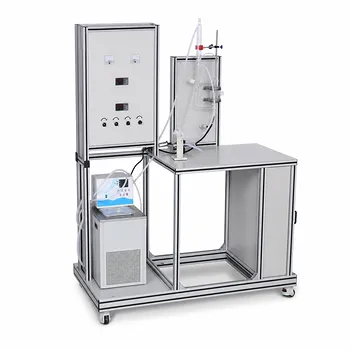
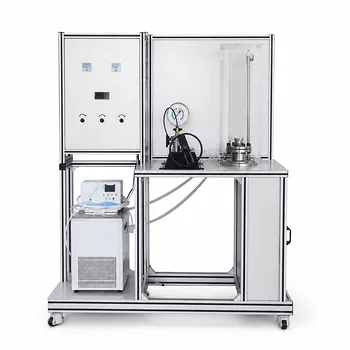
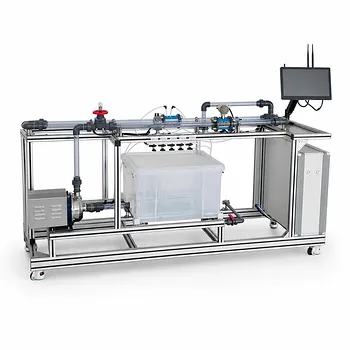
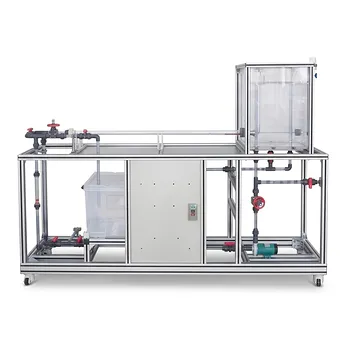
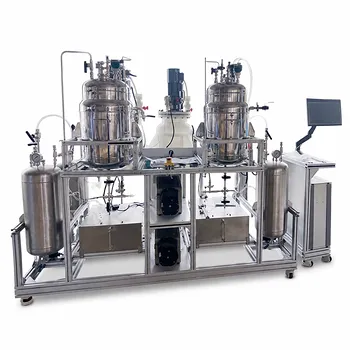
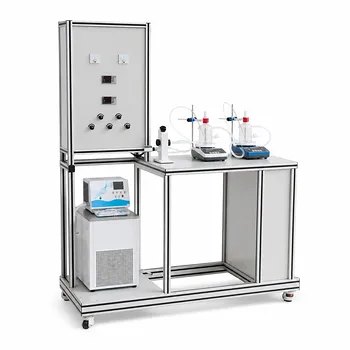
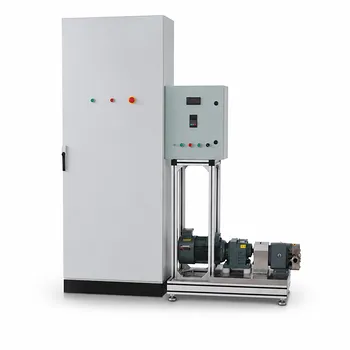
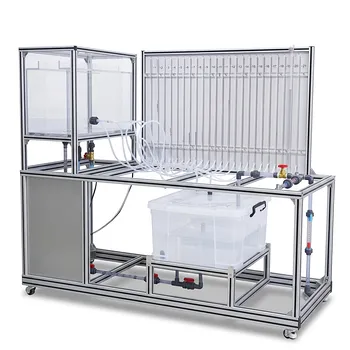
The Gap Between Theory and Reality. Unit operations pilot plants and dedicated VLE apparatuses bridge the gap by allowing students to physically measure real-time pressure, temperature, and phase composition data—the core P-T-x-y variables of vapor-liquid equilibrium. By directly comparing these experimentally generated curves with the activity coefficients predicted by group contribution methods like UNIFAC, learners see exactly where and why the theoretical model deviates from actual behavior. This immediate, hands-on comparison transforms an abstract formula into a tangible lesson on model limitations and the necessity of empirical validation in process engineering.
Predictive models such as UNIFAC offer a rapid way to estimate VLE during initial design, but they are built on idealized group interactions that often fail to capture real-world complexity. Pilot plants and VLE apparatuses give students the power to generate their own data under controlled conditions, revealing those deviations and teaching them why engineers never rely solely on predictions for critical separations.
What Predictive Models Like UNIFAC Actually Do
A Combinatorial + Residual Foundation
The UNIFAC method calculates liquid-phase activity coefficients by splitting them into two parts.
The combinatorial part accounts for differences in molecular shape and size, while the residual part captures the energetic interactions between functional groups.
This group contribution approach lets you estimate VLE for a vast number of mixtures without doing a single experiment.
The Allure and the Built-in Limitation
Predictive models are fast, cheap, and seem to cover every imaginable molecule.
But their accuracy depends entirely on the quality and availability of group interaction parameters.
When those parameters are missing, outdated, or extrapolated beyond their original range, the predicted equilibrium curves can drift far from reality.
How Pilot Plants and VLE Apparatuses Close the Loop
Controlling the Thermodynamic State
A dedicated VLE unit or distillation pilot plant lets students set and hold a constant pressure or temperature while the system moves toward equilibrium.
Once macroscopic properties stabilize—temperature, pressure, and phase volumes stop changing—the system has reached the point where the chemical potential of each component is equal in both liquid and vapor phases.
That real-time control makes abstract thermodynamic conditions concrete.
Measuring P-T-x-y Data Directly
At equilibrium, students extract physical samples of both liquid and vapor phases.
They measure composition via refractometry, gas chromatography, or density—generating the exact xi (liquid) and yi (vapor) data that theoretical models attempt to predict.
Coupled with the logged temperature and pressure, this complete P-T-x-y dataset becomes the empirical benchmark against which a UNIFAC simulation must be tested.
Turning Simulations into Physical Insight
A simulation spits out a smooth equilibrium curve; a pilot plant reveals the jagged reality.
When students overlay their experimental points on the UNIFAC-predicted T-x-y or x-y plot, deviations become impossible to ignore.
They see firsthand that models can misplace the azeotrope, mispredict relative volatility, or miss liquid-liquid phase splits entirely.
Bridging the Gap: What Students Actually Learn
Revealing Missing Parameters and Non‑Idealities
A consistent offset between experimental and predicted activity coefficients screams that the group interaction parameters need adjustment.
Students learn to identify when the residual term is failing—often because the model’s library doesn’t contain the right functional group pairs or neglects proximity effects.
This insight is something no lecture slide can deliver with the same force.
From Ideal Assumptions to Real‑World Constraints
Theoretical predictions assume perfect mixing, instantaneous equilibrium, and no heat loss.
In a pilot-scale distillation column or VLE still, students confront temperature gradients across trays, heat leaks through insulation, and pressure drops that shift the equilibrium point.
These real-world constraints explain why a simulation output is a starting point, not a design guarantee.
Building the Habit of Empirical Validation
The most critical lesson is procedural: never trust a model without experimental backup.
By running the pilot plant themselves, students internalize the engineering workflow—model → predict → build → measure → compare → refine.
That cycle, repeated until the experimental and theoretical results converge, is the heart of safe, efficient process design.
Understanding the Trade‑offs and Limits
Predictive Models Are Only as Good as Their Library
UNIFAC and similar methods cannot predict behavior for systems with missing or poorly defined group parameters.
When a student encounters a novel ionic liquid or a molecule with multiple strongly interacting groups, the model may fail entirely, producing physically impossible activity coefficients.
The experiment then becomes not just a check but the only source of truth.
Pilot Plants Have Their Own Uncertainties
Experimental data is not automatically perfect.
Sampling errors, incomplete degassing, analytical instrument drift, and difficulties in measuring trace components can all introduce noise.
Students quickly learn that closing the material and energy balances is a skill in itself and that experimental error bars must be compared to model tolerance bands.
The Cost and Time of Validation
Running a pilot‑scale experiment takes hours or days, consumes chemicals, and requires supervision.
For early‑stage screening, engineers still rely heavily on predictive models because they are fast and practically free.
The educational takeaway is balance: use UNIFAC to narrow the search, then validate the critical separations with physical data.
Making the Most of the Theory‑Experiment Link
What you prioritize in a unit operations lab shapes the lessons you take away. Tailor your approach to your learning goal.
- If your primary focus is model development: Operate the VLE apparatus to generate high‑purity P‑T‑x‑y data for systems where group interaction parameters are missing, then regress new parameters and test them against an independent set of data.
- If your primary focus is process design: Run a fractional distillation pilot plant across a range of reflux ratios and feed compositions, comparing the actual plate efficiencies and product purities to the values assumed by the UNIFAC‑based simulation, then adjust your design margins accordingly.
- If your primary focus is teaching fundamentals: Have students first predict the T‑x‑y curve using UNIFAC, then physically run the VLE cell to collect the experimental points—the shock of the difference is the moment real thermodynamic understanding begins.
Hands‑on validation transforms a predictive equation from a theoretical convenience into a tool whose limits you respect deeply—and that respect is what builds a trustworthy engineer.
Summary Table:
| Feature | Theoretical Models (e.g., UNIFAC) | VLE Pilot Plants & Apparatuses |
|---|---|---|
| Data Source | Mathematical estimations & group parameters | Direct physical P-T-x-y measurement |
| Real-world Factors | Ignores heat loss & pressure drops | Accounts for actual system constraints |
| Azeotrope Accuracy | May mispredict or miss entirely | Reveals true thermodynamic behavior |
| Primary Benefit | Rapid initial screening | Empirical validation of design models |
Bring Hands-On VLE Validation to Your Lab
Bridging the gap between thermodynamic theory and physical reality requires reliable, high-precision equipment. LABPARK provides premium Educational and Vocational Unit Operations Pilot Plants in chemical engineering, bioprocess & biotech, and environmental & water treatment.
Designed specifically for universities, research institutes, and enterprises, our pilot plants and VLE apparatuses empower students and researchers to generate precise experimental data, validate predictive models, and master process design.
Ready to elevate your engineering curriculum or research capabilities? Contact LABPARK today to get a customized solution for your lab!
Related Products
- Binary System Vapor Liquid Equilibrium Data Determination Educational Unit Operations Pilot Plant
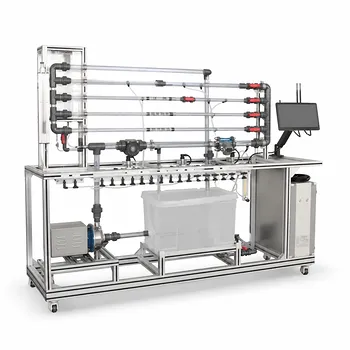
- Fluid Friction Resistance Determination Educational Unit Operations Pilot Plant
- Multi-Functional Special Distillation Educational Pilot Plant
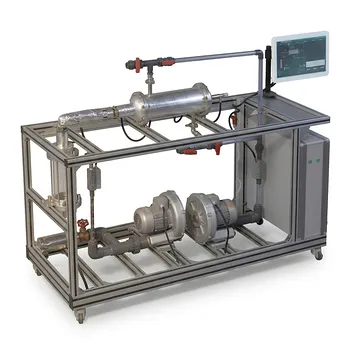
- Shell and Tube Heat Exchanger Heat Transfer Coefficient Determination Educational Pilot Plant
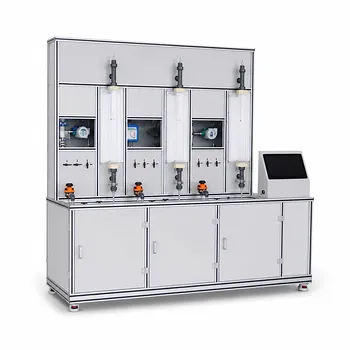
- Rising and Falling Film Evaporation Educational Unit Operations Pilot Plant
People Also Ask
- For VLE Experiments: Fugacity vs. Activity Coefficient Method Selection Criteria
- Why correlate VLE pilot plant data using Wilson, NRTL, and UNIQUAC? Achieve Accurate Column Scale-Up
- How do pilot plants assist in teaching & researching non-ideal VLE? Bridge Theory & Physical Validation
- How to Model VLE for Supercritical & Unstable Components? Pilot Plant Methods
- Why is accurate VLE data critical? Optimize Unit Operations & Process Scale-Up