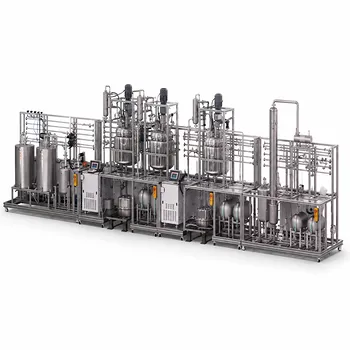
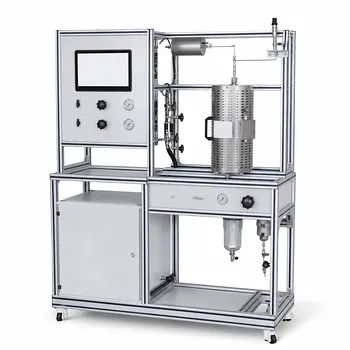
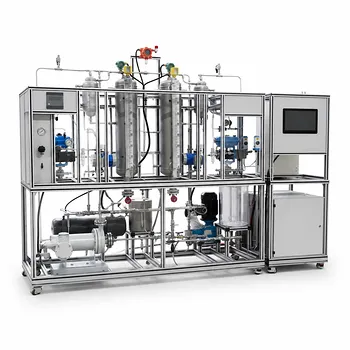
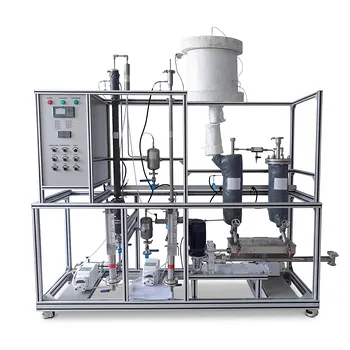
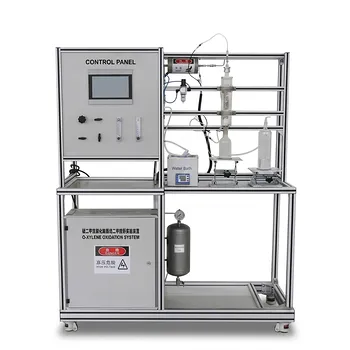
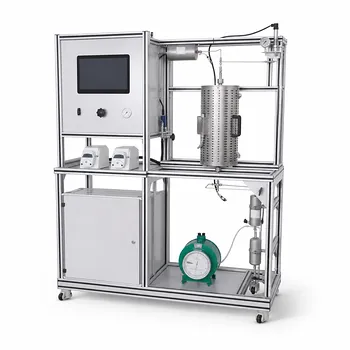
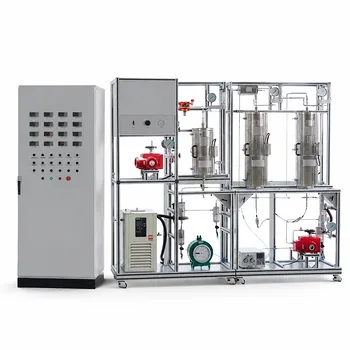
The defining characteristic of a chemical engineering training pilot plant for ammonia synthesis is its ability to decouple feedstock generation from compositional control, allowing for the precise simulation of industrial conditions. Instead of requiring a full-scale steam methane reformer, most educational pilot plants simulate syngas-based ammonia synthesis by using a highly instrumented gas-mixing station. This system blends pure bottled hydrogen and nitrogen through mass flow controllers (MFCs) to achieve the critical 3:1 molar stoichiometric ratio, bypassing the immense complexity of generating and cleaning syngas from scratch.
A training pilot plant simulates feedstock preparation through two distinct philosophies: the upstream simulation using a dedicated gas-mixing station for precise stoichiometry control, and the complete sequence simulation using modular unit operations to replicate the industrial front-end. The central lesson is that real-time, closed-loop control of the H₂/N₂ ratio at the reactor inlet is the most critical variable for preventing catalyst bypass and optimizing conversion, a skill honed by manipulating these scaled-down systems.
The Core Lesson: Simulating Stoichiometry via Gas-Mixing
The primary purpose of a pilot plant is vocational education, not full-scale production. Therefore, the simulation of feedstock preparation often begins at the point of highest pedagogical value: the synthesis loop inlet.
The Heart of the Simulation: The Gas-Mixing Station
The “feedstock preparation” is functionally replaced by a bank of high-pressure cylinders and an intelligent flow control panel. This system delivers pure hydrogen and nitrogen, simulating the clean syngas that would come from a methanator in a real plant. Students physically set the flow rates on mass flow controllers (MFCs) to achieve the non-negotiable 3:1 H₂ to N₂ molar ratio.
Why Closed-Loop Control is Non-Negotiable
Setting the initial ratio is trivial. The educational value lies in maintaining the recycle loop stoichiometry. An online gas analyzer—typically a gas chromatograph (GC)—continuously pulls a sample from the recycle stream upstream of the reactor. If the analyzer detects a hydrogen deficit due to reaction consumption or purge losses, students must adjust MFC setpoints to trim the makeup gas composition, simulating the dynamic process control challenges of an industrial plant.
The Role of Inerts and Purge Management
A critical lesson is that industrial recycle loops accumulate inert gases like argon and methane. In a mixing-station setup, instructors can deliberately bleed a small amount of argon or nitrogen into the feed. Students then observe how an increasing inert concentration reduces reactant partial pressures, forcing them to manipulate the purge stream flow rate. This hands-on exercise teaches the economic balance between energy waste from excessive purging and the kinetic penalty of reduced hydrogen partial pressure.
Alternative Strategy: Simulating the Full Syngas Preparation Chain
Some advanced modular pilot plants do not use a bypass gas-mixing station. They physically simulate the chemical sequence required to create the syngas.
Replicating the Industrial Front-End
This approach integrates several small-scale unit operations in sequence. A steam-generator feeds a micro-reactor packed with a reforming catalyst, converting a hydrocarbon feed into hydrogen and carbon monoxide. This process-oriented simulation moves students upstream to the initial chemical transformations.
The Sequential Purification Train
The raw syngas then flows through a train of absorption columns. A high-temperature shift converter reacts CO and H₂O to maximize H₂ output. An amine-based absorption column strips out the CO₂ using a chemical solvent. Finally, a methanation reactor scrubs the residual CO and CO₂ down to parts-per-million (ppm) levels, producing a gas stream that is functionally identical to the bottled N₂/H₂ mix used in the simpler setup.
The Thermodynamic and Material Constraints
Operating these preparative stages obligates students to manage thermodynamic trade-offs early. They learn that controlling the steam-to-carbon ratio in the reformer dictates the downstream H₂/CO product distribution, and that inadequate desulfurization will irreversibly poison the catalytic sites. This method also introduces the engineering challenge of hydrogen embrittlement. All high-pressure piping and reactor components downstream of the compressor must use specialized, high-strength steel alloys to prevent atomic hydrogen from penetrating and weakening the metal structure.
Understanding the Trade-offs: Mixing Stations vs. Modular Synthesis
The choice between simulating stoichiometry with a gas-mixing station and building a complete front-end is not a cost issue alone. It is a pedagogical trade-off.
The Purity of Control
The gas-mixing station provides a "clean" experimental environment. By bypassing the variable efficiency of reformers and scrubbers, students can isolate the thermodynamics and kinetics of the synthesis loop itself. This prevents upstream fluctuations in CO₂ removal efficiency from masking the downstream reaction physics during a heat transfer experiment. The downside is that students lose exposure to the chemical engineering principles of gas-liquid absorption and primary reforming.
The Reality of Integration
The modular sequence approach teaches system-of-systems thinking. A disturbance in the reformer temperature propagates through the shift converter and changes the methanator feed composition. This integrated chaos perfectly mirrors an industrial control room. However, the educational risk is significant overshoot. A student error in the reforming stage can shut down the entire downstream process, reducing active learning time if the plant cannot be quickly reset through a hot-standby bypass.
Making the Right Choice for Your Educational Goal
The simulation method must align directly with the learning objective. There is no universally superior approach, only a more relevant fit.
- If your primary focus is advanced reaction kinetics and loop control: Choose a gas-mixing station. The ability to step-change the H₂/N₂ ratio precisely and observe catalyst surface dynamics without downstream lag time is unparalleled.
- If your primary focus is integrated process design and unit operations: Choose the modular synthesis train. The physical operation of an absorption column and shift reactor connects textbook concepts of mass transfer and equilibrium to tangible hardware.
- If your primary focus is industrial safety and mechanical integrity: A high-pressure synthesis loop fed by either method must integrate alloy metallurgy studies. The core lesson of preventing hydrogen blistering remains constant regardless of the gas source.
Mastering the simulation of ammonia feedstock is ultimately less about the chemical origin of the gas and more about internalizing the brutal sensitivity of a high-pressure catalytic loop to atomic-scale stoichiometric errors.
Summary Table:
| Feature | Gas-Mixing Station (Upstream Simulation) | Modular Synthesis Train (Complete Sequence) |
|---|---|---|
| Primary Focus | Reaction kinetics & synthesis loop control | Integrated process design & unit operations |
| System Complexity | Low (uses bottled H₂/N₂ via MFCs) | High (multi-stage catalytic reactors & columns) |
| Key Pedagogical Value | Troubleshooting stoichiometry & recycle loops | Managing thermodynamic trade-offs & mass transfer |
Bring real-world industrial processes into your lab with LABPARK. We provide advanced Educational and Vocational Unit Operations Pilot Plants in chemical engineering, bioprocess & biotech, and environmental & water treatment for universities, research institutes, and enterprises. Our highly instrumented systems enable hands-on training in process control, kinetics, and system integration. Contact us today to find the perfect pilot plant solution for your educational and research goals!
Related Products
- Methanol Synthesis and Catalyst Performance Evaluation Educational Unit Operations Pilot Plant
- Ethyl Acetate Synthesis Unit Operations Pilot Plant for Practical Training
- Aspirin API Synthesis Unit Operations Training Pilot Plant
- Multi-Functional Special Distillation Educational Pilot Plant
- Carbon Dioxide Hydrogenation Methanol Synthesis Educational Unit Operations Pilot Plant
People Also Ask
- Why is a purge system necessary when operating a gas recirculation loop in a methanol synthesis pilot plant? (Guide)
- How do temp & pressure affect methanol synthesis pilot plants? Optimize equilibrium and catalyst performance.
- Why do modern methanol pilot plants operate at lower pressures? Catalyst & Feed Requirements Explained
- What are the operational requirements for catalyst activation? Safe Methanol Pilot Plant Operation
- Why Compare Predicted and Experimental Excess Enthalpy? Key to Accurate Pilot Plant Scale-up