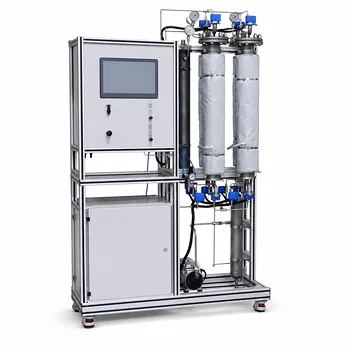
Synthesizing magnetic nanoparticles via co-precipitation demands absolute precision. In chemical engineering educational pilot plants, reaction conditions are controlled through a tightly integrated system: dedicated gas inlet manifolds maintain a stable nitrogen purge to exclude oxygen, PID-controlled jacketed reactors provide precise temperature regulation, and variable-speed agitators ensure homogeneous mixing of the iron salts and alkaline precipitant.
The secret lies not in one piece of equipment but in the orchestration of three interdependent controls—inert atmosphere, exact temperature, and uniform mixing—to prevent premature oxidation and produce nanoparticles of consistent size, while simultaneously teaching the fundamentals of crystallization, mass transfer, and process automation.
The Core Control Triad: Atmosphere, Temperature, and Mixing
Maintaining an Inert Atmosphere: The Nitrogen Purge System
Co-precipitation of Fe₃O₄ is highly sensitive to dissolved oxygen.
Educational rigs use a dedicated gas inlet control loop: mass flow controllers or precision needle valves feed nitrogen into the headspace or directly through a sparger in the reactant solution.
A back-pressure regulator or oil-filled bubbler maintains a slight positive pressure, ensuring air cannot enter.
By continuously purging, the system displaces oxygen and creates the reducing environment necessary to prevent Fe²⁺ oxidation to Fe³⁺ before magnetite can form.
Precise Temperature Regulation: PID-Controlled Heating and Cooling
Temperature directly influences reaction kinetics, crystal nucleation, and growth.
The reactor—typically a glass or stainless steel vessel—is surrounded by a heating/cooling jacket connected to a thermostatic bath.
A PID controller interprets the signal from a resistance temperature detector (RTD) or thermocouple immersed in the reaction mixture and modulates the heating power or coolant flow.
This closed-loop control holds the setpoint within ±0.5 °C, enabling students to study how temperature shifts mean particle size or favors the desired magnetite phase.
Ensuring Homogeneous Reaction Conditions: Variable-Speed Agitation
Local concentration gradients during the rapid addition of the precipitant (e.g., ammonia) can cause polydisperse or agglomerated particles.
A variable-speed overhead stirrer with a pitched-blade impeller provides controlled, uniform mixing.
By adjusting the impeller speed, students can investigate the link between mass transfer, micromixing, and nucleation rate—directly observing how poor mixing yields broad size distributions.
Why These Controls Matter: From Particle Quality to Educational Value
Preventing Oxidation and Phase Impurities
Without effective nitrogen purging, dissolved oxygen converts ferrous ions to ferric, yielding non‑magnetic goethite or hematite side‑products.
The color change from black to brown is an immediate visual cue for students—a powerful lesson on the importance of atmospheric control in reactive synthesis.
Influencing Particle Size and Morphology
Temperature and mixing govern the interplay between nucleation and growth.
Higher temperatures often promote growth over nucleation, giving larger crystallites; rapid mixing at low temperature can produce a burst of nuclei, leading to smaller particles.
By logging temperature profiles and agitation rates against final product size (measured off‑line), students build an intuition for crystallization unit operations.
Teaching Unit Operations and Process Control Principles
These pilot plants are miniature chemical plants: students configure feedback loops, interpret PID parameters, and monitor real-time data from online sensors (pH, conductivity, temperature).
A controlled pH adjustment—using a peristaltic pump that adds ammonia—completes the picture, illustrating how precipitation stoichiometry and zeta potential affect agglomeration.
The system thus bridges kinetics, thermodynamics (Le Chatelier’s principle for temperature‑driven equilibrium shifts), and process safety, all within one accessible experiment.
Understanding the Trade‑Offs and Common Pitfalls
Complexity vs. Learning Curve
A fully automated plant can hide the underlying physics.
Educational designs often strike a compromise: students begin with manual control of the nitrogen rotameter and heater dial, then progress to a supervised PID auto‑tune exercise to understand control stability.
Too much automation too early risks turning the experiment into a black‑box exercise.
Cost and Maintenance Considerations
High‑accuracy mass flow controllers for nitrogen and precision pH probes add significant capital cost.
Regular sensor calibration—especially of pH electrodes in alkaline slurries—is non‑negotiable.
A well‑designed unit includes a purge‑and‑clean protocol so that nanoparticle residue does not clog spargers or foul the jacket.
Common Pitfalls to Avoid
- Insufficient nitrogen flow: A low purge rate lets oxygen back‑diffuse, turning the precipitate brown. Students learn the hard way to measure dissolved oxygen or monitor color.
- Temperature overshoot: A poorly tuned PID can kill the batch by driving the temperature above the safe window where magnetite is stable.
- Neglecting mixing speed: If the agitator stalls or is set too low, the local pH spike near the ammonia inlet causes instant, uncontrolled precipitation and large agglomerates.
Making the Right Choice for Your Educational Goal
- If your primary focus is teaching the fundamentals of oxidation‑reduction chemistry: Invest in a robust nitrogen delivery system with a visible bubbler and integrate a dissolved‑oxygen probe so students can quantify the effect of purging.
- If your primary focus is demonstrating crystallization and particle‑size engineering: Prioritize a jacketed reactor with a fast‑response PID loop and high‑precision temperature sensor, and pair it with variable‑speed mixing to run factorial experiments.
- If your primary focus is process control and automation: Select a unit with industrial‑style instruments (mass flow controllers, digital dosing pumps, online pH and conductivity) and data‑acquisition software that lets students tune PID parameters and export real‑time trends.
- If your primary focus is safety and scale‑up awareness: Emphasize the cooling capacity of the jacket and the exotherm of ammonia addition; run “what‑if” scenarios where the controller fails, to instil a respect for thermal runaway prevention.
Empower your students to see the nanoparticle pilot plant not as a recipe, but as a living system where every knob—purge rate, temperature, stirrer speed—tells a story about reaction engineering.
Summary Table:
| Control Parameter | Equipment & Method | Process & Educational Impact |
|---|---|---|
| Inert Atmosphere | Nitrogen purge loop & bubbler | Prevents Fe²⁺ oxidation, ensuring pure magnetite formation. |
| Temperature | PID-controlled jacketed reactor | Regulates reaction kinetics, crystal nucleation, and growth size. |
| Mixing & Agitation | Variable-speed overhead stirrer | Ensures homogeneity, preventing local pH spikes and agglomeration. |
Bring Advanced Process Control to Your Lab with LABPARK
Ready to equip your students or researchers with the tools to master complex chemical synthesis? LABPARK provides high-quality Educational and Vocational Unit Operations Pilot Plants across chemical engineering, bioprocess & biotech, and environmental & water treatment.
Whether you represent a university, research institute, or enterprise, our pilot plants deliver the precise temperature, atmospheric, and mixing controls necessary for cutting-edge crystallization and reaction kinetics training.
Contact LABPARK today to discuss your laboratory requirements!
Related Products
- Educational Unit Operations Pilot Plant for Intraparticle Diffusion Effective Factor Measurement
- Methanol Synthesis and Catalyst Performance Evaluation Educational Unit Operations Pilot Plant
- Aspirin API Synthesis Unit Operations Training Pilot Plant
- Multifunctional Membrane Separation Educational Pilot Plant with Ultrafiltration, Nanofiltration, Reverse Osmosis
- Multi Functional Membrane Crystallization Educational Unit Operations Pilot Plant
People Also Ask
- How do educational unit operations pilot plants bridge theory and design? Bridge the Engineering Gap
- How do unit operation requirements differ between traditional chemical processes and bioprocesses? Build Better Pilot Plant Curricula
- How do educational unit operations pilot plants bridge theory and industrial process development? Hands-On Learning
- How do educational unit operations pilot plants address safety and waste management when scaling up?
- How do educational pilot plants teach scale-up? Bridge the gap to commercial manufacturing.