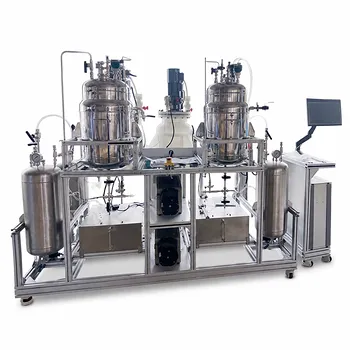
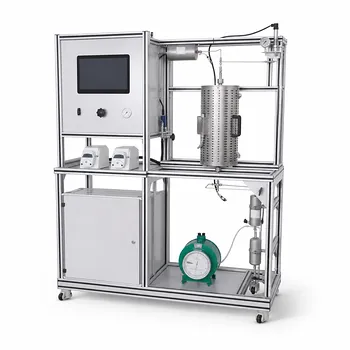
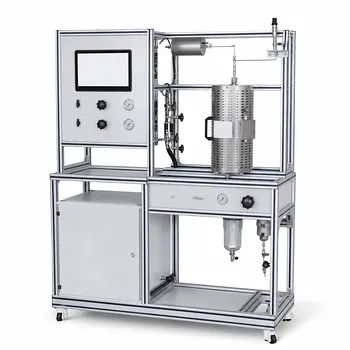
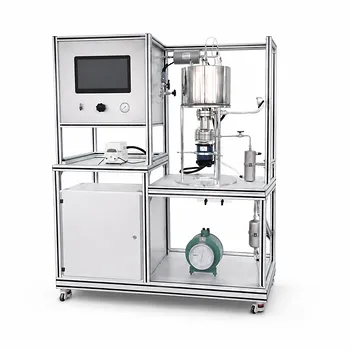
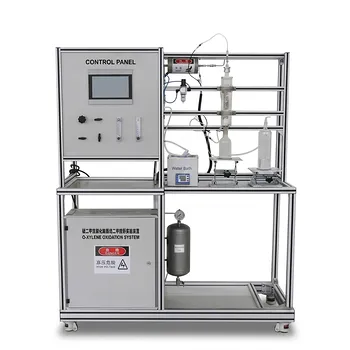
Directly stated, pilot plants allow researchers to observe the slow, often irreversible decline of catalyst performance under continuous flow by exposing the catalyst to real hydroprocessing feeds laced with sulfur, nitrogen, and metal-containing contaminants. By monitoring the drop in conversion and selectivity over hundreds of hours, and by precisely controlling temperature and space velocity, researchers collect the kinetic data required to predict catalyst lifespan and design effective regeneration or replacement strategies for industrial-scale reactors.
The core value of a pilot plant is its ability to compress the industrial timeline in a controlled setting—transforming guesswork about catalyst aging into an engineering science. It not only reveals how fast a catalyst deactivates, but also why, by isolating the exact poisoning, coking, or sintering mechanism at play under process-intensified conditions.
Replicating Industrial Realities for Meaningful Evaluations
Hydroprocessing catalysts face a brutal environment of high pressure, elevated temperature, and a cocktail of contaminants that cannot be simulated in a simple laboratory flask. Pilot plants bridge this critical gap.
The Blind Spots of Bench-Scale Testing
Lab-scale stirred reactors often operate with idealized feedstocks, constant activity assumptions, and no continuous attrition. This misses the cumulative damage caused by real impurities like nickel and vanadium porphyrins in heavy residues.
A pilot plant, by contrast, forces the catalyst to process a continuous stream of contaminated hydrocarbon. This reveals how fouling species build up over time, something a single-point batch test cannot capture.
Introducing Real Impurities and Recycling Effects
By deliberately spiking feeds with sulfur compounds, heavy metals, or nitrogen species, operators can accelerate aging in a controlled way. The plant's continuous recycling loops mimic the recycle of unconverted residue, concentrating poisons just as in a full-scale hydrocracker.
This enables an accurate measure of long-term deactivation rates, not just initial activity. It provides the ground-truth data for calculating how often a commercial load must be replaced or regenerated.
Operational Strategies to Quantify Deactivation Kinetics
Once real-world conditions are established, the pilot plant offers dynamic control to map the kinetics of the decay itself.
Constant-Conversion Variable-Temperature (CCVT) Mode
As the catalyst deactivates, the conversion naturally drops. In a pilot plant, you can enforce a constant conversion by programming the inlet temperature to slowly rise. The slope of this temperature ramp becomes a direct fingerprint of the deactivation rate.
This mode teaches researchers how to compensate for lost activity and provides the activation energy of the deactivation process itself. It directly translates to how an industrial operator would manage a reactor’s thermal budget over a cycle.
Thermal Mapping and Hot Spot Migration
A catalytic bed is never isothermal. Pilot plants equipped with multi-point axial and radial thermocouples reveal how the main reaction zone—the “hot spot”—moves down the bed as the top layers deactivate.
By observing this migration, researchers can diagnose flow maldistribution, predict when a bed becomes dangerously hot, and design quench or inter-stage cooling strategies. This spatial intelligence is invisible in a kinetic model without experimental validation.
Deciphering the Core Deactivation Mechanisms in Hydroprocessing
Aging is not a single event; it is a composite of distinct chemical and physical assaults. A pilot plant can be configured to isolate each one.
Pore Plugging by Metal Sulfide Deposition
In heavy-residue hydroprocessing, organometallic compounds containing nickel and vanadium react to form solid metal sulfides (NiS, V₂S₃). These deposits grow like an onion skin at the catalyst pellet’s exterior, progressively blocking the pores.
The pilot plant demonstrates this directly: by analyzing spent catalyst cross-sections, researchers see how the active inner core becomes starved of reactants. This links pore size distribution to run length—a trade-off that defines catalyst selection.
Parallel, Series, and Thermal Deactivation Pathways
- Parallel deactivation (coking from reactants): By varying feed concentration, the pilot plant measures how coke precursor formation scales with reactant partial pressure, fitting the rate law (-\frac{da}{dt} = k_d c_A^m a^d).
- Series deactivation: Adjusting space velocity reveals if a product molecule further decomposes into a poison or foulant downstream.
- Thermal deactivation (sintering): By running the plant at high temperatures with a clean feed, researchers isolate the purely thermal collapse of the active metal surface area, distinguishing it from chemical poisoning.
This deconvolution is essential for selecting between a more poison-resistant carrier or a more thermally stable active metal.
Configuration Flexibility to Match Feedstock Severity
Not all feeds are equal. A pilot plant’s modularity lets researchers test the exact layered protection scheme that will be scaled up.
Modular Reactor Beds for Metal Content Management
For feeds with low metal content (<25 ppmw), a single fixed bed suffices. For medium severity (25–100 ppmw), a dual or three-bed configuration is used, with wide-pore hydrodemetallization (HDM) catalysts in the first bed to sacrificially trap metals. The protected downstream bed then performs deep hydrodesulfurization (HDS) with a narrow-pore catalyst.
For very high metal feeds (>100 ppmw), a moving bunker reactor is integrated for online catalyst replacement. The pilot plant becomes a miniature process development unit, proving the viability of this complex staging before committing to a multi-billion-dollar installation.
Evaluating Staged Catalyst Formulations
Researchers load a first stage with NiMo/γ-Al₂O₃ for nitrogen and sulfur removal, and a second stage with a noble metal or NiW on zeolite for aromatic saturation and deep cracking. The pilot plant’s sampling ports between stages show exactly how each catalyst type ages under its specific intermediate environment.
This staged evaluation reveals which catalyst is the true lifespan bottleneck and whether a cheaper front-end catalyst can shield a more expensive tail-end one.
Understanding the Trade-offs
No analytical tool is perfect. An honest assessment of pilot plant limitations is critical for making sound decisions.
Cost and Operational Complexity
Running a continuous high-pressure, high-temperature plant for hundreds of hours is expensive. It requires dedicated operators, robust safety systems, and significant feedstock volumes. The data quality must justify the investment over a faster, cheaper lab test.
The Patience of Long-Duration Runs
A meaningful deactivation study can last 50 to 2,000 hours. During that time, a sensor drift or a pump failure can invalidate the kinetic data. The ability to maintain steady operation is the true limiting factor, not just the reactor’s design.
Scale-Up Extrapolation Challenges
Even the best pilot plant has smaller diameter beds and different wall-heating effects than an industrial reactor. Deactivation rates measured in a pilot unit often serve as a reliable trend, not an absolute prediction. Coupling the data with a robust reactor model is essential.
Making the Right Choice for Your Research Goal
How you use a pilot plant ultimately depends on the specific question you need to answer about catalyst aging.
- If your primary focus is predicting industrial catalyst lifespan and regeneration cycles: Operate in constant-conversion variable-temperature mode with the full process feed, and run until the allowable temperature limit is reached. This directly yields the cycle length.
- If your primary focus is screening multiple catalyst formulations or pore architectures: Use a modular multi-bed configuration and section the spent catalysts after a short, standardized deactivation run. Compare the spatial distribution of metals and coke as a function of the catalyst’s pore size.
- If your primary focus is teaching deactivation kinetics and hot spot management: Deliberately run the unit with both clean and poisoned feeds, and use thermal mapping to visualize how reaction zones migrate. Have students calculate the deactivation order from the temperature ramp profile.
Pilot plants transform catalyst aging from an unpredictable failure into a measured, manageable variable—giving you the power to design a truly robust hydroprocessing operation.
Summary Table:
| Mechanism | Cause | Evaluation Method in Pilot Plants |
|---|---|---|
| Pore Plugging | Metal sulfide deposition (NiS, V₂S₃) | Sectioning and analyzing spent catalyst pores |
| Coking | Coke precursor accumulation | Varying feed concentration and space velocity |
| Sintering | Thermal collapse of active surface area | High-temperature runs using clean feedstocks |
| Activity Decline | Continuous exposure to impurities | Constant-Conversion Variable-Temperature (CCVT) mode |
Accelerate Your Research with LABPARK Pilot Plants
Transitioning from bench-scale concepts to industrial-scale performance requires robust, reliable data. LABPARK provides state-of-the-art Educational and Vocational Unit Operations Pilot Plants across chemical engineering, bioprocess & biotech, and environmental & water treatment.
Specifically engineered for universities, research institutes, and enterprises, our modular systems enable precise evaluation of catalyst aging, deactivation kinetics, and process scaling.
Ready to optimize your hydroprocessing research and minimize scale-up risks? Contact LABPARK today to discuss your custom pilot plant requirements!
Related Products
- Methanol Synthesis and Catalyst Performance Evaluation Educational Unit Operations Pilot Plant
- Crude Benzene Hydrogenation Educational Unit Operations Pilot Plant
- Methane Cracking Educational Unit Operations Pilot Plant
- Electrolytic Hydrogen Production Educational Unit Operations Pilot Plant
- 100L Continuous Loop Hydrogenation Educational Unit Operations Pilot Plant
People Also Ask
- Why is a purge system necessary when operating a gas recirculation loop in a methanol synthesis pilot plant? (Guide)
- How do temp & pressure affect methanol synthesis pilot plants? Optimize equilibrium and catalyst performance.
- Why do modern methanol pilot plants operate at lower pressures? Catalyst & Feed Requirements Explained
- What are the operational requirements for catalyst activation? Safe Methanol Pilot Plant Operation
- Why Compare Predicted and Experimental Excess Enthalpy? Key to Accurate Pilot Plant Scale-up