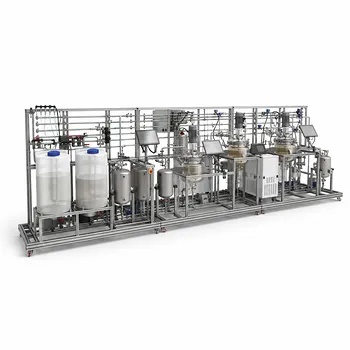
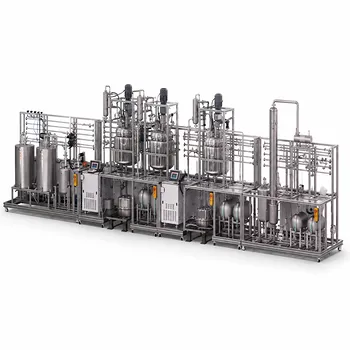
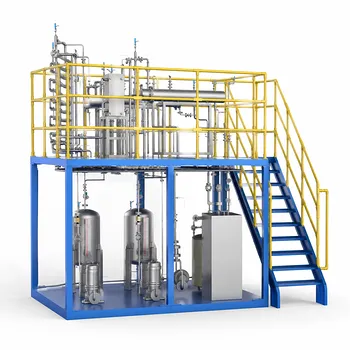
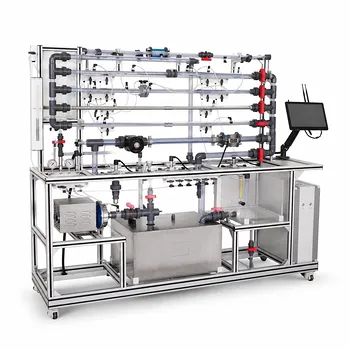
Pilot plants are the essential bridge between a laboratory discovery and a commercially viable, low-cost product. They allow chemical and bioprocess research enterprises to test, refine, and lock down every critical process parameter under production-like conditions. This real-world validation directly reduces the Cost of Goods (COGs) by maximizing yield, slashing raw material waste, preventing catastrophic scale-up failures, and locking in an efficient, robust synthetic route long before a single dollar is spent on a full-scale facility.
The primary cost drivers in manufacturing are raw materials and the active pharmaceutical ingredient (API) itself. Pilot plants tackle COGs at the source by enabling engineers to identify the most efficient synthesis route, optimize reaction conditions, and gather the high-fidelity mass & energy balance data required to design a lean, right-sized commercial plant—eliminating both process waste and costly over-design.
De-Risking the Scale-Up from Bench to Reality
The core economic threat in process development is the unknown. A reaction that works beautifully in a milliliter flask can become dangerous, inefficient, or economically unviable when scaled to thousands of liters. Pilot plants systematically eliminate these unknowns.
Validating the Fundamental Economic Model
Before a business case can be approved, the theoretical cost model must be proven.
Pilot plants provide real-world mass and energy balances under continuous, dynamic flow conditions. You move from calculating theoretical yields to measuring true yields, accounting for imperfect mixing and heat transfer losses.
This empirical data allows you to precisely calculate the true raw material consumption per unit of product, which is typically the dominant factor in COGs. Without this, your cost projections are merely optimistic guesses that can destroy a project’s return on investment.
Bypassing Costly Sequential Scale-Up Stages
The traditional method of scaling up in 10x or 100x increments is slow, expensive, and capital-intensive.
Modern chemical engineering combines experimental data from a single, well-designed bench-scale pilot plant with rigorous computer process modeling. This hybrid approach creates a high-fidelity digital twin that can simulate performance at large scales.
This allows teams to leapfrog multiple traditional pilot stages, going directly from a small experimental setup to an industrial demonstration unit. You maintain control over reaction rates and transport phenomena while slashing both development time and the capital tied up in intermediate facilities.
Directly Attacking the Largest Cost Drivers
A pilot plant is not just a scale-up tool; it is an optimization engine that surgically targets the biggest contributors to your COGs.
Optimizing Yield and Selectivity for Raw Material Savings
The cost of raw materials and the API itself often dominates the final product price. A one-percent yield improvement can be worth millions.
Pilot plants allow engineers to manually manipulate dependent processing steps in a controlled environment. You can test new catalysts, evaluate their stability over multiple cycles, and physically fine-tune parameters like residence time, pH, and temperature profiling.
This process-level optimization goes far beyond flask chemistry. It finds the global optimum for reaction kinetics and selectivity, directly minimizing the consumption of expensive precursors and maximizing the output of your desired product.
Slashing Waste Treatment and Disposal Costs
Waste is not just an environmental issue; it is a direct material cost and an expensive disposal line item. Creating toxic secondary waste compounds the problem.
Pilot-scale systems let you integrate and test resource recovery and waste reduction methods under realistic conditions. You can evaluate the feasibility of separating, treating, and recycling by-products from waste streams back into the process.
This identifies the operational parameters needed to sustain source-level waste minimization. By proving a recycling loop or a less-toxic alternative process in a pilot environment, you eliminate the future capital and operating expenses of massive end-of-pipe treatment facilities, permanently lowering COGs.
De-Bottlenecking and Heat Integration
Inefficient energy use silently bleeds profitability into utility costs. A poorly designed heat exchanger network can lock in high operating expenses for decades.
When debottlenecking an existing process or designing a new one, a pilot plant provides the accurate performance data of individual unit operations that simulation software alone cannot guarantee.
Engineers use these pilot units to run physical simulations through new heat integration schemes or upgraded exchanger designs. This testing minimizes the enormous financial risk of installing a full-scale energy-recovery system based purely on a simulated model, ensuring you actually achieve the projected energy savings.
Understanding the Trade-offs
A pilot plant’s value is undeniable, but its strategic application requires an honest view of the challenges.
The upfront investment in time and capital can be significant. Designing, building, and running a pilot campaign can take months and requires specialized personnel. You must weigh this delay against the catastrophic risk of a failed full-scale launch, which for an un-validated process is almost certain.
A poorly designed pilot plant is a dangerous illusion. If it does not accurately mimic the mixing, shear, and thermal profiles of the intended commercial scale, the "optimized" data it generates will be dangerously misleading. The result is a false-confidence failure that leads directly to a costlier commercial-scale disaster.
Models for non-standard equipment are complex. When your process needs a custom bioreactor or proprietary separator, you can't rely on standard commercial cost databases. Your team must build an Equipment Model Library (EML), defining physical size parameters and creating custom cost correlations with multiple data points. This requires deep expertise to keep cost forecasts accurate.
Making the Right Choice for Your Goal
The successful deployment of a pilot plant depends entirely on defining your primary objective for COGs reduction. Your focus will dictate the design and operational plan of the campaign.
- If your primary focus is maximizing raw material efficiency: Design your pilot runs to exhaustively test reaction kinetics, selectivity, and catalyst recycling loops. The goal is to find the process-operating envelope that yields the most product per gram of expensive input.
- If your primary focus is de-risking scale-up and reducing capital cost: Use the pilot plant to build and validate a high-fidelity digital process model. The empirical data is the key that unlocks the ability to leapfrog intermediate scales and right-size your final plant.
- If your primary focus is eliminating future operating costs from waste treatment: Use the pilot plant as a sustainability test bed to prove source-level waste minimization and by-product recycling. The data must demonstrate that the recycled stream does not poison your catalyst or product quality.
- If your primary focus is accurate long-term cost forecasting: Invest in building and maintaining a detailed Equipment Model Library (EML) for your pilot-unit's data. The precision of your COGs projection for the commercial plant is only as good as the cost correlations you feed into your model.
The pilot plant is your ultimate risk-reduction and value-creation tool. It transforms the abstract promise of bench-scale chemistry into a proven, bankable, and cost-optimized commercial reality.
Summary Table:
| COGs Reduction Driver | Pilot Plant Strategy | Key Economic Impact |
|---|---|---|
| Raw Material Yield | Optimize reaction kinetics, pH, and catalyst reuse | Maximizes output, minimizes precursor waste |
| Scale-Up De-risking | Validate mass & energy balances with digital twins | Eliminates costly intermediate scale-up stages |
| Waste & Utilities | Test recycling loops and heat integration designs | Lowers utility expenses and waste disposal fees |
Optimize Your Process Scale-Up with LABPARK
Are you looking to bridge the gap between bench-scale research and commercial viability? LABPARK helps universities, research institutes, and enterprises minimize scale-up risks and significantly reduce Cost of Goods (COGs).
We design and deliver state-of-the-art Educational and Vocational Unit Operations Pilot Plants across key domains:
- Chemical Engineering (optimized kinetics, reaction, and distillation)
- Bioprocess & Biotech (high-yield bioreactors and downstream processing)
- Environmental & Water Treatment (waste minimization and resource recovery systems)
Don't let scale-up uncertainties compromise your process efficiency. Contact our pilot plant experts today to discover how LABPARK can customize the perfect pilot-scale solution for your research and training needs.
Related Products
- Natural Product Extraction Unit Operations Training Pilot Plant
- Fixed-Bed Chemical Reaction and Gas Dust Tar Removal Unit Operations Pilot Plant
- Ethyl Acetate Synthesis Unit Operations Pilot Plant for Practical Training
- Methanol Synthesis and Catalyst Performance Evaluation Educational Unit Operations Pilot Plant
- Electrolytic Hydrogen Production Educational Unit Operations Pilot Plant
People Also Ask
- How to Demo Solubility Sensitivity in SFE Pilot Plants? Practical Thermodynamics
- How do pilot plants differentiate physical vs chemical extraction? Enhance Chemical Engineering Training
- How are HTU and NTU applied to determine extraction column height? Guide to Pilot Plant Scaling
- How do fluid transport principles apply to pilot plant configuration? Optimize your unit operations.
- What are the limitations of acentric factor models? Avoid pilot plant errors with polar fluids.