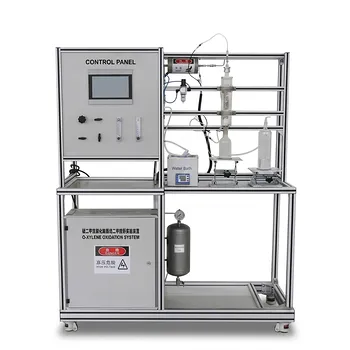
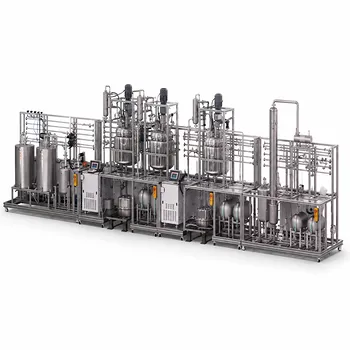
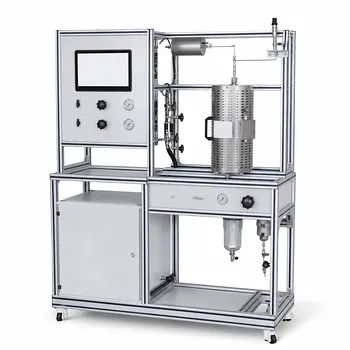
The answer lies not in replicating the extreme, but in mastering the principles with a safe proxy. Chemical reaction pilot plants allow you to study the thermal energy principles of highly exothermic reactions like the Goldschmidt process by using analogous, safer exothermic reactions in a controlled environment. These pilot units are equipped with precision heat exchange, real-time monitoring, and automated safety systems that let you analyze heat transfer rates, temperature profiles, and runaway risks—giving you the critical engineering knowledge needed for industrial reactor design without ever handling a 3500°C thermite reaction.
Rather than trying to contain a Goldschmidt reaction directly, pilot plants de-risk the learning process. They use milder exothermic chemistries as stand-ins, allowing you to identify thermal hazards, map optimum temperature trajectories, and validate heat removal strategies—all the skills required to safely scale up any highly exothermic industrial process.
Why Direct Study of the Goldschmidt Process is Impractical
The Extreme Nature of Metallothermic Reductions
The Goldschmidt reaction—a metallothermic reduction—can instantaneously reach temperatures of up to 3500°C. This extreme heat release, combined with the production of molten metal, creates a hazardous environment that is fundamentally incompatible with a standard teaching or research laboratory. The primary reference confirms that such conditions make direct study “challenging” at best.
The Risk of Thermal Runaway
Any attempt to contain that reaction at a meaningful scale would require exotic materials and emergency systems that obscure the core educational goal. The real danger is thermal runaway: a self-accelerating temperature increase that can lead to pressure build-up, decomposition, and catastrophic vessel failure. A pilot plant built around a surrogate reaction eliminates this existential risk from the start.
The Safe Proxy: Studying Thermal Energy Principles with Analogous Reactions
Choosing the Right Surrogate Chemistry
Instead of a 3500°C metallothermic reaction, pilot plants use monitored exothermic processes that pose a manageable risk. Supplementary references highlight examples like the nitration of benzene (134 kJ/mol exotherm, with critical safety limits at 120°C) or the catalytic hydrogenation of ethyne to alkenes. These reactions are highly exothermic enough to exhibit the same dangerous runaway tendencies, yet their temperature ceilings are an order of magnitude lower and can be safely handled with standard engineering materials.
Capturing the Universal Principles
The goal is not to repeat the Goldschmidt chemistry, but to capture its thermal fingerprint. As the primary reference notes, by analyzing heat exchange rates and temperature profiles, you learn the universal principles of thermal safety and reactor design. Every exothermic reaction, regardless of its absolute temperature, obeys the same laws of heat generation and removal. A pilot plant lets you see and control those laws in action.
Key Design Features of a Safe Pilot Plant
Precision Heat Exchange Systems
Safe study is built on rapid, controllable heat removal. Pilot plants incorporate multiple layers of thermal management. Supplementary references describe systems like external jackets and internal helical cooling coils (as used in nitration), or monolithic loop reactors that recycle cold product gas through an external heat exchanger to limit the temperature rise across the catalyst bed. For multi-tubular reactors, circulating molten salt jackets can maintain near-isothermal conditions while generating steam to dump excess energy.
Real-Time Instrumentation and Automated Interlocks
A pilot plant is a data-rich environment. You collect real-time data on temperature, pressure, and concentration at multiple points. This empirical data is crucial for fitting reaction rate equations and determining rate constants. More importantly, these sensors are connected to automated safety interlocks. If a temperature sensor registers a reading approaching a critical threshold (like 80°C for dimethylnitrobenzene), the system can automatically stop feed pumps, increase cooling flow, or trigger a quench system before a runaway begins.
Integrated Mitigation and Relief Systems
Even with preventive layers, pilot plants are designed to safely handle worst-case scenarios. They may include small-scale scrubbers to neutralize toxic vapors or relief systems that vent excess pressure to a safe location. This mirrors industrial safety barriers, teaching the layered approach to process safety required by modern standards.
Learning Objectives: From Kinetics to Runaway Prevention
Mapping the Optimum Temperature Trajectory
For reversible exothermic reactions, temperature has a dual effect: it speeds up kinetics but hurts equilibrium conversion. Through dynamic cooling control, a pilot plant lets you manually or automatically follow the optimum temperature trajectory ((T_{opt})-(X_A) curve). This hands-on operation demonstrates how to maximize the reaction rate at every conversion stage—a concept critical for designing industrial reactors with maximum space-time yield.
Validating Kinetic Models for Scale-Up
The data you gather isn't just academic. As the references state, it’s essential for validating kinetic models and designing relief systems without industrial-scale danger. You can fit rate equations to your concentration profiles, calculate heat transfer coefficients from the jacket’s energy balance, and then use that validated model to predict how a full-size reactor would behave. This is how you teach future engineers to avoid incidents like the major industrial runaway accidents that have historically occurred.
Comparing Reactor Configurations
Pilot plants often allow for flexible configuration. For example, you can compare gas-phase fixed-bed operation versus a liquid-phase trickle-bed for the hydrogenation of ethyne. This shows how the phase and flow pattern drastically alter the heat management profile and runaway risk. Such direct comparison would be impossible to conduct safely with a Goldschmidt-style reaction but is routine with a well-designed pilot plant.
Understanding the Limitations and Trade-offs
The Analogy is Not Perfect
While the thermal principles are universal, the specific dangers of a 3500°C reaction—like radiant heat damage, containment material melting, and the formation of molten metal pools—cannot be perfectly replicated. The human factor of managing a reaction that can liquefy its own vessel is a lesson these pilot plants can only teach in theory. You will not experience the physical shock and inherent fear that comes with an imminent high-temperature runaway.
The Focus on Heat over Phase Change
The Goldschmidt process is a reduction that completely changes the phase of the products. Many surrogate exothermic reactions in pilot plants are primarily gas- or liquid-phase reactions where phase change is not the dominant hazard. The thermal energy principle of heat removal remains the same, but the multiphase fluid dynamics of a slag-and-metal system are absent.
Risk of Complacency
A perfectly safe, automated system can create a false sense of security. The primary learning must emphasize that the pilot plant’s safety margins are deliberately wide because the reaction is chosen to be forgiving. In industry, the same control philosophy must be applied to reactions at their absolute material limits, where the margin for error is zero.
How to Apply This to Your Project
Your specific goal will determine the ideal pilot plant configuration and surrogate reaction to study the Goldschmidt process’s thermal principles.
- If your primary focus is fundamental heat transfer education: Choose a simple, well-characterized exothermic reaction like benzene nitration in a jacketed stirred tank. Focus on collecting precise temperature profiles and calculating overall heat transfer coefficients. The simplicity makes the core thermal principles unmissable.
- If your primary focus is industrial safety system design: Opt for a reaction with a sharp runaway potential, such as the gas-phase hydrogenation of ethyne. Use the pilot plant’s automated interlocks and relief systems to actively test mitigation strategies. This will teach the layered “defense-in-depth” philosophy critical for process safety.
- If your primary focus is reaction kinetics and reactor optimization: Select a reversible exothermic reaction in a packed-bed or monolith loop reactor. Program your cooling system to trace the optimum temperature trajectory and measure the resulting improvement in space-time yield, linking fundamental kinetics to real reactor productivity.
- If your primary focus is comparing reactor types: Use a flexible pilot plant skid that can be reconfigured from a fixed-bed to a trickle-bed or a fluidized bed (as described for nitrobenzene hydrogenation). This reveals how the reactor architecture itself dictates the thermal management strategy.
The Goldschmidt process’s terrifying power becomes an unforgettable teaching tool only when its underlying physics are safely isolated in a pilot plant. You give up the fire, but you gain the blueprint for engineering safety into any exothermic process.
Summary Table:
| Feature / Aspect | Direct Goldschmidt Process | Safe Pilot Plant Proxy |
|---|---|---|
| Reaction Temperature | Extreme (up to 3500°C) | Controlled & manageable (e.g., <120°C) |
| Primary Hazards | Molten metal, thermal runaway, explosion | Simulated runaway under safety interlocks |
| Safety Mitigation | Highly difficult to contain | Jacketed cooling, automated feed cut-off, relief systems |
| Key Learning Value | Direct observation is too dangerous | Real-time heat transfer, kinetic modeling, and safety system validation |
Safely Advance Your Chemical Engineering Education with LABPARK
Mastering highly exothermic reactions requires the right balance of real-world physics and rigorous safety. LABPARK provides premium Educational and Vocational Unit Operations Pilot Plants in chemical engineering, bioprocess & biotech, and environmental & water treatment.
Designed specifically for universities, research institutes, and enterprises, our pilot plants allow you to safely teach thermal energy principles, kinetic modeling, and process control.
Contact LABPARK today to find the ideal pilot plant solution for your lab!
Related Products
- Fixed-Bed Chemical Reaction and Gas Dust Tar Removal Unit Operations Pilot Plant
- Fixed Bed Gas Solid Catalytic Reaction Educational Pilot Plant
- Multi-Reactor Educational Pilot Plant for Reaction Engineering Unit Operations
- 100L Continuous Loop Hydrogenation Educational Unit Operations Pilot Plant
- O-Xylene Oxidation to Phthalic Anhydride Educational Unit Operations Pilot Plant
People Also Ask
- When to transition from PID to adaptive control in pilot plants? Key process indicators.
- How do deviations in estimating latent heat impact pilot plant thermal systems? Avoid hardware mis-sizing.
- Why Compare Predicted and Experimental Excess Enthalpy? Key to Accurate Pilot Plant Scale-up
- How to study gasification in pilot plants? Compare exit gas composition & efficiency
- Why Use PTFE & Hastelloy in Chemical Pilot Plants? Prevent Corrosion & Ensure Safety