For any liquid-liquid extraction pilot plant, the phase rule dictates that fixing temperature locks the equilibrium compositions, while activity coefficients quantify how far those compositions deviate from ideality. By coupling these two concepts, you transform raw pilot-plant concentration data into a rigorous validation of both your thermodynamic model and your equipment’s mass-transfer performance. The phase rule tells you which variables to control, and activity coefficients tell you what the resulting phase concentrations should be, enabling a direct comparison against real-time measurements.
To validate an LLE unit operation, use the phase rule to reduce the system’s degrees of freedom—typically by holding temperature constant—so that equilibrium compositions become fixed. Then, calculate those compositions via isoactivity equations using an appropriate activity-coefficient model. Sampling the actual extract and raffinate streams and plotting them against your theoretical tie lines reveals whether your equipment is reaching true thermodynamic equilibrium and whether your model predictions are accurate.
How the Phase Rule Guides LLE Experiment Design
The phase rule gives you an immediate roadmap for setting up a validation experiment that isolates thermodynamic equilibrium from equipment effects.
The Degrees-of-Freedom Shortcut
For a binary liquid-liquid system at constant pressure, the phase rule simplifies to F = N = 2 degrees of freedom. With two components and two liquid phases, fixing the temperature uses one degree of freedom, leaving one more variable—typically the composition of one phase.
Once temperature is fixed, every other intensive variable is pinned. This means the compositions of the two coexisting liquid phases are thermodynamically determined and cannot be arbitrarily chosen. In a pilot plant, this translates to a simple experimental protocol: thermostat the extraction unit, and then measure the equilibrium compositions of the extract and raffinate.
Translating Theory to Pilot Plant Protocols
When you run an LLE pilot plant, you first choose an operating temperature. According to the phase rule, that single decision defines the entire solubility envelope for a binary system. Your job is then to verify that the measured stream compositions actually fall on the predicted binodal curve.
You also use this rule to design a minimal but sufficient sampling plan. Because only one composition is independent, you don’t need to measure everything to validate equilibrium. A single pair of well-measured phase compositions, alongside a reliable temperature reading, is enough to benchmark the whole thermodynamic state.
Leveraging Activity Coefficients to Predict Equilibrium
While the phase rule tells you how many variables are fixed, activity coefficients give you the numerical values of the resulting compositions.
The Isoactivity Criterion
In LLE, equilibrium occurs when the activity of each component is equal in both phases. For a binary system of components 1 and 2, this means:
- ( x_1^\alpha \gamma_1^\alpha = x_1^\beta \gamma_1^\beta )
- ( x_2^\alpha \gamma_2^\alpha = x_2^\beta \gamma_2^\beta )
The mole fractions ( x_i ) are what you measure on the pilot plant. The activity coefficients ( \gamma_i ) come from an excess Gibbs energy model like NRTL or UNIQUAC.
Building a Predictive Model Before You Sample
Before the pilot run, you use binary interaction parameters—either from literature or regressed from previous data—to solve the isoactivity equations. The solution produces a theoretical tie line and the full binodal curve.
During the run, you compare the measured tie line (the extract and raffinate compositions) against this prediction. The magnitude of deviation is your primary metric for model validation and equipment performance.
Extending to Multi-Component Systems with Partition Coefficients
In a ternary system (solute, carrier, solvent), the activity coefficient of the solute governs its partition coefficient ( K_D = x_{solute}^{extract} / x_{solute}^{raffinate} ). Predicting ( K_D ) accurately requires a correctly parameterized activity model.
By measuring the solute’s actual concentration in each outlet stream, you calculate the experimental partition coefficient and compare it to the value derived from the isoactivity relationship. A mismatch signals either an inadequate model or mass-transfer limitations in the pilot unit.
Validating Pilot Plant Data Against Theory
Combining the phase rule and activity coefficients turns routine sampling into a powerful diagnostic toolkit.
Spotting Disequilibrium in Continuous Operations
A continuously fed pilot plant is not at static equilibrium; it’s a dynamic system. However, if the contactor stages are efficient, the exiting streams should closely approach thermodynamic equilibrium.
By plotting your measured compositions on a ternary diagram and overlaying the predicted tie lines, you can immediately see if the operating point lies on the binodal curve. Points falling inside the two-phase envelope but off the tie line indicate incomplete phase separation, sampling errors, or mass-transfer limitations.
Quantifying Stage Efficiency and Solvent-to-Feed Ratio
Once you have validated that the thermodynamic model is correct, you can invert the analysis. You treat the model as truth and use the experimental tie line to back-calculate the number of theoretical stages actually achieved.
This is done by stepping off stages on a ternary diagram using the operating line and equilibrium curve. The resulting stage efficiency tells you whether your equipment is delivering the separation it was designed for, and whether the chosen solvent-to-feed ratio is optimal under real flow conditions.
Understanding the Trade-offs and Pitfalls
No validation is complete without acknowledging where the methodology breaks down.
The Activity Coefficient Model is Only as Good as Its Parameters
NRTL and UNIQUAC require binary interaction parameters that are often fitted to a limited data set. If your pilot plant operates at a temperature or concentration range far from the fitting region, predictions can become unreliable. Always check the model’s applicability domain before trusting it for validation.
Assuming Perfect Equilibrium Can Mask Equipment Issues
If you force a model to fit measured data by adjusting parameters, you might inadvertently compensate for poor mixing, entrainment, or temperature gradients. The phase rule assumes true thermodynamic equilibrium; if your pilot plant hasn’t reached it, the entire validation framework becomes ambiguous.
Sample Handling and Analysis Errors
LLE samples can easily change phase during cooling or pressure release. A sample that looks like a single-phase raffinate might have nucleated a second phase in the sample line. On-line spectroscopy or immediate quenching is often necessary to preserve the true equilibrium compositions.
The Temptation to Over-Constrain the System
The phase rule encourages simplicity. Yet in a pilot plant, operators often fix temperature, pressure, and feed flow rates simultaneously. While this doesn’t break the rule (pressure can be an additional degree of freedom), it can lead to confusion about which variable is truly independent. Maintain a clear experimental design that explicitly identifies the controlled intensive variable.
Making the Right Choice for Your LLE Validation Experiments
Your specific goal determines how you combine the phase rule and activity coefficients into a practical validation plan.
- If your primary focus is validating a thermodynamic model: Hold temperature constant, measure both phase compositions for a series of tie lines, and minimize mass-transfer effects by ensuring long residence times. Compare the full binodal curve predicted by your activity-coefficient model against the data.
- If your primary focus is assessing pilot plant stage efficiency: First confirm the model is accurate using a few equilibrium tie lines from a well-mixed batch cell. Then run the continuous pilot plant at the same temperature and directly compare the achieved separation to the theoretical stages predicted by the model.
- If your primary focus is optimizing solvent selection or feed ratio: Use the activity-coefficient model to screen solvents by calculating predicted partition coefficients ahead of time. Then use the phase rule to design a minimal number of validation experiments—each at a fixed temperature—to confirm the predicted selectivity and distribution in your actual equipment.
- If your primary focus is troubleshooting poor separation: Plot your outlet stream compositions on a ternary diagram against the theoretical binodal. If points don’t lie on the curve, focus on residence time and mixing. If they lie on the curve but show a lower partition coefficient than predicted, question your activity-coefficient parameters or check for temperature non-uniformity.
Ultimately, the phase rule provides the experimental discipline, and activity coefficients provide the predictive power—together they ensure that what you measure on your pilot plant is a true reflection of the chemistry, not a coincidence of fluid dynamics.
Summary Table:
| Concept | Role in LLE Validation | Practical Application |
|---|---|---|
| Phase Rule | Determines degrees of freedom (independent variables). | Defines operating temperature and establishes minimal sampling plans. |
| Activity Coefficients | Calculates equilibrium compositions and ideality deviations. | Generates theoretical tie lines using thermodynamic models like NRTL/UNIQUAC. |
| Validation Output | Compares experimental data against thermodynamic models. | Assesses pilot plant stage efficiency and identifies mass-transfer limitations. |
Bring Rigorous thermodynamic Validation to Your Lab
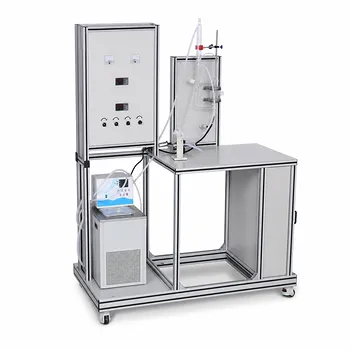
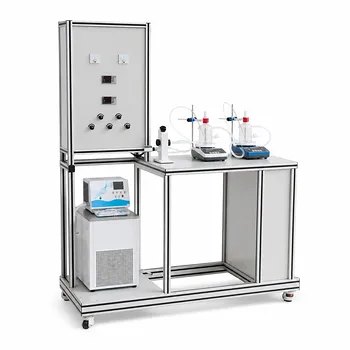
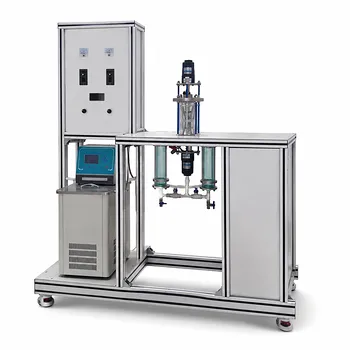
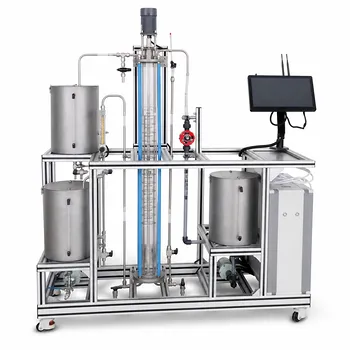
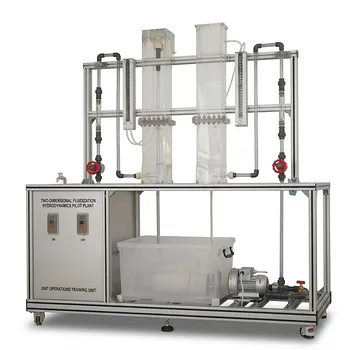
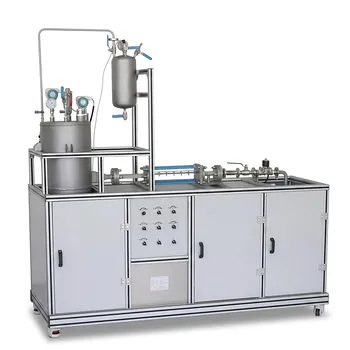
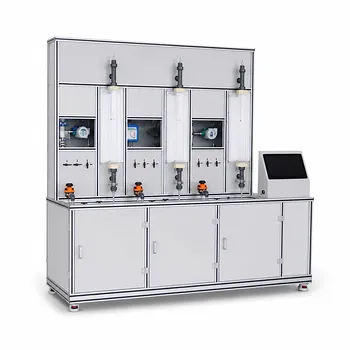
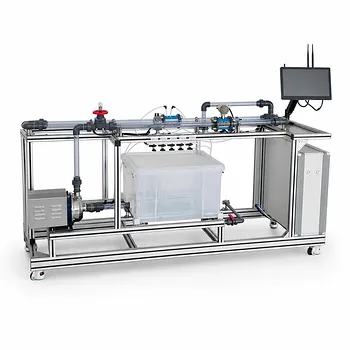
To successfully bridge the gap between thermodynamic theory and practical application, you need reliable, high-precision equipment. LABPARK provides state-of-the-art Educational and Vocational Unit Operations Pilot Plants in chemical engineering, bioprocess & biotech, and environmental & water treatment.
Specially designed for universities, research institutes, and enterprises, our pilot plants empower students and researchers to perform accurate LLE validation, study mass-transfer limitations, and master industrial processes.
Ready to elevate your engineering curriculum or research capabilities? Contact LABPARK today to find the perfect pilot plant solution for your institution!
Related Products
- Binary System Vapor Liquid Equilibrium Data Determination Educational Unit Operations Pilot Plant
- Ternary Liquid-Liquid Equilibrium Educational Pilot Plant
- Comprehensive Liquid-Liquid Extraction Pilot Plant for Engineering Education
- Liquid-Liquid Mass Transfer Coefficient Determination Educational Pilot Plant
- Educational Rotary Disc Liquid-Liquid Extraction Pilot Plant
People Also Ask
- Why correlate VLE pilot plant data using Wilson, NRTL, and UNIQUAC? Achieve Accurate Column Scale-Up
- For VLE Experiments: Fugacity vs. Activity Coefficient Method Selection Criteria
- How do pilot plants assist in teaching & researching non-ideal VLE? Bridge Theory & Physical Validation
- How to Model VLE for Supercritical & Unstable Components? Pilot Plant Methods
- Why is accurate VLE data critical? Optimize Unit Operations & Process Scale-Up