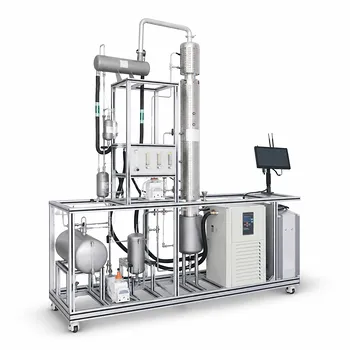
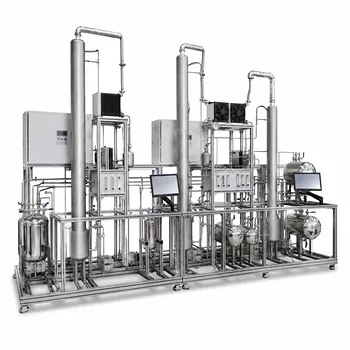
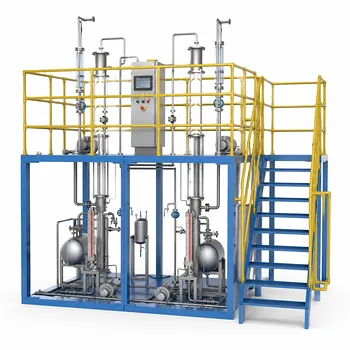
The most direct way to demonstrate temperature-driven phase transitions in a distillation pilot plant is to replicate the fundamental principle of zinc metallurgy: deliberately control the condenser temperature on either side of the distillate’s melting point. In the industrial extraction of zinc, vaporized metal is condensed as liquid if the condenser stays above 419.3°C, or as a fine solid dust if it falls even a fraction below that threshold. In a teaching pilot plant, the same razor’s-edge sensitivity is recreated by fractionating a pure compound whose melting point lies in an easily accessible range, then adjusting the cooling water flow and monitoring the condenser wall temperature so that students can visually observe whether the product emerges as a free-flowing liquid or a crystalline solid.
The zinc metallurgy analogy transforms an abstract heat-transfer lesson into a visceral, cause-and-effect demonstration. It teaches that in any condensation process, the condenser’s thermal profile is not just a parameter—it is a binary switch that dictates phase, morphology, and ultimately product quality. Student experiments built around this insight make phase-change dynamics and process control tangible in a way that purely theoretical discussions never can.
The Zinc Condensation Principle as a Pedagogical Blueprint
The pyrometallurgical route to zinc provides an extreme, unforgettable example of how a single temperature boundary governs product fate. That same clean, binary outcome can be embedded into a standard distillation unit operations lab, giving students a concrete mental model for thermal management.
From Vapor Metal to Laboratory Distillate
In zinc smelting, zinc vapor is distilled from calcined ore and sent to a condenser. This is not fractional condensation of a multi-component mixture; it is the simple, elegant phase change of a single species.
- If the condenser jacket holds the heat-exchange surface at 420°C, vapor becomes liquid zinc, pools, and is tapped off as a dense, high-purity metal.
- If the cooling load is increased even slightly and the surface drops to 418°C, the vapor desublimes directly into zinc dust—a low-density powder loaded with surface oxides and impurities.
This stark contrast—liquid metal versus airborne dust—is not merely a production nuance. It is a direct consequence of crossing the melting point of zinc during the vapor-to-condensed-phase transition. For chemical engineering education, it reveals that the condenser is not just a heat exchanger; it is a phase selector.
Translating the Principle to a Pilot-Scale Distillation Column
A standard distillation unit operations pilot plant—equipped with a fractional column, a shell-and-tube or coil condenser, and a chilled-water loop with a fine control valve—provides everything needed to mimic this behavior with a safe, well-characterized organic compound.
- Select a test material such as naphthalene (melting point 80°C) or p-dichlorobenzene (melting point 53°C). These are solids at room temperature but form clear liquids when melted and have vapor pressures that permit straightforward distillation.
- The condenser cooling water is tempered—either by blending hot and cold streams or by using a recirculating bath—so that the internal wall temperature can be held steadily either above or below the compound’s melting point.
Students then run the column at total reflux, establishing a steady vapor traffic. They slowly shift the condenser temperature across the melting point threshold while observing through a sight glass.
Executing the Demonstration: Control, Observation, and Measurement
Once the plant is configured, the educational power lies in the deliberate manipulation of the thermal boundary. The goal is for learners to see that phase is a process variable, not a fixed property.
Setting the Thermal Trip Point
Unlike industrial columns where the goal is always liquid distillate, this experiment weaponizes the melt/freeze boundary as a teachable moment.
- Students are first asked to keep the condenser outlet coolant temperature 10–15°C above the compound’s melting point. The distillate drips as a transparent liquid and collects in the receiver vessel.
- Without altering the boiling rate or column pressure, they incrementally increase the coolant flow. The condenser wall temperature falls.
- As the surface temperature drops below the melting point, a dramatic morphological shift occurs. Distillate no longer drips; instead, a white, dendritic crust begins to nucleate on the condenser walls, growing into a porous solid layer that can flake off or “snow” into the product line.
The visual feedback is immediate and unambiguous. The same vapor stream now produces a different product form solely because the thermal sink crossed a critical phase-change temperature—precisely mirroring the zinc dust-versus-spelter scenario.
Connecting Temperature Profiles to Heat Transfer
Behind the phase change is a measurable shift in the local heat transfer coefficient.
- When liquid distillate wets the surface, the condensation film provides a relatively high heat transfer rate.
- As solid forms, the fouling layer adds conductive resistance. The vapor-to-wall
ΔTmust increase to maintain the same duty, a change that students can track by logging the temperature at multiple points along the condenser.
This turns the pilot plant into a live heat-transfer laboratory. Students graph the condenser axial temperature profile while oscillating between liquid and solid collection, seeing directly how the profile steepens when solid begins to insulate the heat exchange surface.
Linking Purity to Condensation Regime
The zinc analogy also teaches a lesson about product purity.
- Below the melting point, rapid solidification traps contaminants that would otherwise partition into the liquid phase. In zinc, this yields oxide-laden dust. In the pilot plant, if a binary mixture is used, the solid layer will be enriched in the higher-melting component but will also occlude impurities in interdendritic spaces.
- Above the melting point, the liquid stream can be further refined by reflux, and the flowing liquid film washes the surface, maintaining a cleaner condenser.
By taking samples from both the liquid and solid product streams and analyzing them via refractive index or melting point, students quantify how thermal management directly impacts separation quality—a concept foundational to industrial distillation and condensation processes.
Understanding the Trade-offs and Limitations
While the zinc condensation analogy is singularly powerful, no teaching tool is without its practical boundaries. Being transparent about these constraints deepens the learning experience.
Why It’s Not a Perfect One-to-One with Multicomponent Distillation
The zinc case is a single-component desublimation/condensation. Most real distillations handle multicomponent mixtures. There, the “melting point” is not a single temperature but a solidification range, and the condenser must remain above the cloud point or pour point of the heaviest condensing cut to avoid waxing or plugging.
- Students must understand that the binary on/off behavior in the zinc demo is an idealized boundary. In a hydrocarbon prefractionator, the transition from liquid to semi-solid is gradual, often occurring as a sticky, high-viscosity film rather than a clean crystal.
- The pilot plant can illustrate this nuance by using a eutectic mixture or a wax dissolved in a light carrier. The shift from liquid to a slushy solid broadens the “critical temperature” into a zone, mirroring complex industrial condensers.
This prevents overgeneralization while reinforcing why precise, multi-point temperature monitoring is mandatory.
Equipment Constraints and Safety
Running a condenser intentionally below the distillate’s freezing point invites plugging and mechanical stress.
- A solid layer can detach in chunks and block product lines. The pilot plant must be fitted with a sight glass directly at the condenser outlet and a bypass drain to safely remove accumulations.
- For high-melting compounds, heating the condenser walls back above the melting point must be done gently to avoid thermal shock to the glassware. This teaches students to design clean-in-place procedures and safe operating sequences.
- All safety protocols from material safety data sheets must be followed—many organic solids with convenient melting points are flammable or irritants. Adequate ventilation and personal protective equipment are non-negotiable.
These practical hurdles are themselves valuable lessons in process engineering reality: the best thermodynamic demonstration is useless if it cannot be operated safely and repeatedly.
How to Apply This to Your Teaching or Process Design
The zinc-metallurgy condensation principle can be adapted to a variety of educational or research objectives. The key is to match the depth of the demonstration to the learning outcome.
- If your primary focus is teaching fundamental phase-change thermodynamics: Use a pure, benign solid with a melting point between 50–90°C. Operate the condenser as a simple diagnostic tool, showing that crossing the melting point changes the product morphology instantly. Keep the procedure simple and visual.
- If your primary focus is heat transfer and fouling resistance: Instrument the condenser with multiple thermocouples. Have students calculate the overall heat transfer coefficient under liquid-film versus solid-covered conditions. Compare the measured values with standard condensation correlations and quantify the effect of fouling layer thickness.
- If your primary focus is process control and automation: Configure the coolant flow valve to a PID controller that holds the condenser wall temperature at a setpoint just above or just below the melt threshold. Introduce intentional disturbances (coolant temperature swings) and challenge students to maintain the desired product phase, mimicking the industrial imperative to avoid zinc dust in pyrometallurgical plants.
- If your primary focus is safety and operability: Run the condenser into a solid-forming regime, then demonstrate the restart procedure: reduced boil-up, gradual jacket heating, and monitoring differential pressure to detect a plug before it bursts free. This turns a potential operational hazard into a hands-on troubleshooting exercise.
The condensation principle extracted from zinc metallurgy does not require a furnace at 1000°C. It only requires a well-instrumented pilot condenser, a measured temperature controller, and a compound willing to switch its allegiance from liquid to solid at a command. In that precise moment, when students turn a knob and see dripping liquid crystallize into a cascade of powder, they understand thermal management not as a textbook equation but as a physical law they directly control.
Summary Table:
| Parameter | Zinc Metallurgy Principle | Pilot Plant Analog |
|---|---|---|
| Working Species | Zinc vapor | Naphthalene or p-dichlorobenzene |
| Hot Condensation | Liquid zinc (>419.3°C) | Free-flowing liquid distillate |
| Cold Condensation | Zinc dust (<419.3°C) | Solid crystalline crust (fouling) |
| Process Impact | Binary phase selector | Visual heat transfer & control demo |
Bring Hands-On Process Control to Your Lab
LABPARK provides state-of-the-art Educational and Vocational Unit Operations Pilot Plants in chemical engineering, bioprocess & biotech, and environmental & water treatment. We help universities, research institutes, and enterprises bridge the gap between theory and practice with highly visual, safe, and precisely controlled process equipment.
Ready to upgrade your lab's training capabilities? Contact LABPARK today to discuss your custom pilot plant needs!
Related Products
- Continuous Sieve-Plate Distillation Pilot Plant for Unit Operations Laboratory Education
- Multi-Modal Distillation Unit Operations Training Pilot Plant
- Green Anhydrous Ethanol Purification Extractive Distillation Unit Operations Training Pilot Plant
- Dual-Mode Rectification Pilot Plant for Practical Training Unit Operations
- Ethyl Acetate Synthesis Unit Operations Pilot Plant for Practical Training
People Also Ask
- Why is vacuum operation capability an essential feature for a distillation unit operations pilot plant? Unlock Efficiency
- What are the primary reflux ratio control strategies? Master Distillation Unit Operations
- How does catalyst water concentration affect distillation pilot plant design? Key separation train choices.
- How to select the right activity coefficient model (Wilson, NRTL, UNIQUAC) for distillation pilot plants?
- How can real-time carbon number prediction improve distillation pilot plants? Optimize control.