If you're struggling with irreproducible HPLC results from your pilot-scale reactor, the core fix is to stop taking small samples from a thick, heterogeneous mixture. Instead, dissolve or dilute the entire reaction mass homogeneously in a volumetric flask, then draw your analytical sample from that uniform solution. But accuracy doesn't stop there; you must also abandon simple area-percent calculations and move to quantitative HPLC with mole-basis response factors ($R^{mole}_{f}$) to calculate the actual moles of starting material and product, ensuring your mass balance is fully and verifiably closed.
Core Takeaway: Relying on a small physical grab from a non-uniform slurry guarantees a sampling error that no amount of careful HPLC can fix. The only reliable path is to homogenize the entire batch via dissolution or dilution, then apply mole-based quantitative analysis to track material flows absolutely, closing the mass balance.
Why Partial Sampling Fails Thick, Heterogeneous Mixtures
The problem isn't your HPLC method—it's what you're injecting. When a reaction mass is thick, viscous, or contains solids, the act of extracting a few milliliters inevitably distorts the representation of the true bulk composition.
The Nature of the Sampling Error
The error is physical, not analytical. From a dense mixture, lighter liquid phases or smaller particles are preferentially drawn into a pipette or thief. Heavier solids settle, and viscous layers cling to vessel walls, making a "representative" grab sample an illusion.
The Pillars of Sampling Error (And Why They All Apply to a Reactor Grab)
Sampling theory identifies three additive error sources that collectively explain why a simple reactor dip fails:
- Increment Delimitation Error (IDE): A thief or pipette does not create a true, parallel-sided cross-section of the entire reactor volume. It samples a localized, biased zone.
- Increment Extraction Error (IEE): As the sample is pulled, larger particles or dense phase droplets are left behind because they can't flow into the narrow opening at the same rate as the bulk liquid. The center-of-gravity rule is violated.
- Increment Preparation Error (IPE): The extracted aliquot can settle, evaporate solvent, or even continue reacting before it reaches the volumetric flask, changing its composition before analysis.
Together, these errors guarantee that the sample reaching the HPLC vial will not reflect the true average composition of the reactor. The solution is to remove the need for a partial extraction entirely.
The Foundational Fix: Homogenize the Entire Mixture
Instead of attempting to take a perfect sample from an imperfect mixture, operators should render the entire mixture perfectly uniform. This eliminates the sampling step as a source of error.
The Whole-Mixture Dissolution/Dilution Method
The primary reference method is unambiguous: empty the entire reaction mass into a volumetric flask (or appropriate vessel) and add a suitable solvent to dissolve all components and bring the mixture to a known, exact volume. Once completely dissolved and homogenous, a small sample from this flask will be truly representative of the entire batch. No IDE, IEE, or IPE can distort a fully dissolved, well-mixed solution.
This technique is the gold standard for pilot-scale kinetic studies where mass balance closure is non-negotiable. It converts a sampling challenge into a simple dissolution problem, leveraging the precision of volumetric glassware.
When You Cannot Dilute the Whole Batch
For very large reactors or reactive mixtures that cannot be quenched/dissolved, you may be forced into partial sampling. In these rare cases, you must aggressively mitigate errors by using a sample loop or recirculation line with a diluent injection port, ensuring the stream is fully homogenized in-line before a continuously flowing aliquot is directed to a sample loop. The principles of proper cross-stream cutting and velocity-matching from the supplementary references then become critical operational parameters, but the uncertainty always remains higher than the whole-batch method.
Beyond Sampling: The HPLC Analysis Must Also Change
Eliminating sampling error is only half the battle. The way you process the HPLC data can still obscure side reactions and ruin the mass balance.
The Trap of HPLC Area Percent
Reporting results as "area percent" assumes every component has an identical detector response factor. For a reaction mixture, this is almost never true. Impurities, by-products, and even the starting material and product can have vastly different absorbance or ionization efficiencies. An area-percent report can systematically under-report major components while hiding the formation of a dark, high-response by-product, making the mass balance appear to close when it does not.
Implementing Mole-Basis Response Factors ($R^{mole}_{f}$)
The rigorous alternative is quantitative HPLC. You must experimentally determine the mole-basis response factor for every key species. This factor links the instrument's peak area to an absolute number of moles injected. The calculation becomes:
(Actual moles of species i in the reaction) = (Peak Area of i) / ($R^{mole}_{f,i}$) × (Dilution Factor)
Using these factors, you compute the absolute molar quantities of starting material and products, then verify that the total molar balance accounts for all material inputs and outputs within acceptable error. Only this method reveals the true extent of conversion and the formation of "invisible" side products that would otherwise corrupt your kinetic model.
Understanding the Trade-offs
This rigorous approach is powerful, but it demands more from your workflow.
The Cost of Accuracy
Dissolving an entire pilot-scale batch can require large volumes of high-purity solvent, which adds cost and waste. The process is also more time-consuming than a quick pipette grab, potentially slowing down a design-of-experiments campaign. Operators must weigh these logistical factors against the catastrophic cost of decisions based on flawed kinetic data.
The Hidden Effort of Response Factor Calibration
Determining $R^{mole}_{f}$ requires pure reference standards for all reactants and products—which may not be available early in development. You must also verify detector linearity over the relevant concentration range and periodically re-check standards to account for instrument drift. This is an ongoing commitment, not a one-time setup.
Making the Right Choice for Your Goal
Your sampling and analytical protocol must match your project's objective and the specific nature of your reaction mixture.
- If your primary focus is closing mass balance for an authoritative kinetic model: Dilute or dissolve the entire reactor contents to a known volume, and use fully calibrated, mole-basis quantitative HPLC. This is the only defensible approach.
- If your primary focus is rapid screening of many conditions and the mixture is visually homogeneous: The whole-batch dilution may be too slow. In this case, implement a rigorous, continuous-flow dilution sampling loop, but validate its accuracy against the whole-batch method for your specific mixture before trusting the data.
- If your primary focus is detecting and quantifying an unknown side product: Area-percent reporting is useless. You must isolate or synthesize the unknown to determine its $R^{mole}_{f}$ or use an orthogonal technique like an evaporative light scattering detector (ELSD) with a universal calibration. Only then can you truly close the mass balance.
Achieving a closed mass balance in a pilot-scale reactor with a thick slurry is not a refinement of standard practice—it requires a fundamental break from it. By eliminating the physical sampling act through total homogenization and pairing it with absolute molar quantification, you transform your HPLC from a fingerprinting tool into a precision analytical instrument capable of delivering data you can stake a scale-up decision on.
Summary Table:
| Method | Error Risk | Best For | Key Action |
|---|---|---|---|
| Whole-Batch Dilution | Extremely Low | Authoritative kinetic models | Dissolve entire reaction mass to a known volume |
| In-Line Slipstream | Moderate to High | Large reactors / continuous screening | Implement velocity-matched loop with diluent injection |
| Direct Grab Sampling | Extremely High | Visual inspection only | Avoid for heterogeneous mixtures / slurries |
Optimize Your Pilot-Scale Operations with LABPARK
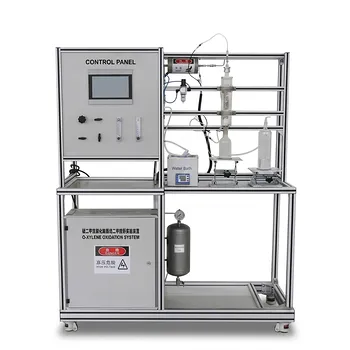
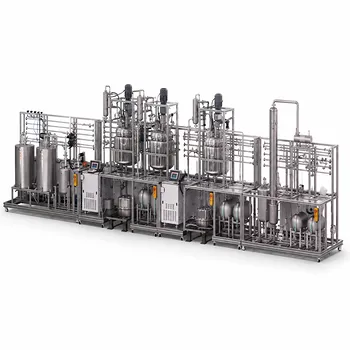
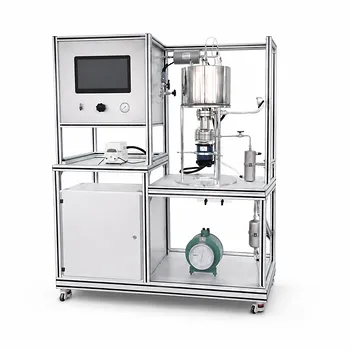
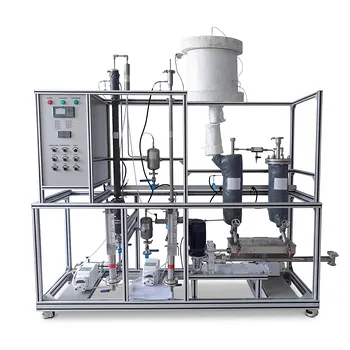
Ensuring accurate mass balance and reliable sampling is critical for scaling up chemical processes. LABPARK provides high-quality Educational and Vocational Unit Operations Pilot Plants in chemical engineering, bioprocess & biotech, and environmental & water treatment for universities, research institutes, and enterprises.
Ready to eliminate process scale-up uncertainties? Contact LABPARK today to find the perfect pilot plant solution for your facility!
Related Products
- Fixed Bed Gas Solid Catalytic Reaction Educational Pilot Plant
- Multi-Reactor Educational Pilot Plant for Reaction Engineering Unit Operations
- Residence Time Distribution and Reactor Flow Characteristics Determination Educational Pilot Plant
- Fixed-Bed Chemical Reaction and Gas Dust Tar Removal Unit Operations Pilot Plant
- Tubular Reactor Flow Characteristics Determination Educational Unit Operations Pilot Plant
People Also Ask
- How do reactor pilot plants safely study gas-solid reactions? Master kinetics with thermal & flow control.
- How does the Mears criterion evaluate transport resistance? Key Guide to Intrinsic Kinetics
- Fluidized vs. Fixed Bed Reactors: Comparing Heat & Complexity in Pilot Plants
- Why is a multibed configuration necessary for exothermic reactions? Optimize your pilot plant trajectory.
- How is the friction factor determined for fixed-bed pilot plants? Select the best pressure drop correlation.