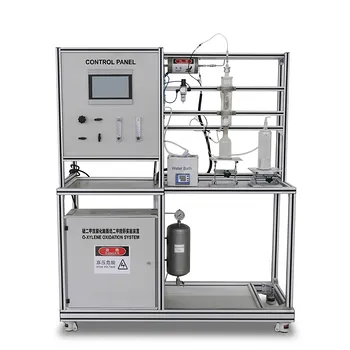
To answer directly, educational chemical reactor pilot plants transform the synthesis of coordination compounds like hexamminecobalt(III) chloride from a small‑scale recipe into a controlled, data‑rich engineering exercise. Students use jacketed reactors, variable‑speed agitators, and automated dosing systems to manage temperature, mass transfer, and reagent feed rates—the same critical parameters that govern industrial scalability. By actively manipulating these variables and logging real‑time data, learners uncover how thermodynamics, kinetics, and safety interlocks converge in chemical manufacturing.
The real goal is not just making a compound, but learning to think like a process engineer. When you use a pilot plant to synthesize [Co(NH₃)₆]Cl₃, every temperature setpoint, agitation speed adjustment, and H₂O₂ dosing step becomes a lesson in balancing reaction yield, heat management, and operational safety—skills that transfer directly to any fine‑chemical or pharmaceutical scale‑up.
The Educational Power of a Pilot Plant Reactor
Bridging the Gap Between Glassware and Industry
Bench‑top glassware relies on the chemist’s intuition to swirl, warm, and add reagents by hand. A pilot plant replaces that manual improvisation with quantitative control and continuous measurement.
The jacketed vessel, thermostatic bath, and mechanical stirrer turn a synthesis into a reproducible unit operation. Students learn how heat‑transfer coefficients, mixing times, and feed profiles impact product purity—concepts that cannot be taught with a simple hotplate and magnetic stirrer.
The Unique Demands of Coordination Compound Synthesis
Coordination complexes are unusually sensitive to the reaction environment. Slight changes in temperature or mixing can favor different oxidation states, ligand substitution pathways, or even a completely different isomer.
For a compound like [Co(NH₃)₆]Cl₃, the lesson extends beyond the cobalt chemistry itself. It becomes a vehicle for understanding how multiphase systems, solid catalysts, and dissolved gases behave in a stirred tank, reinforcing core chemical engineering principles with a tangible, colorful product.
Critical Process Parameters for Hexamminecobalt(III) Chloride Synthesis
Precise Temperature Regulation and Heat Transfer
The classic preparation requires a heating phase (often around 323–333 K) followed by cooling to crystallize the product. A jacketed reactor connected to a thermostatic bath makes this cycle measurable and optimizable.
Students can track heating and cooling rates, calculate jacket‑side heat‑transfer coefficients, and see how deviations from the target range lead to by‑products such as cobalt hydroxides. This transforms a simple heating step into a laboratory for non‑isothermal reactor behavior.
Mastering Mass Transfer Through Agitation
The reaction mixture is heterogeneous: a solid activated‑carbon catalyst, dissolved ammonia gas, and aqueous cobalt ions. Without vigorous mixing, gas‑liquid‑solid contact fails, and yield plummets.
Variable‑speed agitators on pilot plants allow students to study the influence of impeller design and speed on mass transfer rates. The same principle appears across chemistries—whether it is dissolving hydrogen in hydrogenation reactions or dispersing oxygen in an oxidation, mixing is rarely just “stirring.”
Safe Exotherm Management with Controlled Dosing
Adding the oxidant, hydrogen peroxide, must be done slowly. The oxidation of Co²⁺ to Co³⁺ is strongly exothermic, and an uncontrolled addition can cause thermal runaway or rapid peroxide decomposition.
Pilot‑plant dosing pumps, paired with temperature interlock logic, teach industrial safety protocols. Students set feed‑rate limits, monitor the reactor temperature trend in real time, and experience first‑hand how a seemingly simple addition step becomes a process‑control challenge at scale.
Extending the Lessons: Universal Parameters Across Coordination Chemistries
From Isomer Selectivity to Kinetics
The PtCl₂(NH₃)₂ system famously illustrates thermodynamic versus kinetic control: high temperature gives the trans‑isomer, while low‑temperature ammonia substitution yields the cis‑form. A pilot plant enables programmed temperature ramps and timed reagent additions that make isomer selectivity a deliberate engineering choice, not a black‑box synthesis.
Students can simultaneously collect concentration‑time data. Plotting the logarithm of reactant concentration versus time reveals a first‑order dependence, while a reciprocal plot reveals second‑order kinetics. Finding the linear fit determines the reaction order and the rate constant (k)—essential for reactor sizing.
pH‑Driven Complexation and Solvent Management
In rare‑earth complexes like europium‑dibenzoylmethane, ligand deprotonation requires precise pH control (typically 7–8). Too low, and complexation stalls; too high, and hydroxides precipitate.
Pilot plants equipped with automated pH monitoring and dosing pumps turn this sensitivity into a dynamic control exercise. Coupled with reflux condensers for volatile solvent recovery, the setup teaches how to balance reaction chemistry with solvent management and heat integration—skills required for any manufacturing‑scale production of fine chemicals.
Real‑Time Analytics for Reaction Order and Rate Constants
Even when the goal is purely educational, integrating online sensors transforms the reactor into an isothermal kinetic laboratory. By maintaining a constant temperature and logging concentration over time, students can apply integrated rate equations to unknown systems.
The same pilot plant that makes [Co(NH₃)₆]Cl₃ one day can be used the next to study how thermochromic nickel complexes switch from square‑planar to octahedral geometries with temperature and solvent coordination—reinforcing that sensor‑rich environments are the foundation of process understanding.
Understanding the Trade‑offs and Common Pitfalls
Balancing Exothermic Control and Reaction Rate
A too‑slow peroxide addition might protect against thermal spikes but can starve the reaction of oxidant, leading to incomplete conversion. The student learns there is no universal “safe” flow rate—it must be optimized through systematic adjustment and monitoring, a lesson in the real‑world tension between safety and productivity.
Avoiding Contamination and Side Reactions
Coordination compounds are often susceptible to trace metal contamination or premature crystallization in feed lines. Educational pilot plants force students to think about material compatibility, purging, and cleaning protocols that are invisible in glassware but critical for stainless‑steel reactors.
Instrumentation Lag and Safety Interlocks
Temperature measurement in a jacketed vessel always lags behind the actual reaction mass. Students who ignore this lag may overshoot the setpoint during exothermic dosing. Pilot plants with well‑designed control loops and hard‑wired interlocks make this latency tangible, teaching the value of conservative alarm limits and feed‑forward control strategies.
How to Design Your Pilot‑Plant Experiment for Maximum Learning
The setup you choose should match the engineering principle you want to highlight. Below are goal‑driven configurations for a coordination‑compound synthesis lab.
- If your primary focus is heat‑transfer fundamentals: Use the jacketed reactor with a well‑characterized fluid, run heating/cooling curves, and calculate overall heat‑transfer coefficients (U) for different agitation speeds.
- If your primary focus is reaction kinetics: Operate the reactor isothermally, dose the limiting reagent in a controlled manner, and sample at defined intervals to determine reaction order and rate constants (k) from linearized plots.
- If your primary focus is industrial safety and exotherm management: Equip the reactor with a peristaltic dosing pump and temperature‑based interlock logic; students must set maximum temperature limits and optional feed‑shutoff setpoints before starting.
- If your primary focus is selectivity and thermodynamics: Program a temperature ramping profile over several hours, take samples at key intervals, and use analytical techniques (e.g., UV‑Vis or melting point) to track isomer ratios as a function of thermal history.
Mastering these variables in an educational pilot plant does more than produce a few grams of a colorful complex. It builds the intuition and discipline needed to scale up any reaction safely and efficiently.
Summary Table:
| Parameter | Role in Synthesis | Educational & Engineering Lesson |
|---|---|---|
| Temperature | Regulates reaction kinetics & crystallization | Calculating heat-transfer coefficients & thermal ramps |
| Agitation | Enhances gas-liquid-solid mass transfer | Studying impeller design & mixing efficiency |
| Dosing Rate | Controls exothermic reagent addition (H2O2) | Designing safety interlocks & process control loops |
Elevate Your Engineering Lab with LABPARK
Bridge the gap between laboratory glassware and industrial reality. LABPARK offers advanced Educational and Vocational Unit Operations Pilot Plants in chemical engineering, bioprocess & biotech, and environmental & water treatment. Specifically designed for universities, research institutes, and enterprises, our systems empower learners to master critical process parameters like heat transfer, mass transfer, and safety loops.
Ready to upgrade your training or research facilities? Contact LABPARK today to request a catalog or discuss your custom pilot plant needs!
Related Products
- Methanol Synthesis and Catalyst Performance Evaluation Educational Unit Operations Pilot Plant
- Ethyl Acetate Synthesis Unit Operations Pilot Plant for Practical Training
- Carbon Dioxide Hydrogen Methanol Synthesis Educational Unit Operations Pilot Plant
- Carbon Dioxide Hydrogenation Methanol Synthesis Educational Unit Operations Pilot Plant
- Aspirin API Synthesis Unit Operations Training Pilot Plant
People Also Ask
- Why is a purge system necessary when operating a gas recirculation loop in a methanol synthesis pilot plant? (Guide)
- How do temp & pressure affect methanol synthesis pilot plants? Optimize equilibrium and catalyst performance.
- Why do modern methanol pilot plants operate at lower pressures? Catalyst & Feed Requirements Explained
- What are the operational requirements for catalyst activation? Safe Methanol Pilot Plant Operation
- How do steady-state and dynamic simulations complement pilot plants? Validate scale-up and controllability