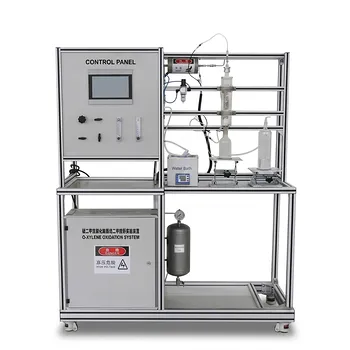
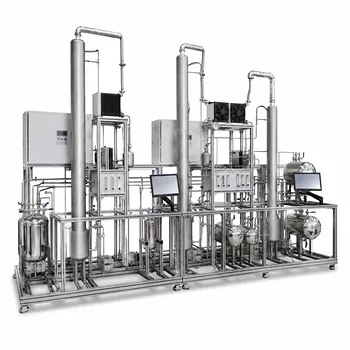
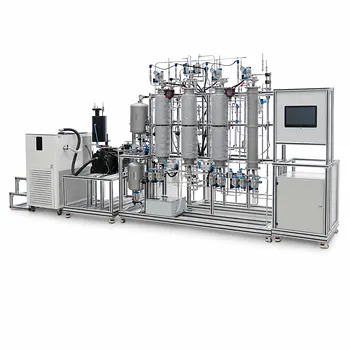
Pilot plant simulations provide a fully instrumented, safe environment where students directly manipulate feed compositions, monitor thermal dynamics, and trigger automated safety systems to learn exactly how explosive limits are controlled during catalytic ethylene oxidation.
By using mass flow controllers to keep oxygen concentration around 7–8% and ethylene around 20–30%, the plant operates safely outside the explosive envelope. Students observe real‑time gas concentrations, implement automatic interlocking shutdowns, and add gas‑phase inhibitors (organic chlorides at 1–3 µL/L) to prevent thermal runaway—all while explosion‑proof relief devices stand as the final safeguard. This hands‑on experience bridges the gap between theoretical flammability limits and industrial‑scale process safety management.
The catalytic oxidation of ethylene to ethylene oxide operates dangerously close to flammability boundaries. Pilot plants teach safety by letting future engineers experience firsthand how precise feed control, inert dilution, and active safety interlocks keep the reaction stable. Automatic shutdowns and explosion‑proof relief systems then provide a layered defense against the ever‑present risk of ignition.
The Architecture of a Safe Educational Pilot Plant
Replicating the Industrial Process with Modular Unit Operations
A teaching pilot plant mimics a full ethylene oxide production line.
It integrates raw material preparation, the catalytic reactor, product separation, recycling loops, and post‑treatment.
This modular design lets students trace the flow of mass and energy, seeing how a disturbance in the reactor cascades through the entire system.
Embedding Explosion Mitigation and Interlock Systems
Reactors are equipped with explosion‑proof disks, safety valves, and blast vents to relieve pressure if thermal runaway occurs.
Automated emergency shutdown (ESD) valves slam shut when online gas analyzers detect a breached threshold, while nitrogen purging sweeps flammable gases from the system.
Laboratory gas detection alarms provide an additional early warning layer, so students learn to trust instrumentation rather than intuition.
Controlling the Explosive Triangle: Combustible, Oxidizer, and Ignition
Operating Outside the Flammability Envelope with Feed Ratio Management
Combustion requires simultaneous fuel, oxidizer, and an ignition source.
The pilot plant deliberately breaks this triangle.
Mass flow controllers maintain a very low oxygen concentration (≈7–8 mol%) and a large excess of ethylene (20–30 mol%), pushing the mixture well below the Lower Flammability Limit for oxygen.
Adding an inert diluent with high heat capacity—like methane—further narrows the explosive range while boosting thermal conductivity.
Real‑Time Monitoring and Automated Response
Online gas analyzers track ethylene, oxygen, and carbon dioxide every second.
If a sensor detects a drift toward the flammability zone, the interlocks automatically cut the reactant feed and initiate a nitrogen quench.
Students witness that a few percentage points can be the difference between stable operation and a hazardous mixture, cementing the concept of flammability limits (LFL/UFL) far more effectively than a lecture.
Thermal Stability and Runaway Prevention
The reaction is highly exothermic; adiabatic temperature rises easily exceed 50 °C.
Multi‑point thermocouples map axial and radial temperature profiles, while an automated cooling jacket—or high‑precision coolant circulation—removes heat.
Students can also inject gas‑phase inhibitors (organic chlorides at 1–3 µL/L) to moderate the reaction rate.
By changing inhibitor dosing and watching the temperature response, they learn how chemical agents can act as a “kinetic handbrake” against runaway.
Understanding the Trade‑offs and Limitations
Safety Margin vs. Process Efficiency
Keeping the mixture far from the explosive envelope limits single‑pass ethylene conversion to just 7–15%.
This low per‑pass conversion demands a large recycle stream, adding capital and energy costs.
Students discover that industrial safety comes at a price: the extra separation and recompression work required by a conservative process design.
The Role of Inhibitors and Catalyst Life
Organic chlorides improve selectivity toward ethylene oxide but adsorb strongly on the silver catalyst.
Over time, even minute concentrations can accumulate and poison active sites.
The pilot plant provides the opportunity to quantify this gradual deactivation, teaching the long‑term operational trade‑off between immediate safety enhancement and catalyst longevity.
Scale‑Down Effects on Safety Training
Pilot‑scale reactors may not reproduce large‑scale mixing dead zones or flow maldistribution that can create local hotspots.
Because of this, students must interpret pilot data critically, understanding that additional safety factors are needed when scaling up.
The pilot plant’s dense instrumentation compensates by revealing fundamental cause‑and‑effect relationships invisible in an industrial unit.
How to Leverage Pilot Plants for Effective Safety Training
- If your primary focus is process safety fundamentals: Use the pilot plant to map the actual explosive envelope of the ethylene‑air‑inert mixture and practice safe startup/emergency shutdown procedures hands‑on. Let students trigger interlocks under controlled conditions to build muscle memory for industrial operations.
- If your goal is reactor design and relief system sizing: Collect kinetic and temperature data across the full operating window to fit reaction rate equations and determine rate constants. Then apply that empirical model to calculate the required vent capacity for a scaled‑up reactor.
- If you aim to optimize selectivity while maintaining safety: Test different inhibitor concentrations, feed ratios, and diluent levels while monitoring hot‑spot temperatures. Use the data to identify the highest selectivity point that does not compromise the safety margin.
In every scenario, the unit operations pilot plant transforms abstract safety rules into lived operational judgement—turning theoretical knowledge into the instinctive caution that defines a truly skilled chemical engineer.
Summary Table:
| Safety Feature / Parameter | Operational Range / Spec | Role in Process Safety & Training |
|---|---|---|
| Oxygen Feed Ratio | 7–8 mol% | Maintained low to keep reaction safely below flammability limits. |
| Ethylene Feed Ratio | 20–30 mol% | Large excess minimizes risk and simulates industrial recovery loops. |
| Gas-Phase Inhibitor | 1–3 µL/L (Organic Chlorides) | Serves as a kinetic control agent to mitigate sudden thermal runaway. |
| Active Systems | ESD Valves & Nitrogen Purge | Automatically isolates feeds and dilutes the system when limits are breached. |
| Passive Safeguards | Explosion-proof disks & vents | Final physical layer designed to safely relieve excessive pressure. |
Bring Realistic Process Safety Training to Your Institution with LABPARK
Bridge the gap between theoretical safety limits and real-world industrial operations. LABPARK offers highly customizable, fully instrumented Educational and Vocational Unit Operations Pilot Plants across chemical engineering, bioprocess & biotech, and environmental & water treatment.
Whether you are a university seeking to enrich undergraduate lab coursework, a research institute testing reaction kinetics, or an enterprise training plant operators, our pilot systems provide the precise control, advanced interlocks, and safety safeguards required for modern engineering programs.
Contact LABPARK today to discover how we can help you build a safer, more effective learning environment.
Related Products
- Ethylbenzene Dehydrogenation Educational Unit Operations Pilot Plant
- O-Xylene Oxidation to Phthalic Anhydride Educational Unit Operations Pilot Plant
- Methanol Synthesis and Catalyst Performance Evaluation Educational Unit Operations Pilot Plant
- Carbon Dioxide Hydrogenation Methanol Synthesis Educational Unit Operations Pilot Plant
- Methane Cracking Educational Unit Operations Pilot Plant
People Also Ask
- What parameters & reactor configurations are needed for ethylbenzene dehydrogenation pilot plants?
- Why is steam dilution critical in dehydrogenation? Pilot Plant Control Guide
- Isothermal vs Adiabatic Reactors: Key Differences in Ethylbenzene Dehydrogenation Pilot Plants
- How do pilot plants help students verify material balances? Bridge Theory with Real-world Data
- Why is the steam-to-feedstock ratio critical in catalytic dehydrogenation? Learn the 3 key roles of steam.