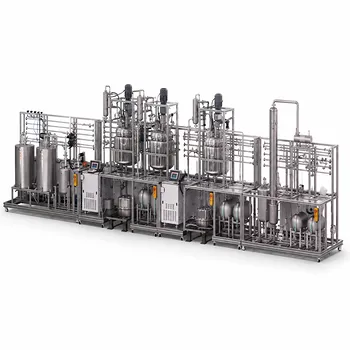
Pilot plants are the only way to truly measure and minimize Process Mass Intensity (PMI) in a realistic setting. They allow students and researchers to move beyond theoretical calculations and physically track every gram of material flowing through a chemical process—especially solvents, which account for roughly 80% of the mass in pharmaceutical synthesis. By running reactions, distillations, and extractions at a meaningful scale, users can establish complete mass balances, test solvent recovery systems, and directly quantify how operational changes drive PMI down. This hands-on experience transforms a sustainability metric from an academic exercise into a practical, optimizable target.
Process Mass Intensity optimization is not about tweaking a formula on paper—it’s about managing real material flows, reclaiming solvents, and making the entire synthesis train do more with less mass. Chemical engineering unit operations pilot plants provide the only controlled, scalable environment where students and researchers can safely experiment with these strategies, directly measuring their impact on PMI and building the intuition needed for industrial process development.
The Central Role of Solvents in PMI
Why Solvents Dominate Pharmaceutical PMI
In pharmaceutical manufacturing, solvents and water make up the vast majority of the total mass processed.
Reactions, workups, crystallizations, and purifications all demand large solvent volumes relative to the final active pharmaceutical ingredient (API) mass.
This means that any effort to reduce PMI must first focus on solvent usage—a truth that becomes vividly clear when you can physically see the solvent tanks and waste streams in a pilot plant.
Measuring and Minimizing Solvent Usage in a Pilot Plant
A pilot plant lets you measure exact solvent inputs at every stage, from initial charging to final rinse.
You can collect and weigh waste solvent streams, compare them to the solvent accounted for in product and byproducts, and identify where losses or excesses occur.
This direct observation often reveals hidden inefficiencies—like over-washing a filter cake or using far more extraction solvent than the theoretical minimum—that spreadsheet calculations alone would never catch.
From Mass Balance to Optimization: The Pilot Plant Advantage
Establishing Accurate Mass Balances
The foundation of PMI work is a closed mass balance: total mass in must equal total mass out, within acceptable measurement error.
In a pilot plant, students and researchers can weigh raw materials, collect all output streams (product, waste, recovered solvents), and verify closure.
Any gap in the balance signals an opportunity to understand where mass is being lost—through evaporation, spills, or uncollected residues—and drives a deeper investigation into the process.
Experimenting with Solvent Recovery and Recycling
Once a reliable balance is established, the next step is to bring solvents back into the process instead of discarding them.
Pilot-scale distillation columns, extraction units, or membrane separators enable you to physically recover and reuse solvents from reaction mixtures or mother liquors.
By measuring the quality and quantity of recovered solvent, you can calculate exactly how much new solvent the process still needs, directly lowering the PMI for each batch.
Directly Quantifying PMI Reductions
Because PMI is simply the total mass of all materials divided by product mass, any reduction in solvent or auxiliary material usage becomes a visible, measurable improvement.
When you run a pilot plant campaign with and without solvent recycling, or with different solvent choices, you can compute a before-and-after PMI.
This tangible feedback tightly links operational changes to sustainability metrics, giving students and researchers a powerful tool to prove the value of their process optimizations.
Beyond Solvents: Process Intensification and PMI
Integrating Unit Operations to Reduce Material Footprint
Pilot plants equipped for process intensification (PI) take PMI reduction a step further.
Technologies like reactive distillation, monolithic reactors, or membrane-based separations combine multiple unit operations into a single, compact piece of equipment.
This integration often eliminates entire separation steps—and their associated solvent and energy demands—shrinking the overall material footprint and dramatically lowering PMI.
Validating Intensified Processes at Pilot Scale
A major barrier to adopting PI is the lack of hands‑on experience and pilot‑scale facilities to test new, intensified configurations.
By running a reactive distillation column or a membrane reactor in a pilot plant, you can directly measure how much solvent and mass the integrated process saves compared to the conventional multi‑step route.
This physical verification—comparing experimental PMI data against simulated or literature values—builds the confidence needed to bring low‑PMI processes closer to industrial reality.
Understanding the Trade-offs and Limitations
The Scale-Up Gap
Pilot‑plant PMI figures are not always perfectly predictive of full‑scale manufacturing.
Larger equipment can introduce heat‑transfer or mixing inefficiencies that alter solvent requirements, and the logistics of solvent recovery become more complex.
While pilot plants provide the essential learning loop, students and researchers must recognize that final PMI optimization requires on‑site industrial data.
The Complexity of Realistic Solvent Recovery
Recovering solvents in a pilot plant sounds straightforward, but achieving pharmaceutical‑grade purity for reuse often demands multiple purification steps.
Those additional distillation or drying steps themselves require energy and may generate waste, meaning the net PMI improvement can be smaller than expected if the recovery train is inefficient.
A critical mindset is needed: measure the recovered solvent’s true purity and factor all auxiliary inputs into the PMI calculation.
Balancing Laboratory Workload and Throughput
Running a pilot plant with meticulous mass‑tracking takes time, materials, and coordination.
For teaching laboratories, the overhead can limit how many experiments students can perform in a semester.
Similarly, research groups must balance the desire for extensive PMI studies against budget and equipment availability—sometimes making simulated sensitivity analyses a more practical complement.
Making the Right Choice for Your Research or Teaching Goal
Your approach to using a pilot plant for PMI optimization should align with what you most need to accomplish.
- If your primary focus is teaching fundamental PMI principles: Run a single, well‑characterized batch with full mass accounting, and let students see exactly how solvent mass dwarfs product mass before and after a simple solvent recycle step.
- If your primary focus is developing an industrially relevant low‑PMI process: Use the pilot plant to test integrated, intensified unit operations (e.g., reactive distillation) and rigorously compare the experimental PMI against conventional batch data.
- If your primary focus is validating simulation models for PMI: Collect detailed mass‑balance and solvent‑recovery data under controlled conditions, then quantify the discrepancy between predicted and actual PMI to refine your models.
- If your primary focus is bridging the gap between lab‑scale and commercial reality: Operate the pilot plant under constraints that mimic manufacturing (e.g., solvent quality, purge streams) and document how those constraints prevent PMI from reaching theoretical minimums.
Every gram you track in a pilot plant moves you closer to chemical processes that are not just more efficient on paper, but genuinely sustainable in the real world.
Summary Table:
| PMI Optimization Strategy | Key Action in Pilot Plant | Core Benefit |
|---|---|---|
| Solvent Tracking & Balance | Measure and weigh all input and waste streams physically | Identifies hidden solvent waste and inefficiencies |
| Recovery & Recycling | Integrate pilot-scale distillation and separation units | Minimizes fresh solvent demand and lowers overall PMI |
| Process Intensification | Combine reactions and separations (e.g., reactive distillation) | Eliminates process steps and reduces material footprint |
Accelerate Process Optimization with LABPARK
Bridge the gap between theoretical calculations and industrial reality. LABPARK provides state-of-the-art Educational and Vocational Unit Operations Pilot Plants in chemical engineering, bioprocess & biotech, and environmental & water treatment.
Designed specifically for universities, research institutes, and enterprises, our pilot plants empower your students and researchers to master closed mass balances, validate solvent recovery systems, and optimize Process Mass Intensity (PMI) in a controlled environment.
Ready to elevate your lab's capabilities? Contact LABPARK today to find the perfect pilot plant system for your facility.
Related Products
- Carbon Dioxide Hydrogen Methanol Synthesis Educational Unit Operations Pilot Plant
- Multi-Reactor Educational Pilot Plant for Reaction Engineering Unit Operations
- Ethyl Acetate Synthesis Unit Operations Pilot Plant for Practical Training
- Multi Pump Fluid Transport Process Piping Unit Operations Training Pilot Plant
- Multi-Modal Distillation Unit Operations Training Pilot Plant
People Also Ask
- How do temp & pressure affect methanol synthesis pilot plants? Optimize equilibrium and catalyst performance.
- Why is a purge system necessary when operating a gas recirculation loop in a methanol synthesis pilot plant? (Guide)
- Why do modern methanol pilot plants operate at lower pressures? Catalyst & Feed Requirements Explained
- What are the operational requirements for catalyst activation? Safe Methanol Pilot Plant Operation
- Why is the chemical plant startup schedule crucial? De-risk scale-up with pilot plants.